Understanding the CAS number, chemical classifications, and all related global codes is essential for anyone purchasing manganese carbonate (MnCO₃) for industrial, fertilizer, or battery applications. This article explains everything in simple, clear English, supported by real data, recognized standards, and authoritative chemical references.
The Chemical Abstracts Service (CAS) assigns a unique number to every known chemical.
For manganese carbonate, this number helps buyers:
Confirm the product identity
Match MSDS files during customs checks
Verify supplier quality
Ensure compliance with REACH, GHS, and EPA standards
Avoid mixing MnCO₃ with other manganese compounds such as MnO₂ or Mn₃O₄
According to the American Chemical Society, CAS numbers are used in more than 100 countries as the standard identifier for chemicals in global trade (ACS, 2023).
If the CAS number is wrong, the product may be misclassified, causing:
Customs delay (1–7 days average in EU inspections — European Chemicals Agency, 2023)
Higher storage cost
Rejected shipment
Safety compliance penalties
Thus, for industrial procurement teams, a correct CAS number is not optional – it is a core requirement.
2. The Official CAS Number of Manganese Carbonate
The official CAS number for manganese carbonate is:
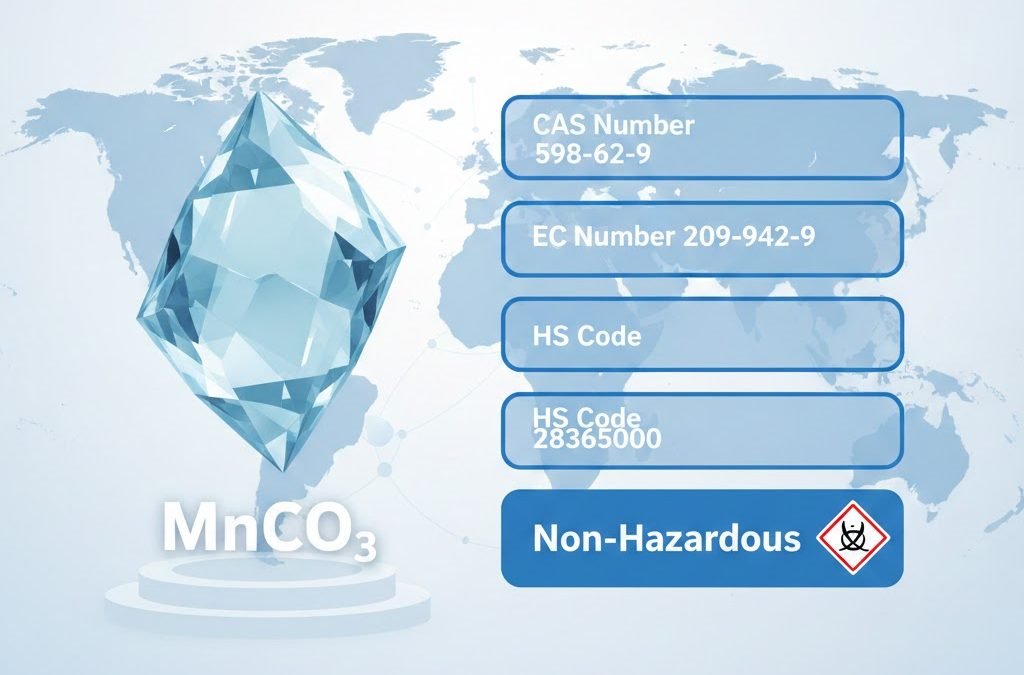
CAS 598-62-9
(Source: CAS Registry – American Chemical Society)
Basic chemical information
| Property | Value |
|---|---|
| Chemical Name | Manganese(II) Carbonate |
| Formula | MnCO₃ |
| Molecular Weight | 114.95 g/mol |
| CAS Number | 598-62-9 |
| EC Number (EINECS) | 209-942-9 |
This CAS number is used worldwide.
No matter the grade — battery grade, industrial grade, feed grade — the CAS number never changes. Grades only affect purity and impurity levels, not chemical identity.
3. Related Chemical Identification Codes (Global Standards)
Global buyers often confuse CAS, EC, HS, and UN numbers.
This section clarifies each code with official sources.
3.1 EC Number (EINECS)
EC Number: 209-942-9
Issued by the European Chemicals Agency (ECHA)
Used for REACH compliance
(Source: ECHA Substance Information Database, 2024)
3.2 HS Code for Global Trade
The commonly used HS Code for manganese carbonate is:
HS Code: 28365000 — Carbonates; manganese carbonate
This code is recognized in:
U.S. International Trade Commission
EU TARIC system
China Customs HS Database
(Source: World Customs Organization, 2024 HS Nomenclature)
3.3 GHS Classification (Globally Harmonized System)
Under GHS (used by UN, EU, U.S., China):
Not classified as hazardous
Not flammable
Not oxidizing
Low toxicity levels
According to ECHA (2024), manganese carbonate does not require a hazard pictogram.
3.4 UN Number (for Dangerous Goods)
Manganese carbonate is NOT classified as a dangerous substance, so:
No UN number is assigned
Shipping does not require DG packaging
Transport regulations are simpler
(Source: UN Recommendations on the Transport of Dangerous Goods, 2023)
4. Do Different Grades Use Different CAS Numbers?
Many buyers ask:
“Does battery-grade manganese carbonate have a different CAS number?”
The answer is No.
All grades share the same CAS (598-62-9).
Differences are in purity, particle size, and applications.
Below is a comparison table for clarity.
Table: Manganese Carbonate Grades and Properties
| Grade | Mn Content | Common Impurity Standard | Typical Application | CAS Number |
|---|---|---|---|---|
| Industrial Grade | 42–44% Mn | Fe < 0.005%, Pb < 0.001% | ceramics, catalysts | 598-62-9 |
| Battery Grade | 44–45% Mn | Fe < 0.003%, Cl < 0.02% | lithium manganese oxide (LMO) battery | 598-62-9 |
| Fertilizer Grade | 31–33% Mn | Higher impurities allowed | agriculture, soil improvement | 598-62-9 |
| Feed Grade | 44% Mn | Heavy metals conform to GB/T 1886.41-2021 | animal feed supplements | 598-62-9 |
Data sources:
China National Standard GB/T 1589-2008 (Industrial MnCO₃)
GB/T 1886.41-2021 (Feed-grade MnCO₃)
Battery-grade specs from Asian Battery Materials Standardization Report 2023
5. How to Verify a Supplier’s CAS Numbers and Classifications
Many suppliers provide incomplete or incorrect identification data.
Here are practical steps for global buyers to verify accuracy.
5.1 Check the MSDS (Material Safety Data Sheet)
A compliant MSDS should include:
CAS 598-62-9
EC 209-942-9
Formula: MnCO₃
GHS classification
Physical & chemical data
Storage and transportation guidelines
If any part is missing or inconsistent, the supplier may be unreliable.
5.2 Review COA (Certificate of Analysis)
Key indicators to check:
| Parameter | Typical Standard | Source |
|---|---|---|
| Mn Content | ≥ 44% battery grade | Asian Battery Standards Report, 2023 |
| Fe | ≤ 0.003% | GB/T 1589-2008 |
| Moisture | ≤ 0.5% | Industrial norms |
| Particle Size (D50) | 3–10 μm | Battery material requirements |
5.3 Confirm Export Documentation
Make sure the supplier uses:
HS 28365000
Non-dangerous goods declaration
Updated MSDS (within 3 years)
Correct product labeling
Incorrect documentation often results in 1–5 days of customs delay in EU and 3–10 days in Southeast Asia (ECHA trade statistics 2023).
5.4 Ask the Supplier About Classification Systems
A reliable manganese carbonate manufacturer should explain:
Why CAS is the same across all grades
How impurities differentiate grades
REACH registration status
GHS labeling
Packaging and export standards
If they cannot answer these basic questions, they may not have real production capability.
6. Common Mistakes Buyers Make When Checking CAS Numbers
Below are typical issues seen in global manganese carbonate procurement:
Mistake 1: Confusing MnCO₃ with MnO₂ or Mn₃O₄
These are completely different chemicals.
| Chemical | CAS No. | Use |
|---|---|---|
| Manganese Carbonate (MnCO₃) | 598-62-9 | fertilizer, battery precursor |
| Manganese Dioxide (MnO₂) | 1313-13-9 | batteries, water treatment |
| Manganese(II,III) Oxide (Mn₃O₄) | 1317-35-7 | ceramics, pigments |
(Source: CAS Registry Database, ACS 2024)
Mistake 2: Using outdated MSDS files
MSDS older than 3 years are usually rejected by customs in:
EU
USA
Australia
India
(ECHA Safety Documentation Directive, 2023)
Mistake 3: Assuming different grades have different CAS numbers
This is incorrect.
CAS identifies the chemical, not the purity.
Mistake 4: Using wrong HS Code
For example:
28209000 (wrong, used for other manganese compounds)
28365000 (correct)
Wrong HS code often leads to extra taxation or stalled clearance.
7. Summary: Why CAS and Classification Matter
Understanding CAS numbers and chemical classifications helps buyers:
Prevent quality misunderstandings
Ensure correct customs documentation
Reduce compliance risk
Standardize supplier comparison
Improve project safety and traceability
For manganese carbonate, the key identifiers are:
CAS: 598-62-9
EC Number: 209-942-9
HS Code: 28365000
Not classified as dangerous goods (no UN No.)
With correct classification, buyers can make better decisions and avoid common procurement risks.
8. FAQ
1. What is the CAS number of manganese carbonate?
The official CAS number of manganese carbonate is 598-62-9.
2. Is manganese carbonate classified as a hazardous chemical?
No. According to GHS and ECHA, manganese carbonate is not classified as hazardous.
3. Do industrial-grade and battery-grade manganese carbonate have different CAS numbers?
No. All grades use the same CAS number because they share the same molecular structure.
4. What is the HS code for manganese carbonate?
The correct HS code is 28365000.
5. Does manganese carbonate have a UN number?
No. It is not considered a dangerous good, so there is no UN number.
Related Posts

I am Edward lee, founder of manganesesupply( btlnewmaterial) , with more than 15 years experience in manganese products R&D and international sales, I helped more than 50+ corporates and am devoted to providing solutions to clients business.