Executive Summary
Four channels supply feed-grade MnO in bulk: direct from the manufacturer, trading companies and agents, B2B platforms, and industry trade shows. The channel does not decide quality. The verification process after you find a supplier decides quality.
- Channel 1 and Channel 2 overlap more than they appear — a “factory” may be a trader, and a trader may hold real stock.
- The same verification checklist applies to every channel. Only the order of steps changes.
- The cost of a bad channel choice is not the price markup. It is the rejected container at the destination port.
Quick Answer: The Four Channels for Bulk MnO Sourcing and How to Choose
| Channel | Best for | Choose it when |
|---|---|---|
| Direct from manufacturer | Lowest cost, factory audits, custom specs | You buy container volume and can run your own verification |
| Trading company / agent | Flexibility, mixed small lots, language and logistics support | You need multi-source comparison or one consolidator |
| B2B platform (Alibaba, Made-in-China, Global Sources) | Supplier density, low MOQ, dispute mechanism | You are screening many candidates from one search |
| Industry trade show (FIAAP/VICTAM, IPPE) | Face-to-face trust, long-term supply relationships | You can afford travel and want to meet before committing |
One-line logic: lowest cost and a verifiable factory → go direct. Flexibility or small volumes → platform or trader. Long-term supply → meet at a show. Whichever you pick, run the same verification process.
Why the Channel Matters Less Than What You Do After You Find It
Channels are not good or bad. The same factory sells direct, lists on a platform, and supplies traders. The same trader appears at trade shows and on Alibaba. What changes from channel to channel is not the product — it is who stands between you and the kiln.
Two buyers find the same supplier. One asks for the COA, the TDS, and the last three batch records. The other asks for the price. They get the same product and different risk levels. The channel was identical; the outcome was not.
So treat this article as two halves: where to look, and what to do after you look. The second half carries the risk. The first half is just search.
Channel 1 — Direct from the Manufacturer: Lowest Price, Highest Verification Need
Buying direct removes the middle layer. You pay the factory price, you can audit the plant, and you can ask for custom particle size or packaging. This is the right channel for container-volume buyers who have qualification capability.
The cost is that you do the verification yourself. A factory in another country must be checked on company registry, export record, production process, and quality systems — without an agent doing it for you. Language and cross-border communication sit on your side of the table.
How to confirm “direct” is actually direct:
- Match the company name on the invoice against business registration records.
- Check export history: customs records, port data, and how long the name has shipped feed materials.
- Ask for a live video tour of the production line — not a photo album. A trader can send photos; a factory can show you the kiln in real time.
- Ask which plant the order will be produced in and verify that address matches the registered address.
If the “factory” cannot name its own plant, you are talking to a trader — which is not a crime, but it is not a direct deal. The full framework for separating factories from traders sits in How to Choose a Reliable Manganese Oxide Supplier for Animal Feed.
Channel 2 — Trading Companies and Agents: Flexibility with a Markup
Traders exist for a reason. They consolidate small lots, compare several factories, handle language, and manage logistics for buyers who cannot run a sourcing office. If you buy less than a container, a good trader is often the cheapest practical option — because a factory will not repack 5 tonnes for you at a fair price.
The risk is a longer responsibility chain. A trader may buy from a factory, or from another trader, or blend several sources. When a shipment fails, you chase the trader, who chases the trader below, who chases the factory.
How to tell a real-holding trader from a name-only trader:
- Ask for proof of stock or a bill of lading from a recent shipment of the same product.
- Ask for the upstream factory name and its COA — a trader with real supply names the factory.
- Ask what happens on a claim: who tests, who pays, and how the responsibility chain is written into the contract.
- Compare their COA basis with the factory’s COA basis. If they differ, someone is re-labelling.
Judgment, not prejudice: a trader who names the factory, holds stock, and stands behind the COA is a legitimate supply channel. A trader who cannot name a factory is a forwarding agent with a price list.
Channel 3 — B2B Platforms (Alibaba, Made-in-China, Global Sources): The Long Tail
Platforms give density. One search returns dozens of suppliers, MOQs from 1 tonne to 25 tonnes, and a dispute mechanism that a private deal lacks. For first-time buyers, they are the fastest way to build a shortlist.
The traps are equally dense:
- Inflated reviews and certifications. Verification badges are marketing, not quality. Some are bought or self-issued.
- Low price as a lead-in. The headline price quotes a different spec — lower assay, industrial grade, or smaller bags. The real price appears after you commit.
- “Certified” does not mean feed-grade. A quality management certificate says nothing about heavy metal limits or solubility.
The platform screening checklist, before you talk to anyone:
- Company age: 5+ years of export history in the same product.
- Registered address matches a real industrial zone, not a residential address.
- Factory certification documents — original files, not photos of a badge.
- A sample COA from a recent batch, with named test methods.
- The last three batch COAs, not just the best one.
- Confirm the spec in writing before discussing price: MnO%, measured Mn%, moisture, particle size, heavy metals.
The last point is the whole game: the spec discussion comes before the price discussion. For poultry lines with the tightest exposure requirements, ask for Low Heavy Metal MnO for Poultry Feed Additives & Premix Production — the COA tells you whether the heavy metal panel matches your target market’s limits.
Channel 4 — Industry Trade Shows and Delegations: High-Trust, Low-Frequency
FIAAP/VICTAM, IPPE, the World’s Poultry Congress, and regional feed expositions bring feed ingredient suppliers to one floor. You see the person, touch the sample, and sit across the table from a company that must answer tomorrow. For long-term supply relationships, this is the highest-trust channel available.
The costs: frequency is low, and travel is expensive. You cannot source a container on a show schedule.
Turn the show from socialising into screening with three steps:
- At the booth: collect the factory profile, the TDS, and a sample COA. Ask which plant produced the sample on the table.
- After the show: within two weeks, request the last three batch COAs and confirm the spec in writing.
- Before any order: send the sample to your own lab and schedule a factory visit.
A supplier who treats the booth as a marketing wall and a supplier who treats it as an introduction to a real plant behave differently across those three steps. The show is the introduction; the verification is the deal.
The Channel Comparison Table: Pros, Cons, Risks, and Verification per Channel
| Channel | Pros | Typical risks | The verification move |
|---|---|---|---|
| Direct factory | Lowest price, auditable, customisable | You do all vetting; communication load | Registry + export record + live video plant tour |
| Trader / agent | Flexibility, consolidation, logistics help | Longer chain, blending, re-labelling | Proof of stock, named upstream factory, claim clause |
| B2B platform | Density, low MOQ, dispute mechanism | Inflated reviews, spec bait-and-switch | Company age, original certs, last 3 batch COAs, spec in writing first |
| Trade show | Face-to-face trust, long-term fit | Low frequency, travel cost | Documents at booth → COAs in 2 weeks → own-lab sample + visit |
Decision guide by buying stage: first-time and small volume → platform or trader. Container volume with repeat orders → direct factory. Strategic supply, two to five years → show meeting plus factory audit.
Country-Specific Sourcing Notes: China, India, and Beyond
China is the largest supply base for feed-grade MnO, combining imported manganese ore with reduction processing capacity. Export experience is mature: Chinese producers generally issue COAs as standard, handle international documentation, and ship on Incoterms that overseas buyers expect. The main manganese-producing regions cluster around Hunan, Guizhou, and Guangxi.
India holds significant manganese ore resources and a growing processing base, mainly serving domestic and regional demand. South Africa is a major ore producer but has limited downstream feed-grade MnO conversion; it feeds the raw material market more than the finished product market.
Origin is not a quality label. A Chinese plant with a clean COA history and a plant elsewhere with patchy records are not the same risk. Judge the supplier, not the country — but do note documentation habits. Some origins issue COAs by default; others need to be asked. Asking is always acceptable.
The Verification Path, Channel by Channel
The same five-step verification sequence, adjusted for entry point:
| Entry point | Step 1 | Step 2 | Step 3 | Pass standard |
|---|---|---|---|---|
| Platform store | Check company registration and age | Request original factory certs + sample COA | Confirm spec in writing before price | Address matches plant; COA has named methods |
| Trader | Request proof of stock and upstream factory name | Request the upstream COA | Add claim and testing clause to contract | Trader names factory and stands behind COA |
| Direct factory | Registry + export record check | Live video plant tour | Arrange physical audit | Plant, kiln, and lab visible; process explained |
| Trade show | Collect documents at booth | Request last 3 batch COAs within 2 weeks | Own-lab sample retest + visit | Documents consistent; sample passes your spec |
The five dimensions behind these steps are— product spec, quality system, capacity, compliance, and commercial terms .Use that framework as the scorecard; this list is the schedule.
Logistics and Documentation When Buying from an Overseas Supplier
“Bought” is not the same as “received.” Overseas purchase adds a layer of logistics and documents that decide whether the product clears the destination port.
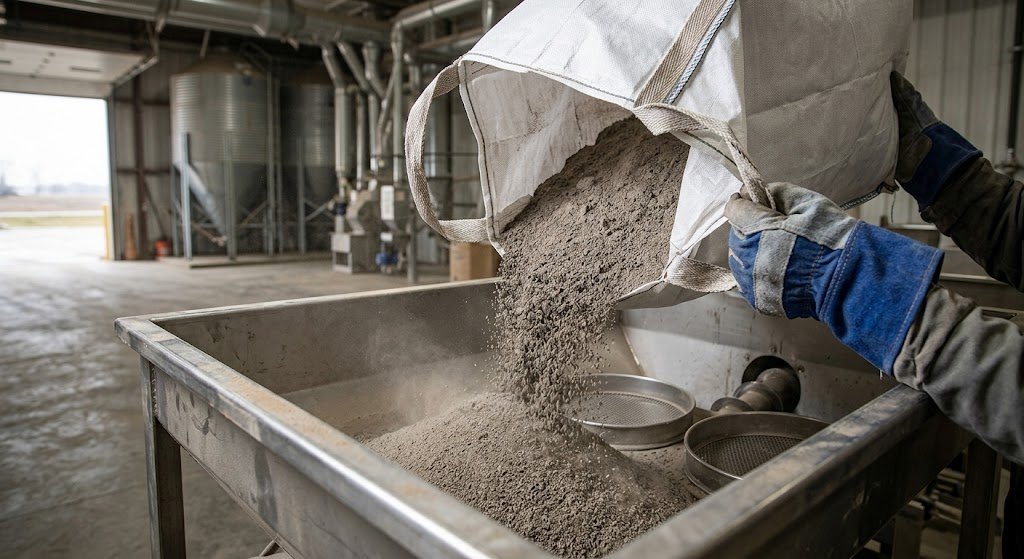
Packaging and loading: feed-grade MnO 60% typically ships in 25 kg laminated bags, with 1 MT big bags available. A 20-foot container holds roughly 20–25 tonnes; Confirm bag construction, palletisation, and moisture protection before production, not after arrival.
Documentation set for a cross-border shipment:
- COA for the batch (dual assay basis: MnO% and measured Mn%, moisture, particle size, heavy metals — see What Should Be Included in a COA for Feed-Grade Manganese Oxide).
- Safety Data Sheet (SDS/MSDS).
- Certificate of Origin.
- Commercial invoice, packing list, and bill of lading.
- Country-specific registration: the EU requires feed additives to comply with Regulation (EC) No 1831/2003; the US applies AAFCO definitions; several markets require an import permit or a country-of-origin declaration.
Check the destination country’s feed material rules before signing the contract. A perfect product that cannot be registered in your market is a storage cost, not a feed ingredient.
Frequently Asked Questions About Buying MnO in Bulk
Is it safe to buy MnO from Alibaba?
Safe as a search engine, not as a quality system. Use the platform to find candidates, then verify each one with registration records, original certificates, recent batch COAs, and a lab test on a sample. The platform’s dispute mechanism helps after a problem; the verification process prevents the problem.
How do I find the factory behind a trading company?
Ask directly: name of the upstream factory, its COA, and proof of stock or a recent bill of lading. A trader with real supply answers in writing. Cross-check the factory name against registration records, then request the same verification steps you would run on any supplier.
What’s the minimum order for a direct-from-factory deal?
Typically one container (20–25 tonnes) for a factory-direct price. Below that, you pay repacking and handling costs that erase the direct price advantage — which is why traders and platforms exist for smaller lots. Ask for the MOQ in writing; it is a negotiating point, not a fixed law.
Should I attend trade shows just to source minerals?
Not for a single container. Shows pay off for strategic, repeat supply — when you want to meet the people behind a five-year relationship and arrange a factory audit. For one-off sourcing, a platform or a verified trader gets the same product at lower cost.
Can one supplier handle my whole mineral premix needs?
Only if they prove it. A MnO supplier can source other minerals, but sourcing is not the same as producing. Ask which products are factory-made and which are traded, and apply the same COA and batch-record verification to every line. One trusted supplier beats five cheap ones — but trust is earned line by line, not assumed from the first product.
Conclusion: Find Them Anywhere, Verify Them Everywhere
Four channels, one process. Look wherever the density is: direct factory for volume and audits, trader for flexibility, platform for screening, trade show for long-term trust. Then run the same verification on every candidate — registry, certificates, batch COAs, own-lab sample, and a plant visit where the volume justifies it. The channel gets you to a supplier. The verification keeps the rejected container away from your port.
We put the verification evidence on the table before you ask: factory introduction and production process, feed-grade TDS, recent batch COAs, samples, and a factory visit invitation. Start with Feed Grade Manganese Oxide (MnO) 60%, then request the documentation pack — contact us to begin qualification.

I am Edward lee, founder of manganesesupply( btlnewmaterial) , with more than 15 years experience in manganese products R&D and international sales, I helped more than 50+ corporates and am devoted to providing solutions to clients business.