Executive Summary
Compare MnO suppliers in three steps: normalize every quote to price per kg of elemental manganese, align all COAs to the same basis and metric, then score suppliers on quality, compliance, and supply. The winner is the supplier with a real, competitive unit cost — not the lowest price per tonne.
- Normalize price first. Per-tonne numbers lie.
- Align COAs second. Different bases are not comparable.
- Score third. Numbers become a ranked decision.
Quick Answer: The Three-Step Method for Comparing MnO Suppliers
| Step | Action | Tool |
|---|---|---|
| 1 | Normalize every quote | Price per kg of elemental Mn |
| 2 | Align all COAs | Side-by-side table, same basis |
| 3 | Score and rank | Weighted: quality / compliance / supply / commercial |
One rule governs all three: comparison must happen on the same basis, or you are comparing packaging, not product. A per-tonne price, a dry-basis COA, and a single-batch snapshot each hide more than they show.
Why Comparing MnO Quotes the Naive Way Backfires
Four basis traps turn a simple price comparison into a wrong decision.
- Purity basis differs. One supplier quotes MnO%, another quotes Mn%. A quote “at 60%” and a quote “at 46.5% Mn” describe the same product — but look different in a naive table.
- Assay basis differs. As-received includes moisture; dry basis does not. At 1.5% moisture, the same batch shows ~0.7 Mn points higher on a dry basis. Two truthful suppliers, two different numbers.
- Particle size grade differs. A fine premix grade costs more to mill than a coarse grade. Comparing them by price alone compares different products.
- Test method differs. Titration Mn and ICP Mn can disagree; laser diffraction and sieve analysis give different distributions. Methods must match before numbers can.
Any one of these unaligned makes your price gap conclusion wrong. The three steps exist to close all four.
Step 1 — Normalize Every Quote to Price per kg of Elemental Mn
The formula that makes all quotes comparable:
Price per kg Mn = (price per tonne ÷ 1,000) ÷ (measured Mn% ÷ 100)
Use the measured Mn% from the COA — not the nominal TDS value. A worked example across three grades:
| Supplier | Grade | Price per tonne | Measured Mn% | Price per kg Mn |
|---|---|---|---|---|
| A | 60% MnO | $700 | 46.4% | $1.51 |
| B | 62% MnO | $750 | 48.0% | $1.56 |
| C | 55% MnO | $640 | 42.6% | $1.50 |
Three readings from one table:
- The 62% product is the most expensive per kg of Mn — despite being mid-priced per tonne. Label purity is not value.
- A and C are effectively equal per kg Mn. The per-tonne gap of $60 disappears once the assay is counted.
- If B’s 48.0% came from a dry-basis report and A’s 46.4% from as-received, the real comparison tightens further — moisture must be added back before judging.
Two more normalizations belong in the same step:
- Packaging. 25 kg bags carry bag cost; big bags carry less packaging per tonne. Compare landed, bagged cost.
- Trade terms. FOB vs. CIF changes the landed price by freight and insurance. Push every quote to the same incoterm before comparing.
The full arithmetic background is in How Much Elemental Manganese Is in 60% Manganese Oxide (MnO)? The shortcut rule: every supplier quotes a number per tonne; none of those numbers is comparable until it is per kg of Mn.
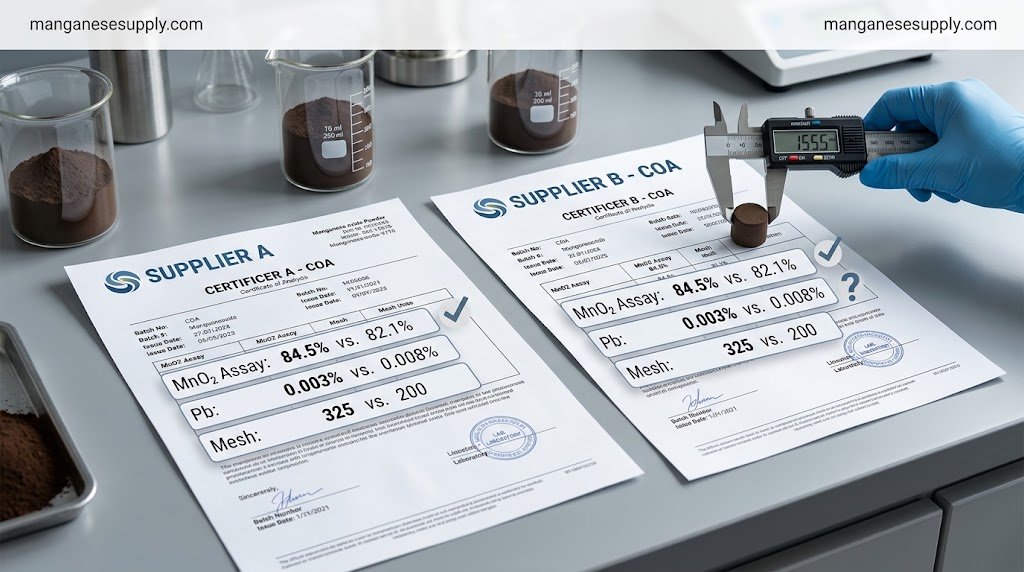
Step 2 — Build the Side-by-Side COA Comparison Table
Collect the last three COAs from each supplier and fill one table.
| Line | Supplier A (3 batches) | Supplier B (3 batches) | Supplier C (3 batches) |
|---|---|---|---|
| MnO % measured | 60.1 / 60.0 / 59.8 | 62.2 / 61.5 / 61.0 | 55.1 / 55.3 / 55.0 |
| Mn % measured | 46.5 / 46.4 / 46.2 | 48.1 / 47.6 / 47.2 | 42.6 / 42.8 / 42.5 |
| Particle size | 80–200 mesh, stable | 80–200 mesh, stable | 80–200 mesh, stable |
| Citric solubility | 91 / 90 / 89 | 82 / 84 / 81 | 90 / 89 / 90 |
| Moisture | 0.9 / 1.0 / 1.1 | 1.3 / 1.6 / 1.8 | 1.0 / 1.1 / 1.2 |
| As / Pb / Cd (ppm) | 1.8 / 4.2 / 0.9 | 3.9 / 8.8 / 2.1 | 1.5 / 3.8 / 0.8 |
| Method | ICP / laser | ICP / laser | ICP / laser |
Three alignment actions before reading:
- Unify the assay basis. If one supplier reports dry basis and another as-received, convert one — usually by adding the moisture back to the as-received figure.
- Unify methods. Same method per parameter, or the columns are not comparable.
- Read the range, not the batch. Three batches give a spread. The spread is the quality system; a single COA is just one day at the factory.
The 10-item standard for reading a single certificate is in What Should Be Included in a Certificate of Analysis (COA) for Feed-Grade Manganese Oxide? This table is the comparison layer on top of it.
Reading Between the Lines: What COA Patterns Reveal About Each Supplier
Side-by-side comparison exposes what single certificates hide.
| Pattern | What it reveals |
|---|---|
| Values sit comfortably below limits | Controlled process with raw material margin |
| Values pressed against the spec line | Production runs at the edge — next batch may tip over |
| Tight spread across 3 batches | A real quality system in place |
| Wide spread (e.g., solubility 95→78) | Process instability or changing raw material sources |
| Every value exactly equals the TDS | The COA is copied, not tested — real measurements vary |
| Heavy metals “pass” with no numbers | No margin you can verify — treat as worst case |
| Methods missing | Results cannot be audited or compared |
In the example table above, Supplier B is the pattern story: highest assay, but solubility drifting down and heavy metals creeping toward limits. The trend — not the headline — is the reason to rank them third on quality.
Step 3 — Score the Suppliers: Quality, Compliance, Supply, and Commercial
Weights are a starting point; adjust them to your own risk profile.
| Dimension | Weight | What earns 1 vs. 5 |
|---|---|---|
| Quality (COA record) | 40% | 1: wide spread, values at limits, missing methods. 5: tight spread, healthy margins, full methods |
| Compliance documentation | 25% | 1: documents on request, no market match. 5: target-market files produced unprompted |
| Supply stability | 20% | 1: vague capacity, no track record. 5: capacity, lead-time history, reference buyers |
| Commercial terms | 15% | 1: rigid MOQ, sample fees, FOB-only. 5: trial support, flexible terms, clear problem handling |
Scoring anchors do the work: without them, scores are vibes. Two suppliers can both be “good” and rank opposite ways once the anchors are written down. The full five-dimension evaluation framework behind this scoring is in How to Choose a Reliable Manganese Oxide Supplier for Animal Feed? — Step 3 here is its arithmetic version.
The Two-Shortlist Rule: Why You Should Never Funnel to Just One
The correct output of comparison is two names: one primary, one backup.
- Primary supplier: negotiate volume pricing, lock the spec and COA standard into a framework agreement.
- Backup supplier: keep qualified — an active sample, a validated COA, a contact who answers — without buying volume from them.
Why two and not one: a single-source mineral is a single point of failure for a continuous feed plant — one furnace outage, one customs hold, one raw material shift, and the line stops. Why two and not three: every extra qualified source costs re-validation samples, paperwork, and QC attention. One primary plus one warm backup is the honest minimum.
Common Comparison Mistakes That Lead to Bad Purchases
| Mistake | Why it hurts |
|---|---|
| Comparing per-tonne prices only | Ignores assay, packaging, and terms — the entire price gap can be an artifact |
| Trusting TDS promises instead of COA measurements | TDS is intent; COA is evidence |
| Ignoring batch-to-batch spread | Single-batch luck decides a multi-year relationship |
| Ignoring heavy metal margins | Values near the limit fail the next inspection |
| Forgetting freight, insurance, and terms | FOB vs. CIF can flip the ranking |
| Letting the cheapest sample decide | Samples are screened; containers are reality — grade the system, not the sachet |
Each mistake has the same root: comparing on different bases. The three steps exist to stop each one.
From Comparison to Order: The Trial Batch as the Final Test
Comparison ends with a decision; the trial batch confirms it. The sequence:
- Order samples or trial lots from the top two.
- Retest both at the same laboratory, same methods. Your numbers, your basis.
- Run a plant-scale mixing check. CV, flow, and handling in your equipment — the paper cannot show this.
- Write the comparison into the contract. Spec values, COA standard per lot, methods, discrepancy and rejection clauses — the contract clause guidance in What Should Be Included in a Certificate of Analysis (COA) for Feed-Grade Manganese Oxide? becomes the framework agreement.
The trial is not a formality. It is the last step where a mistake is still cheap.
Frequently Asked Questions About Comparing MnO Suppliers
How many suppliers should I compare?
Three to five at the quote stage, then two in the shortlist. Fewer hides market range; more dilutes your testing budget.
What if the cheapest per kg Mn has the worst COA?
Then it is not the cheapest — it is the cheapest on one line and most expensive on every other. Rank by the weighted score, and let the price per kg Mn stand as the tiebreaker among roughly equal scores.
How often should I re-run the comparison?
Annually, plus after any major change — new raw material source, new production line, ownership change. The last 3–5 COAs from your current supplier are the early-warning signal between reviews.
Conclusion: Same Basis, Real Data, Weighted Decision
Three steps produce the decision: normalize every quote to price per kg of elemental Mn, align all COAs to the same basis in one table, and score on quality, compliance, and supply with anchored weights. Keep one primary and one backup supplier, confirm with a trial batch, and write the comparison into the contract. Every mistake in this article comes from comparing on different bases; every step exists to prevent it.
We invite the comparison. Put our TDS and the last three batch COAs into your side-by-side table — dual assay with basis, solubility, particle size distribution, and heavy metal panels with named methods. Start with Feed Grade Manganese Oxide (MnO) 60%, request the documentation pack, and let the table decide. Contact us for recent COAs, samples, and a trial quotation.

I am Edward lee, founder of manganesesupply( btlnewmaterial) , with more than 15 years experience in manganese products R&D and international sales, I helped more than 50+ corporates and am devoted to providing solutions to clients business.