Executive Summary
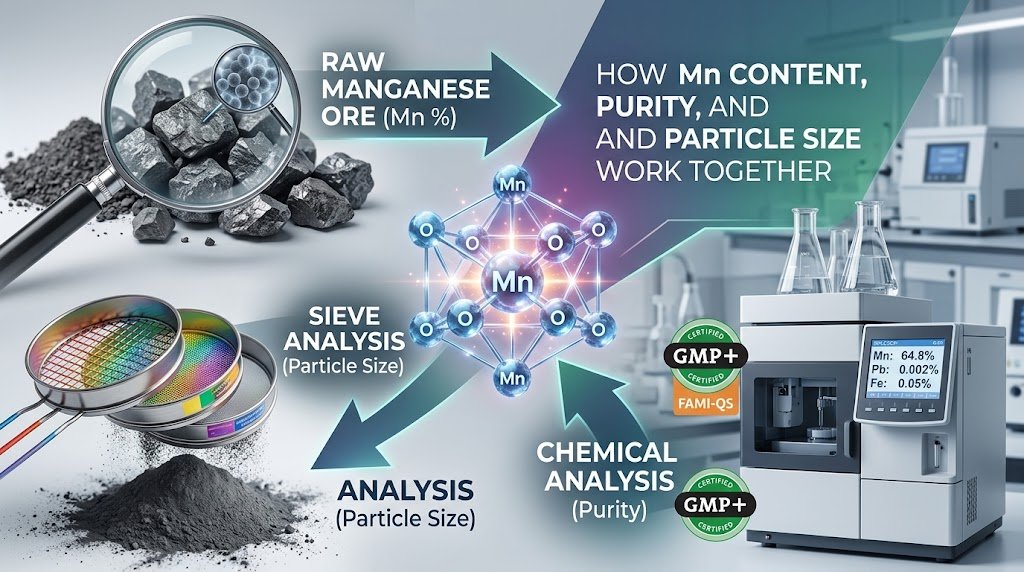
Feed-grade MnO quality is a triangle: manganese content sets nutrient value, purity sets safety and availability, particle size sets mixing performance. All three come from the same production process. Weak on any one corner, the product fails.
- Mn content defines what you are buying per tonne.
- Purity defines what else is in the bag.
- Particle size defines what happens after the bag is opened.
Quick Answer: The Quality Triangle of Feed-Grade MnO
Three numbers, three different jobs.
| Corner | Question it answers |
|---|---|
| Mn content | How much nutrient are you buying? |
| Purity | What else is in the bag? |
| Particle size | Can the nutrient reach every mouthful evenly? |
Mn content is value density. Purity is the safety and availability layer. Particle size is process performance. They do not substitute for each other. A high Mn% cannot fix bad mixing; a tight mesh range cannot fix heavy metals.
Manganese Content: The Number That Sets What You’re Actually Buying
Elemental Mn is the line your formula consumes. It derives from MnO purity by arithmetic: Mn% = MnO% × 0.774. A 60% MnO product carries 46–47% Mn — about 465 g of Mn per kg.
Two reading rules:
- Read both lines. A TDS listing 60% MnO should show 46–47% Mn. If the Mn line is missing or inconsistent, ask why.
- Confirm the assay basis. As-received includes moisture; dry basis does not. At 1.5% moisture, the same product shows ~0.7% more Mn on a dry basis. Two COAs can differ by basis alone.
Mn content decides dosing arithmetic and true cost: kg MnO per tonne = supplemental Mn (mg/kg) ÷ 465. Price per kg of elemental Mn — not per kg of powder — is the honest comparison between suppliers. Full background: How Much Elemental Manganese Is in 60% Manganese Oxide (MnO)?
Purity: Not Just How Much Mn — What Else Is in the Bag
Purity operates on two levels, and confusing them is expensive.
Level 1: phase purity. Is the manganese present as fully reduced MnO, or mixed with higher oxides (MnO₂, Mn₃O₄)? Higher oxides dissolve poorly in the gut and deliver less available Mn. A product can assay high and still underperform if part of that assay is the wrong oxide.
Level 2: the impurity profile. Heavy metals (As ≤ 5, Pb ≤ 10, Cd ≤ 5 ppm), moisture ≤ 1.5%, insolubles.
The counterintuitive result: a 62% MnO product can have lower availability than a clean 60% product. If the extra two points come from higher-oxide phases, the assay rises while citric acid solubility falls. This is why solubility data belongs next to the assay, not as an afterthought. Full mechanism: What Factors Affect the Bioavailability of Manganese Oxide in Animal Nutrition?
Particle Size: The Spec That Decides Performance After the Bag Is Opened
The mechanism chain: particle size distribution → mixer CV → Mn deviation per mouthful. At swine inclusion rates of 30–90 g per tonne, a mixing defect is not a rounding error — it is the whole dose.
| Too fine | Too coarse |
|---|---|
| Dust losses at dosing and bagging | Segregation in the mixer and in transport |
| Weighing errors at small inclusion | Slow dissolution in the gut |
| Operator exposure | Uneven CV within the batch |
A controlled range — 80–200 mesh — means the producer mills and classifies to a distribution. A single value (“100 mesh”) is nominal only. “Powder” is not a spec. The range, not the midpoint, is the guarantee.
Why the Three Factors Must Be Read Together
Each corner can be gamed alone. The triangle cannot.
| Combination | What it means |
|---|---|
| High Mn% + uncontrolled particle size | Uniformity disaster at low inclusion rates |
| High purity + higher-oxide phases | Availability trap: good numbers, poor delivery |
| Perfect particle size + weak heavy metal control | Safety risk — well-mixed contamination |
| 62% MnO, no solubility data | The assay is hiding the phase question |
The pattern to respect: a supplier strong on one headline number and silent on the other two is not offering a bargain. The silence is the information. Single spectacular numbers are marketing; the triangle is quality.
How the Production Process Sets All Three Numbers
The three specs are not independent choices. They are outputs of the same process.
| Process step | Sets |
|---|---|
| Reduction calcination (temperature, time, atmosphere) | Phase purity and MnO assay |
| Milling and air classification | Particle size distribution |
| Raw material source and ore selection | Heavy metal baseline |
This is the practical difference between a producer with process control and a trader blending lots to hit an assay. Blending can raise one number. It cannot control a phase, a distribution, or a metal. When you ask for the last 3–5 batch COAs and the spread is tight, you are reading the process — not the paperwork.
How Each Factor Is Tested — and How to Read the Numbers
| Parameter | Typical method | Notes |
|---|---|---|
| Mn content | ICP-OES, AAS, or titration | Methods agree within tolerance; name the method on the COA |
| Phase / oxidation state | XRD or chemical phase analysis | The only direct check on “fully reduced” |
| Particle size | Laser diffraction or sieve analysis | Different methods give different distributions — do not compare across methods |
This answers a common purchasing puzzle: two labs, two COAs, different numbers — and both right. Titration Mn and ICP Mn are not directly comparable; laser diffraction D50 and a sieve midpoint are different measurements. Compare like with like, and require the method on every certificate.
What This Means for Your Next Purchase Decision
The pass lines, on one page:
| Factor | Pass line |
|---|---|
| Mn content | ≥ 46–47% Mn, paired with MnO ≥ 60%, basis stated |
| Phase purity | Citric acid solubility ≥ 85–90%; XRD data on request |
| Impurity profile | As ≤ 5, Pb ≤ 10, Cd ≤ 5 ppm; moisture ≤ 1.5% |
| Particle size | 80–200 mesh as a controlled range |
Red-flag combinations that should end the conversation: high assay with no solubility line; tight mesh claim with no heavy metal numbers; “typical” values pressed against every limit.
Next steps: work the specification line by line in What Manganese Oxide Specifications Should Feed Manufacturers Check Before Buying?, then set the purity band for your application in How Do Feed Manufacturers Choose the Right Grade of Manganese Oxide?
Frequently Asked Questions About MnO Quality Parameters
Is a higher Mn% always better quality?
No. A higher assay with higher-oxide phases can deliver less available Mn than a clean 60% product. Read Mn% together with citric acid solubility — never alone.
Can good particle size compensate for lower purity?
No. Particle size controls distribution of the material; it cannot remove lead or convert MnO₂ into MnO. The corners do not substitute for each other.
How do I know the MnO is fully reduced?
Ask for XRD or phase analysis, and check citric acid solubility ≥ 85–90% on the batch COA. Solubility is the practical proxy; XRD is the direct proof.
Which factor matters most for premixes?
Particle size consistency first — it decides CV in the premix tower — followed by phase purity. For mineral mixes and blocks, moisture and heavy metals lead.
Conclusion: Quality Is a System, Not a Single Number
Feed-grade MnO quality is a triangle. Mn content sets what you buy, purity sets what travels with it, particle size sets how it performs. All three are set by the same production process — reduction, classification, and raw material control — and weak on any one corner means the product fails somewhere predictable.
We publish TDS with dual assay, citric acid solubility, particle size distribution, and heavy metal panels, backed by batch COAs and XRD phase data on request. See Feed Grade Manganese Oxide (MnO) 60% for the fully documented grade. TDS, COA history, and samples available on request — contact us for the documentation pack.

I am Edward lee, founder of manganesesupply( btlnewmaterial) , with more than 15 years experience in manganese products R&D and international sales, I helped more than 50+ corporates and am devoted to providing solutions to clients business.