Executive Summary
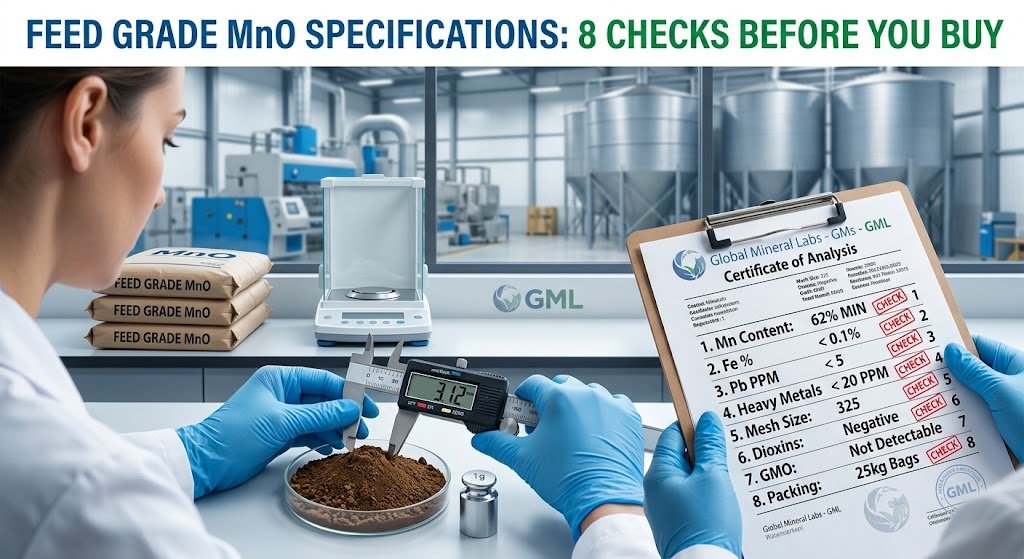
Check eight specifications before buying feed-grade manganese oxide. A TDS missing any one of them deserves a follow-up question.
- MnO purity ≥ 60% and elemental Mn ≥ 46–47% — read both lines.
- Particle size 80–200 mesh, moisture ≤ 1.5%.
- Citric acid solubility ≥ 85–90%.
- Heavy metals: As ≤ 5 ppm, Pb ≤ 10 ppm, Cd ≤ 5 ppm.
- Batch-to-batch consistency — the spec that is not printed on the TDS.
Quick Answer: The Eight Specs That Belong on Every Feed-Grade MnO TDS
| # | Spec | Typical feed-grade value | Red flag |
|---|---|---|---|
| 1 | MnO purity | ≥ 60% | No elemental Mn line alongside |
| 2 | Elemental Mn | ≥ 46–47% | Mn inconsistent with MnO × 0.774 |
| 3 | Particle size | 80–200 mesh | Listed only as “powder” |
| 4 | 2% citric acid solubility | ≥ 85–90% | Absent from TDS |
| 5 | Moisture | ≤ 1.5% | Above 2% |
| 6 | As | ≤ 5 ppm | Stated only as “complies” |
| 7 | Pb / Cd | ≤ 10 ppm / ≤ 5 ppm | Limits far looser than market norms |
| 8 | Batch consistency | 3–5 recent COAs, tight spread | Only one “golden sample” offered |
Judgment standard: a supplier who controls production publishes all eight without being asked. See Feed Grade Manganese Oxide (MnO) 60% for a fully specified grade.
MnO Purity (≥60%) and Elemental Mn (≥46–47%): Read Both Lines, Not One
The two lines do different jobs.
| Line | What it establishes | Who uses it |
|---|---|---|
| MnO ≥ 60% | Product grade and purity | Trading, quality classification |
| Mn ≥ 46–47% | Nutrient content | Formulators, nutritionists |
The conversion is arithmetic: Mn% = MnO% × 0.774. A TDS listing 60% MnO should show 46–47% Mn. If it shows less, ask what else is in the product. If it shows no Mn line at all, ask why. Full background: see How Much Elemental Manganese Is in 60% Manganese Oxide (MnO)?
Particle Size (80–200 Mesh): The Spec That Shows Up in Your Mixer
Particle size is not cosmetic. It decides what happens in your plant.
| Spec presentation | Meaning |
|---|---|
| Range (80–200 mesh) | Producer controls milling; expect consistent flow and mixing |
| Single value (e.g., “100 mesh”) | Only a nominal figure; actual distribution unknown |
| “Powder” | No spec at all; expect anything |
Why the range matters:
- Too coarse → segregation in the mixer, uneven CV, deficient and over-dosed animals in the same batch.
- Too fine → dust losses at dosing, weighing errors, operator exposure.
- At swine inclusion rates (30–90 g/tonne), uniformity is the whole game.
Match the spec to your line: check the CV your mixer achieves with the current grade before switching suppliers on price alone.
Solubility in 2% Citric Acid (≥85–90%): Your Availability Preview
This is the only number on a TDS that predicts bioavailability.
Citric acid solubility approximates the dissolving power of the proximal gut. Values ≥ 85–90% indicate available Mn for monogastrics. It correlates with tissue Mn deposition far better than total Mn assay does.
A TDS without this line means one of two things: the producer does not measure it, or does not want it seen. Both are answers. Full context: see What Factors Affect the Bioavailability of Manganese Oxide in Animal Nutrition?
Moisture (≤1.5%) and Bulk Density: The Handling Specs
Two underrated lines that decide the receiving experience.
| Spec | Typical | Why it matters |
|---|---|---|
| Moisture | ≤ 1.5% | Above 2%, bagged product cakes in storage and long sea voyages |
| Bulk density | ~1.0–1.3 kg/L | Sets silo capacity, bag sizing, and container loading count |
Moisture also touches the assay: a 60% MnO spec on an as-received basis with 2% moisture carries less Mn per tonne than a dry-basis spec suggests. Confirm the basis.
Bulk density errors surprise purchasing departments at the port: a misjudged density changes how many tonnes fit in a container and what the landed cost per kg of Mn really is.
Heavy Metal Limits: As, Pb, Cd — The Compliance Gate
| Metal | Typical feed-grade limit | Reference frameworks |
|---|---|---|
| As | ≤ 5 ppm | EU feed additive regs, AAFCO, GB 13078 |
| Pb | ≤ 10 ppm | EU, AAFCO, GB 13078 |
| Cd | ≤ 5 ppm | EU, AAFCO, GB 13078 |
Markets differ in detail. The buyer’s job is to confirm the numbers against the destination market’s limits, not the origin market’s.
Reading the numbers:
- “Max” values are contractual limits. “Typical” values show where production actually runs. Typical at half the limit is a good sign; typical pressed against the limit is not.
- Heavy metals are the one-vote veto. Everything else can be negotiated; a Cd miss sends the container back.
Batch-to-Batch Consistency: The Spec That’s Not on the TDS
One clean TDS proves one good batch existed. It proves nothing about the next one.
Ask for the last 3–5 batch COAs and read the spread:
| Signal | Meaning |
|---|---|
| MnO 60.1, 60.4, 60.2, 60.3, 60.5 | Controlled process; safe to formulate against |
| MnO 60.8, 58.9, 61.5, 59.4, 60.0 | Wide swing; your formula assumptions move with every container |
Batch variance is a quality-system readout. A producer publishing tight batch history has instrumentation and process control behind the certificate. A producer refusing batch history has something behind it too.
Red Flags on a Manganese Oxide TDS: Seven Warning Signs
- Only MnO, no Mn. The nutrient line is what your formula needs.
- Particle size written as “powder.” No milling control, no mixing guarantee.
- No citric solubility data. Availability unknown by choice.
- Heavy metals as “complies.” Complies with what? Numbers or nothing.
- No test method stated. ICP-OES, AAS, or titration — without it, assays are not comparable across suppliers.
- Limits conspicuously loose. Cd ≤ 20 ppm on a feed-grade sheet is an industrial grade wearing a feed label.
- Typical far from max. Typical Pb 2 ppm against max 30 ppm means production runs somewhere you cannot predict.
Any single flag earns a question. Three or more earn a new supplier search.
From Spec Sheet to Purchase Contract: Making the Numbers Binding
A spec you did not write into the order is a suggestion.
| Contract clause | What it locks down |
|---|---|
| Assay basis | As-received or dry — stated, not assumed |
| Test method | ICP-OES, AAS, or titration named per parameter |
| Batch COA per shipment | Certificate accompanies each container |
| Pre-shipment sampling | Buyer or agent samples before loading |
| Non-conforming batch | Rejection, replacement, or credit — decided in advance |
| Heavy metal caps | Written as your market’s limits, not the origin’s |
The pattern is simple: numbers on paper become protection only when the contract references them. Suppliers who resist binding specs are telling you what the next dispute will be about.
Frequently Asked Questions About Feed-Grade MnO Specifications
What is the minimum Mn content I should accept?
46% elemental Mn (59% MnO) is the practical floor for feed-grade material. Below that, ask what is diluting the product.
Is 60% MnO a standard spec?
Yes — it is the most traded feed-grade worldwide, with 62–65% available for premium lines. Expect the TDS to carry the paired Mn line.
How do I know the TDS numbers are real?
Batch COA with named test method, third-party SGS or Intertek verification, and sample testing on arrival. Cross-check Mn against MnO × 0.774.
Which specs matter most for premixes?
Particle size consistency and moisture — they decide CV and caking in your premix tower. For mineral mixes and blocks, moisture and heavy metals lead.
Conclusion: Check the Lines, Then Ask for the COA
Eight specs decide whether feed-grade manganous oxide performs as purchased: MnO and Mn dual assay, particle size, citric solubility, moisture, As, Pb, Cd — plus the batch history that proves them repeatable. Seven red flags tell you when to walk away. Contract clauses turn the numbers into protection.
We publish full specifications with dual assay, batch-level citric solubility data, and recent batch COAs. TDS, COA history, and samples available on request — contact us for the documentation pack.

I am Edward lee, founder of manganesesupply( btlnewmaterial) , with more than 15 years experience in manganese products R&D and international sales, I helped more than 50+ corporates and am devoted to providing solutions to clients business.