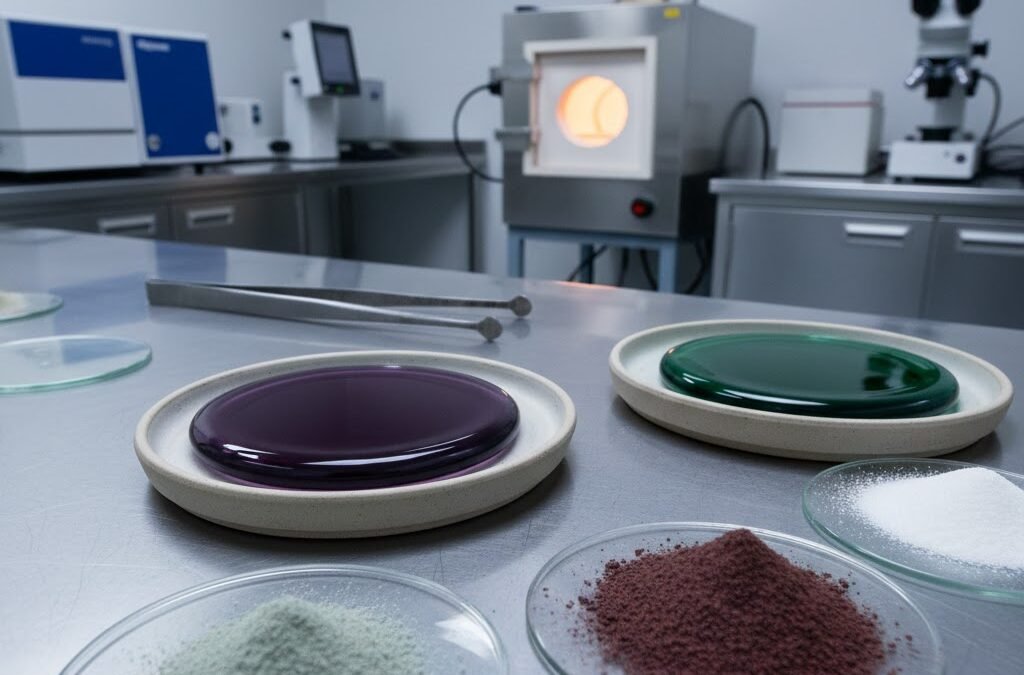
Manganese oxide is a critical functional additive in glass manufacturing, widely used to control color, improve optical clarity, and stabilize melt chemistry. Depending on oxidation state and dosage, manganese oxides (primarily MnO and MnO₂) can act as decolorizing agents, intentional colorants, or redox modifiers in soda-lime, borosilicate, and specialty glasses. Typical addition levels range from 0.01–0.5 wt%, yet even ppm-level variations can significantly affect visible transmittance, tint consistency, and defect rates. For container, flat, and optical glass producers, controlling manganese oxide purity, particle size, moisture, and iron content is essential to achieving stable color coordinates, high luminous transmission, and reproducible batch performance.
1. Technical Background: What Is Manganese Oxide in Glass?
1.1 Chemical Forms Used in Glassmaking
In industrial glass production, “manganese oxide” typically refers to:
Manganese(II) oxide (MnO)
Manganese dioxide (MnO₂)
During melting (≈1,400–1,600 °C), manganese readily participates in redox reactions, shifting between Mn²⁺ and Mn³⁺ depending on furnace atmosphere and batch composition. This redox flexibility is what makes manganese oxide particularly valuable in glass chemistry.
1.2 Role in the Glass Batch
Manganese oxide is introduced into the raw batch alongside silica sand, soda ash, limestone, and other modifiers. Its main functions include:
Neutralizing green coloration caused by iron impurities
Adjusting oxidation–reduction balance in the melt
Producing controlled purple, gray, or amber hues
Supporting fining and melt homogeneity in some formulations
Because modern glass production relies on tight color tolerances, manganese oxide quality directly affects downstream yield and visual acceptance.
2. Why Manganese Oxide Matters for Optical Clarity
2.1 Iron Impurities and Green Tint
Most silica sands contain Fe₂O₃ at 0.02–0.08%, which introduces a greenish tint and reduces visible light transmission. Manganese oxide counteracts this by oxidizing Fe²⁺ to Fe³⁺ and introducing complementary absorption in the visible spectrum.
Typical outcomes:
Visible light transmittance (VLT) improvement of 1–3%
Reduction in green chromaticity (lower a* values in CIELab)
This effect is especially important for float glass, architectural glazing, and display glass, where color neutrality is a key KPI.
2.2 Decolorization Mechanism
At low dosages (often 50–300 ppm Mn):
Mn³⁺ produces a faint purple absorption band
This optically compensates the green from iron
Net effect: visually “clear” or neutral glass
Over-addition, however, leads to purple or gray tinting, making dosage control critical.
3. Manganese Oxide as a Glass Colorant
3.1 Intentional Color Development
At higher concentrations (0.1–0.5 wt%), manganese oxide functions as a deliberate colorant:
Light pink to amethyst hues (oxidizing conditions)
Brown or gray tones (reducing conditions)
This is commonly used in:
Decorative glass
Tableware
Historical and restoration glass
Color strength depends not only on Mn content but also on particle size distribution and melt uniformity.
3.2 Redox Interaction with Other Oxides
Manganese oxide interacts with:
Iron oxides (FeO / Fe₂O₃)
Selenium compounds
Cobalt oxide
Poor control can lead to unstable color shifts between production runs, which is why consistent manganese oxide specifications are essential for batch-to-batch repeatability.
4. Key Material Properties and Their Impact
4.1 Purity (%) → Optical Stability
Typical glass-grade manganese oxide purity:
≥98.0% for container and flat glass
≥99.0% for optical and specialty glass
Higher purity minimizes unintended color from trace contaminants.
4.2 Particle Size (µm) → Melt Homogeneity
Recommended D50: 5–20 µm
Fine particles dissolve faster, reducing streaks and cords
Oversized particles (>75 µm) may cause incomplete dissolution and local color spots
Laser diffraction (ISO 13320) is commonly used for PSD control.
4.3 Moisture & LOI (%) → Batch Consistency
Moisture: ≤0.5%
LOI: ≤1.0%
Excess moisture alters batch weight accuracy and furnace redox balance, affecting both color and energy efficiency.
4.4 Impurity Control (ppm) → Defect Risk
Critical impurity limits:
Fe: ≤500 ppm (optical glass often ≤200 ppm)
Pb, As, Cd: ≤10 ppm combined
Cu, Ni: ≤50 ppm
Trace metals can introduce unwanted coloration or compliance issues.
5. Specification Table (Typical Glass Applications)
| Parameter | Typical Glass-Grade Range | Why It Matters |
|---|---|---|
| Purity (%) | 98.0–99.5 | Color stability, reproducibility |
| Particle size D50 (µm) | 5–20 | Uniform dissolution, no streaking |
| Fe content (ppm) | ≤200–500 | Prevents green/brown tint |
| Heavy metals (ppm) | ≤10 | Regulatory & visual compliance |
| Moisture (%) | ≤0.5 | Batch accuracy |
| LOI (%) | ≤1.0 | Furnace redox control |
6. Impact on Glass Performance KPIs
Controlled manganese oxide addition influences:
Visible light transmission: +1–3% compared to iron-only batches
Color consistency (ΔE): ≤1.0 across production runs
Defect rate: Reduced cords and color streaks
Yield: Fewer rejected sheets or containers due to tint variation
For architectural and automotive glass, even small ΔE improvements can significantly reduce rejection rates.
7. Quality Control & Testing Methods
7.1 Certificate of Analysis (COA)
A standard COA should include:
Mn content (%)
Fe, Pb, As, Cu (ppm)
Particle size D10 / D50 / D90
Moisture and LOI
Acceptance is typically based on application-specific color tolerance windows.
7.2 Analytical Techniques
ICP-OES / ICP-MS: Trace metal analysis
Laser diffraction (ISO 13320): Particle size distribution
Thermogravimetric analysis (TGA): LOI verification
UV-Vis spectroscopy (on glass samples): Optical transmission impact
Representative sampling is essential, especially for bulk shipments.
8. Purchasing & Supplier Evaluation Considerations
8.1 Grade Differentiation
Industrial grade: Suitable for container glass
High-purity grade: Required for float, optical, and display glass
Suppliers should clearly distinguish grades and provide consistent specifications.
8.2 Packaging & Storage
25 kg moisture-barrier bags or 1 t big bags
Dry storage to prevent agglomeration and oxidation state drift
8.3 Common Sourcing Risks
Inconsistent oxidation state between batches
Poor Fe control leading to color drift
Inadequate PSD control causing melt defects
Supplier audits and trial melts are strongly recommended.
9. FAQ: Manganese Oxide in Glass Manufacturing
What manganese oxide is most commonly used in glass?
MnO and MnO₂ are both used, depending on redox requirements.
How much manganese oxide is typically added?
From tens of ppm (decolorizing) up to 0.5 wt% (coloring).
Why is iron content in manganese oxide important?
Iron directly affects green/brown tint and optical transmission.
Does particle size really matter at high furnace temperatures?
Yes. Finer particles dissolve faster, improving color uniformity.
Can manganese oxide replace selenium completely?
Not always. Many formulations use both for precise color balancing.
10. Final Practical Checklist for Glass Producers
Define target color coordinates (L*, a*, b*)
Specify manganese oxide purity and Fe limits
Control particle size (D50 5–20 µm)
Verify moisture and LOI before batching
Run pilot melts when changing suppliers
Monitor ΔE and VLT as ongoing KPIs
Related Products

manganese dioxide

manganese carbonate

manganese sand
Related Posts

I am Edward lee, founder of manganesesupply( btlnewmaterial) , with more than 15 years experience in manganese products R&D and international sales, I helped more than 50+ corporates and am devoted to providing solutions to clients business.