Buying manganese carbonate for the first time can feel confusing. Many international buyers worry about purity, inconsistent specifications, unclear pricing, and import rules. These concerns are common because manganese carbonate is used in many critical industries such as batteries, fertilizer, ceramics, animal feed, and water treatment.
Before we move into FAQs, it is important to understand why this topic matters. Most first-time buyers face the same problems:
1) Purity Is Often Not as Advertised
Some suppliers advertise Mn ≥ 44%, but real content may be 40–42%.
This happens because production methods vary, and some factories use low-grade ore.
2) Impurities Affect Performance
High levels of chloride, sulfate, or heavy metals affect battery performance, feed safety, and ceramic color stability.
3) Different Countries Require Different Standards
EU requires REACH registration
Some buyers need food-grade or feed-grade safety limits
Battery factories require impurity levels <0.005%
4) Packaging, transport, and HS Codes are unclear
Many buyers do not know:
Is manganese carbonate dangerous goods?
What is the correct HS code?
What packaging is used for export?
5) High risk when paying a new supplier
Many new importers fear:
poor-quality cargo
delivery delays
payment risk
2. FAQs for First-Time Manganese Carbonate Buyers
Below are the most common questions international buyers ask before making their first order.
FAQ 1: What is the standard purity for manganese carbonate?
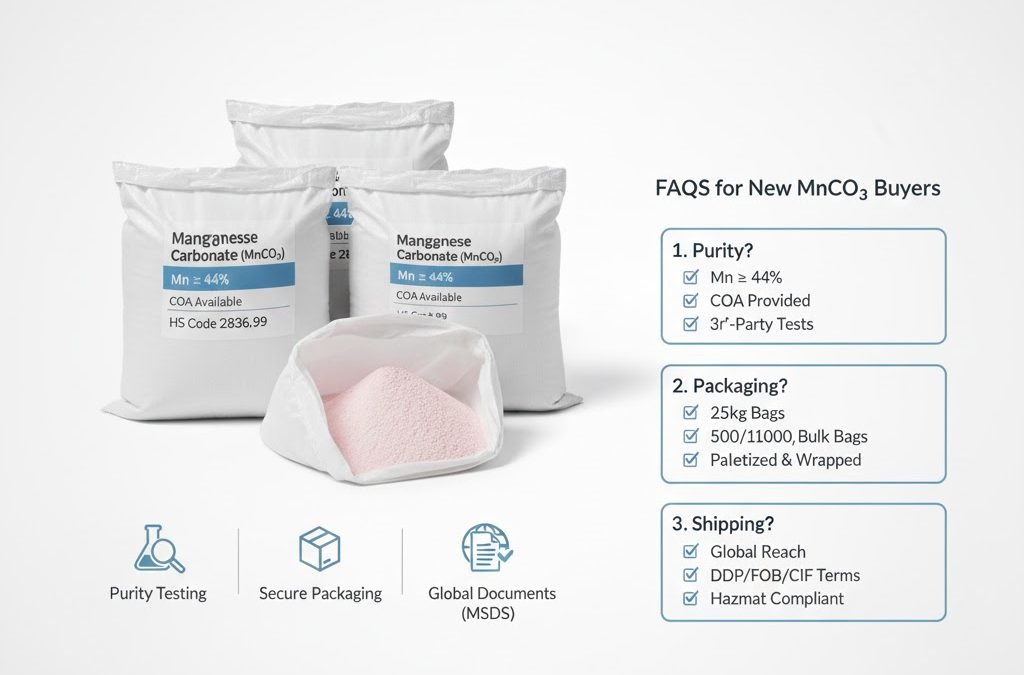
Most industrial-grade MnCO₃ follows China’s national standard GB/T 14838-2007.
| Parameter | Industrial Grade Standard | Typical Factory Supply |
|---|---|---|
| Mn (Manganese) | ≥44% | 44–45% |
| Moisture | ≤5% | 2–4% |
| Insoluble Substance | ≤0.1% | 0.05–0.1% |
| Sulfate (SO₄²⁻) | ≤0.6% | 0.2–0.5% |
| Chloride (Cl⁻) | ≤0.03% | 0.01–0.02% |
| Heavy Metals (Pb, As, Cd) | Must meet industry use requirement | Low ppm level |
For battery grade, manganese content often needs to be ≥45%, and impurities must be extremely low.
FAQ 2: What is the HS Code for manganese carbonate?
The global HS code is:
???? HS Code: 2836.99
This code is widely used in China, the USA, and Europe.
Some local customs may add extensions (e.g., 2836990000), but the first six digits remain the same.
FAQ 3: Is manganese carbonate considered dangerous goods?
No, manganese carbonate is not classified as dangerous goods under UN transport regulations.
Not flammable
Not explosive
Not corrosive
No special DG paperwork required
However, because powders may cause dust, suppliers normally include:
MSDS
Ventilation suggestions
Dust protection notes
But overall: it is safe for sea transport, air transport, and truck transport.
FAQ 4: What packaging is used for exporting manganese carbonate?
Standard packaging includes:
| Packaging Type | Weight | Features |
|---|---|---|
| Woven Bag + PE Liner | 25 kg/bag | Most common, moisture protection |
| Jumbo Bag | 1,000 kg/bag | For large buyers, easy loading |
| Pallet Package | 40 bags/pallet | Cleaner and easier unloading |
All bags include:
label
batch number
production date
lot tracking
This helps with quality control and customs inspection.
FAQ 5: What documents should I request from the supplier?
For the first purchase, you should request:
COA (Certificate of Analysis)
MSDS
Packing list
Commercial invoice
Product specification sheet
Certificate of origin
If shipping to EU: REACH status
A professional supplier will provide these immediately.
FAQ 6: What affects the price of manganese carbonate?
Price is mainly influenced by:
1) Manganese ore cost
The cost of ore can fluctuate 10–20% depending on global markets.
2) Purity and grade
Industrial grade: cheaper
Battery grade: higher price due to low impurities
3) Packaging type
Jumbo bags reduce cost by 5–8 USD/ton
Palletizing adds 2–4 USD/ton
4) Port of delivery
CFR/CIF destination affects freight cost
FOB China is cheapest
Typical market price range:
???? USD 400–2000/ton, depending on grade and destination.
FAQ 7: How can I verify quality before placing a large order?
First-time buyers can follow these steps:
1) Request a sealed sample
This sample should match the batch to be produced.
2) Ask for a real COA with batch number
Check if numbers are consistent across multiple batches.
3) Use a third-party lab
Such as SGS or Intertek.
4) Request a production video or live inspection
Most good suppliers are willing to do this.
5) Random sampling from bulk cargo before loading
This guarantees consistency.
FAQ 8: What is the normal lead time for manganese carbonate?
Typical schedule:
| Step | Time |
|---|---|
| Production | 7–10 days |
| Bagging & QC | 2–3 days |
| Booking vessel | 5–7 days |
| Sea shipping to US West Coast | 15–25 days |
| Sea shipping to US East Coast | 28–35 days |
| To Southeast Asia | 5–10 days |
| To EU | 25–40 days |
Total delivery time:
???? 25–45 days depending on destination.
FAQ 9: What payment terms do suppliers usually accept?
First-time orders usually follow:
T/T 30% deposit, 70% before shipment
100% T/T before shipping (for small orders <10 tons)
L/C at sight (for large shipments over USD 20,000)
Other options:
Alibaba Trade Assurance
PayPal for sample fees
FAQ 10: How do I choose a reliable manganese carbonate supplier?
You should check these points:
✔ Manufacturing capability
Ask for:
production capacity
equipment photos
annual export volume
✔ Stable quality
Request:
COA from different months
impurity reports
testing method (e.g., ICP-OES, titration)
✔ Clear communication
A good supplier answers:
within 24 hours
with clear data
with safety documents
✔ Export experience
Check:
shipping documents
destination markets
customs clearance records
✔ Strong after-sales service
Reliable suppliers offer:
free re-test if cargo quality is disputed
sample first
stable long-term supply
3. Summary Table
| Topic | Key Information |
|---|---|
| Standard Purity | Mn ≥ 44% (GB/T 14838-2007) |
| HS Code | 2836.99 |
| Dangerous Goods? | No |
| Packaging | 25kg bag / 1,000kg jumbo bag |
| Shipping Time | 25–45 days total |
| Payment Terms | T/T, LC |
| Documents | COA, MSDS, Specification, Invoice |
| Quality Test | SGS/Intertek, sample verification |
4. Final Advice for First-Time Buyers
If this is your first time buying manganese carbonate:
Always request a sample with batch number
Compare COA from at least two suppliers
Ask for clear impurity data (SO₄²⁻, Cl⁻, Pb, As)
Ask about production method and stability
Choose palletized packaging if moisture is a concern
Use third-party inspection for the first order
A good supplier should make your first order simple and safe.
Related Posts

I am Edward lee, founder of manganesesupply( btlnewmaterial) , with more than 15 years experience in manganese products R&D and international sales, I helped more than 50+ corporates and am devoted to providing solutions to clients business.