In the manganese carbonate (MnCO₃) industry, purchasing volume significantly affects pricing, logistics, and procurement strategy. Buyers from different sectors—battery materials, ceramics, catalysts, and water treatment—often need to decide whether to order in bulk or small quantities.
This article explains the key differences, including price structures, lead times, quality consistency, and purchasing flexibility, to help buyers choose the most suitable option for their needs.
In global trade, “bulk” and “small quantity” refer to very different purchasing models:
| Order Type | Typical Quantity Range | Common Buyers | Main Purpose |
|---|---|---|---|
| Bulk Order | ≥1 metric ton | Industrial plants, distributors | Continuous production or resale |
| Small Quantity Order | 1–100 kg | Laboratories, R&D institutes, new customers | Testing or small-scale application |
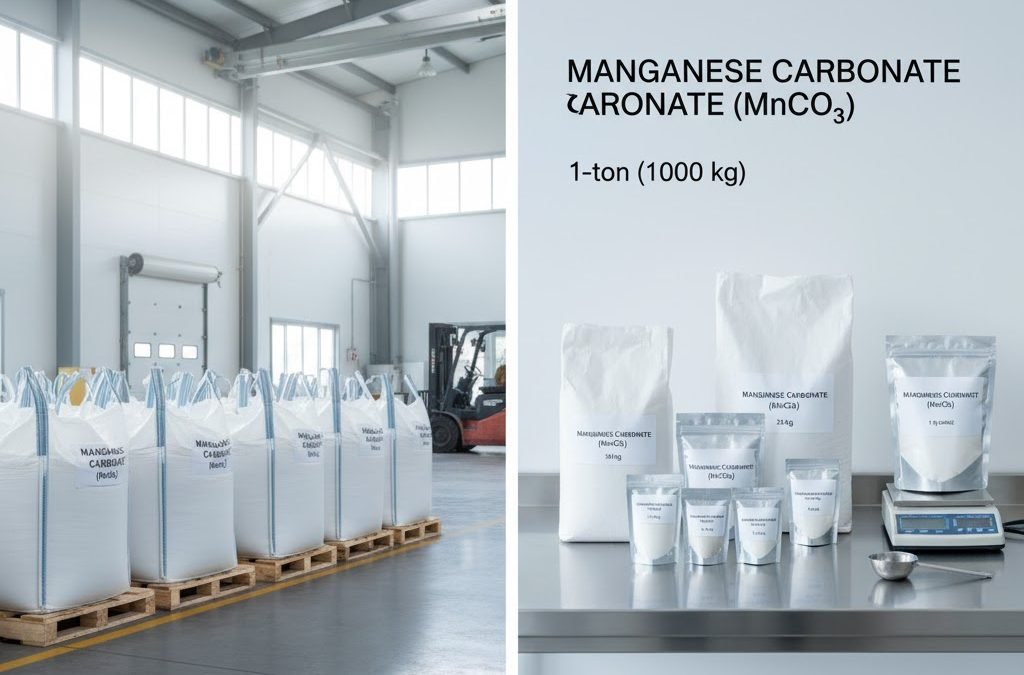
Bulk orders usually follow full-container (FCL) or less-than-container (LCL) sea shipment, while small orders are shipped via air or courier (e.g., DHL, FedEx). This distinction directly impacts pricing and delivery speed.
2. Price Differences Between Bulk and Small Quantity Orders
Price variation between bulk and small orders primarily comes from production cost allocation, logistics, and packaging differences.
According to market data from major Chinese manganese carbonate manufacturers in 2025:
| Order Type | Typical Unit Price | Packaging | Shipping Method |
|---|---|---|---|
| Bulk Order (≥1 ton) | USD 800–1000/ton (FOB China) | 25 kg bags or 1-ton jumbo bags | Sea freight |
| Small Quantity (1–100 kg) | USD 3–5/kg (CIF) | 1–25 kg sealed bags | Air freight / Courier |
Bulk orders are more cost-effective per unit because raw materials, labor, and freight costs are distributed over a larger quantity.
However, small quantity purchases provide flexibility for new buyers or research institutions that want to verify product quality before large-scale procurement.
3. Lead Time and Logistics Comparison
Lead time depends on order size, customization requirements, and shipping route.
Typical industry averages are as follows:
| Order Type | Production Lead Time | Shipping Time | Total Delivery (Approx.) |
|---|---|---|---|
| Bulk Orders | 15–25 days | 25–45 days (by sea) | 40–70 days |
| Small Quantity Orders | 3–7 days | 3–10 days (by air/courier) | 6–17 days |
Bulk shipments are typically exported through ports like Shanghai or Qingdao, while small parcels are dispatched directly from factories via international express services.
For urgent R&D or pilot projects, small orders offer a clear advantage in speed.
4. Quality Control and Consistency
Quality consistency is critical, especially for large industrial buyers.
Bulk Orders undergo multi-batch blending and uniformity testing to ensure even composition across tons of material.
Small Quantity Orders are often produced or repacked from an existing verified batch, ideal for sample validation or research use.
Typical Quality Parameters (based on GB/T 16121-2011):
| Item | Industrial Grade | Battery Grade |
|---|---|---|
| MnCO₃ content | ≥ 43.5% | ≥ 44.0% |
| Fe content | ≤ 0.02% | ≤ 0.01% |
| Moisture | ≤ 0.5% | ≤ 0.3% |
| Particle size (D50) | 10–30 μm | 3–10 μm |
Factories with ISO 9001 certification generally apply three-stage QC — raw material inspection, in-process testing, and pre-shipment verification — to ensure product stability.
5. Lead Times for Custom Manganese Carbonate Orders
Custom manganese carbonate—such as special purity grades, fine particle sizes, or surface-treated types—requires additional production and testing time.
Typical lead times are 20–35 days before shipment.
| Customization Type | Additional Time Required | Reason |
|---|---|---|
| High-purity grade (≥99.5% MnCO₃) | +5–8 days | Extra purification and impurity analysis |
| Fine particle size (<10 μm) | +3–5 days | Secondary grinding and sieving |
| Surface-modified MnCO₃ | +7–10 days | Coating or doping process |
| Custom packaging (fiber drum, palletized bags) | +2–3 days | Non-standard labeling and materials |
| Export certification (REACH, RoHS) | +2–4 days | Additional documentation and testing |
To save time, buyers should:
Provide detailed specifications early.
Approve pre-production samples quickly.
Maintain long-term supply agreements for recurring orders.
6. How to Decide Which Type Suits You
| Scenario | Recommended Order Type | Reason |
|---|---|---|
| R&D testing, laboratory use | Small quantity | Fast delivery and flexibility |
| Battery or ceramic plant production | Bulk order | Lower cost per ton |
| First-time cooperation | Small quantity sample + bulk follow-up | Reduces risk, ensures compatibility |
| Distributor stock replenishment | Bulk order | Optimized logistics and pricing |
Tip: A combined strategy—starting with a 20 kg trial, then confirming a 1–5 ton bulk shipment—helps balance risk and efficiency.
7. Supplier Tips to Reduce Cost and Delivery Time
Manufacturers can help optimize your order process with these measures:
Specification Standardization – Use consistent purity and moisture specifications to avoid re-testing delays.
Advance Production Planning – Forecast quarterly demand to reserve production slots.
Efficient Packaging Choice – Choose 25 kg woven bags or jumbo bags to reduce packing costs.
Framework Agreements – Annual contracts help lock in pricing and production priority.
Consolidated Shipping – Combine multiple products (e.g., MnCO₃ + MnO₂) to reduce freight costs.
8. Conclusion
Both bulk and small quantity manganese carbonate purchasing have their advantages.
Bulk orders are ideal for industrial users looking for cost efficiency, consistency, and long-term supply stability.
Small quantity orders suit laboratories, new customers, or pilot projects that prioritize flexibility and speed.
Choosing the right approach depends on production scale, budget, and timeline.
By working directly with experienced Chinese manufacturers, buyers can achieve both quality assurance and timely delivery — whether for a 10 kg trial order or a 10-ton production batch.
FAQ: Manganese Carbonate Bulk vs Small Quantity Purchasing
Q1: What is the minimum order quantity (MOQ) for bulk manganese carbonate?
Most factories set MOQ at 1 metric ton, though smaller trial orders can be arranged for new customers.
Q2: Can I order less than 25 kg for testing?
Yes. Many suppliers offer 1–10 kg sample packs shipped by air for laboratory or pilot testing.
Q3: How can I reduce shipping costs for small orders?
Consolidate with other materials or choose economy air freight instead of express courier.
Q4: Are bulk and small orders made from the same production line?
Typically yes, but bulk batches undergo more rigorous blending and quality uniformity testing.
Q5: What is the standard lead time for bulk vs small orders?
Small orders: 3–7 days, bulk orders: 15–25 days, depending on capacity and specifications.
Related Products

manganese dioxide

manganese carbonate

manganese sand
Related Posts

I am Edward lee, founder of manganesesupply( btlnewmaterial) , with more than 15 years experience in manganese products R&D and international sales, I helped more than 50+ corporates and am devoted to providing solutions to clients business.