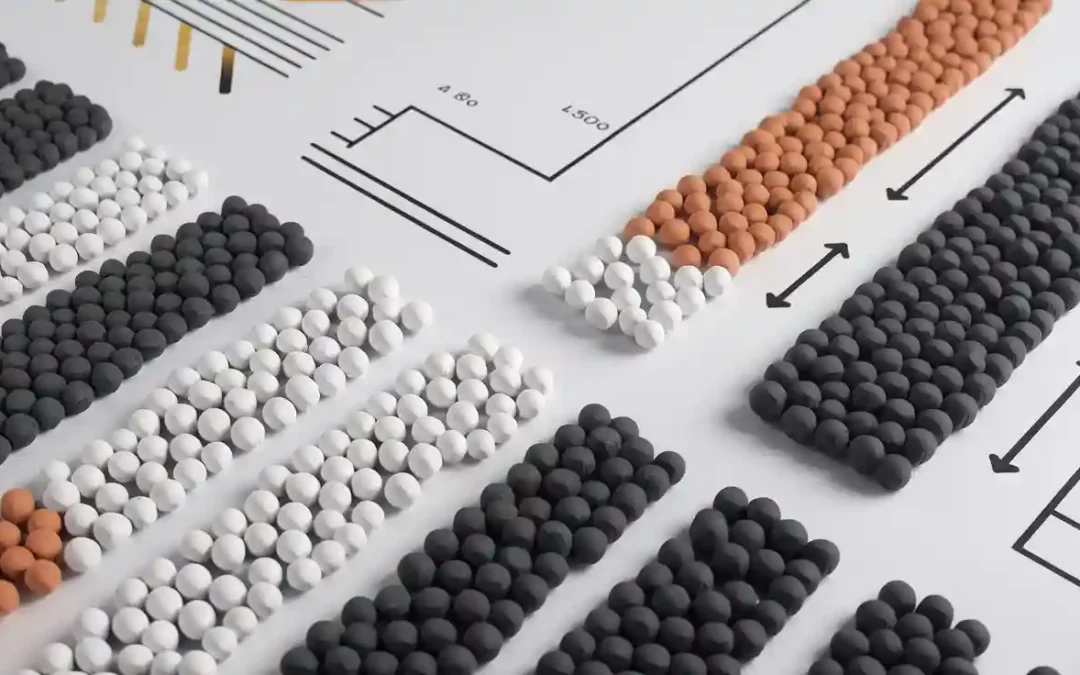
Manganese dioxide particle size distribution is very important for how well batteries and catalysis work. Smaller manganese dioxide particles have more surface area. This helps reactions happen faster and makes catalytic activity better. Battery tests show that smaller particles almost triple the starting capacity. But, they also make the battery lose capacity faster and increase internal resistance as time goes on. In catalysis, smaller particles always make reactions go faster. They do this by giving more active sites. So, particle size distribution is a key part of making industrial processes work better.
Smaller manganese dioxide particles have more surface area. This makes reactions happen faster. It helps batteries and catalysts work better.
Mixing fine and coarse particles keeps reactions quick. It also makes the material stable. This helps batteries last longer. Catalysts also work well.
Medium-sized particles with a small size range help batteries give steady energy. They also improve battery capacity. Batteries last longer too.
Controlling particle size during manufacturing is important. Changing temperature, chemicals, and methods can help. This makes batteries, water treatment, and medicine work better.
Measuring particle size with tools like laser analyzers is helpful. It lets engineers make manganese dioxide products that are safe and reliable.
Particle Size Distribution
Definition and Importance
Particle size distribution tells us how big or small the particles are in a material. In manganese dioxide nanomaterials, this affects how the material works in different uses. If the particle sizes are close together, most particles are about the same size. If the sizes are spread out, there are both small and large particles. Fine particles have more surface area, so reactions happen faster. Coarse particles make the material more stable and can slow down reactions. The right mix of fine and coarse particles helps manganese dioxide work better in batteries and catalysis. Scientists and engineers watch particle size distribution closely because it changes how manganese dioxide works in real products.
Manganese Dioxide Particle Size
Manganese dioxide particle size is important for how well it works. Commercial manganese dioxide, especially chemical manganese dioxide, usually has round particles with a gamma crystalline structure. The speed of heating during making controls the particle size. Slow heating makes bigger, more even particles. Fast heating makes smaller particles. Many manganese dioxide nanoparticles have tiny, hair-like bumps on their surfaces. These bumps give more surface area, which helps in batteries. Sometimes, hybrid particles form when electrolytic manganese dioxide starts the reaction. These hybrids have both high density and high surface area.
Manganese dioxide nanoparticles in commercial products are usually between 28 nm and 50 nm. Transmission electron microscopy checks these sizes. The table below shows common particle sizes for manganese dioxide used in catalysis:
Application | Particle Size Range (nm) | Notes |
|---|---|---|
Catalysis | Highly spread out, often not crystal | |
Commercial Nano | 28 – 50 | Matches what suppliers say |
Manganese dioxide nanomaterials with lots of fine particles and nanoparticles give more places for reactions. But, having both fine and coarse particles helps balance how fast reactions happen and how stable the material is. This balance is important for manganese dioxide used in batteries, catalysis, and other areas.
Influence of Particle Size Distribution
Surface Area and Reactivity
Particle size distribution is very important for manganese dioxide nanomaterials. Fine particles and nanoparticles have more surface area than coarse particles. More surface area means there are more places for reactions to happen. Manganese dioxide nanoparticles with less crystal structure or more amorphous shapes have higher surface areas. These shapes help them grab metals better and make oxidation stronger. The type of crystal, phase, and shape also change how particle size affects reactivity.
Note: Things like pH in the environment can change the surface charge and how much manganese dioxide can adsorb. This links changes in surface area to how reactive it is.
Layered and tunneled nanostructures, such as birnessites and cryptomelane, have lower surface energy and are more stable when small. These features help them work better in jobs that need high reactivity. If manganese dioxide touches other oxides or natural organic matter, some active sites can get blocked. This makes the nanoparticles less efficient. In nature, when manganese dioxide sticks to other metal oxides like Al2O3, it can block active sites and lower how well it reacts.
Fine particles give more surface area and reactivity.
Coarse particles make the material more stable but have fewer active sites.
Nanoparticles with layered structures are more stable and reactive.
Electrochemical Performance
Particle size distribution affects how batteries work. Electrodes with many different particle sizes and big particles have higher resistance and break down faster. This makes batteries work worse and not last as long. Very small manganese dioxide nanoparticles can lose capacity because a strong solid layer forms on them. Coarse particles can cause lithium to build up and slow down reactions, which lowers efficiency.
Tests show that making lithium manganese oxide powders smaller increases capacity and efficiency. Smaller nanoparticles have more surface area for lithium ions to move and fit into the structure. But, smaller particles also make the spaces between them smaller. This makes it harder for lithium ions to move out and needs more force to remove them.
Tip: The best battery performance and longer life come from using medium-sized particles with sizes close together. This balance helps capacity, speed, and stops the battery from breaking down too fast.
Conductivity and Ion Transport
Smaller manganese dioxide nanoparticles help electricity and ions move better. Fine particles and nanostructures make more paths for ions, so MnO2 works better. Nano-sized manganese dioxide, especially under 10 nm, has more surface area and active spots for redox reactions. This makes reactions and ion movement faster.
But, very tiny nanoparticles can dissolve quickly and do not last long. Bigger coarse particles have less surface area and lower capacitance, so reactions are slower and conductivity drops. Special nanomaterials with the right structure and particle size can be both efficient and stable.
Nanoparticles help ions and electricity move better.
Fine particles make MnO2 work more efficiently.
Coarse particles slow down conductivity and ion movement.
Theranostic uses get better ion movement with manganese dioxide nanomaterials.
How well manganese dioxide works depends on the mix of fine and coarse particles, the nanostructure, and what it is used for. Engineers and scientists must think about these things to make manganese dioxide nanoparticles work best in batteries, catalysis, and other uses.
Performance in Applications
Batteries
Manganese dioxide nanoparticles are important for batteries. Engineers use them to make batteries work better. Smaller particles have more surface area. This means more reactions can happen. Batteries with small particles start with high capacity. They also discharge faster. But, very tiny particles can lose capacity quickly. They can also make resistance go up over time. Medium-sized nanoparticles help batteries last longer. They also keep discharge fast.
Battery makers watch particle size closely. They want to use MnO2 as well as possible. If all particles are the same size, batteries work more steadily. This helps batteries last longer. Big particles slow down discharge. They also make batteries less efficient. Mixing small and big particles can help batteries work better. The voltage when the battery is not used depends on particle size. Smaller nanoparticles give higher voltage at first.
Tip: Picking the best particle size mix for manganese dioxide helps batteries work well and last longer.
Catalysis
Manganese dioxide nanoparticles help chemical reactions go faster. Scientists found that smaller nanoparticles have more surface area. This gives more places for reactions to happen. The table below shows what studies found about catalytic activity:
Aspect Studied | Findings |
|---|---|
Particle Size | Crystallite size up to ~15 nm in radiolytically formed nano-MnO2 |
Surface Area | Nano-MnO2 has 4–13 times higher specific surface area than commercial MnO2 |
OH-Groups Adsorption | Increased number of OH-groups adsorbed on oxide surface with decreasing particle size |
Catalytic Activity | Higher catalytic activity in decomposition of H2O2 and N2H4 correlated with smaller particle size and higher surface area |
Morphology & Pore Size | Characterized by SEM, BET, and FTIR; morphology affects catalytic performance |
Synthesis Method | Radiolytic synthesis allows control over particle size and shape, influencing catalytic activity |
Manganese dioxide nanoparticles shaped like rods work better in CO oxidation. The way they react depends on their size and shape. Smaller and well-shaped particles help reactions happen faster. They also give more places for electrons to move.
Catalysts with the right particle size help chemical treatments work well. These nanomaterials help factories get faster reactions and more product. Theranostic uses also get better results. High surface area helps with both finding and treating problems.
Water Treatment and Other Uses
Water cleaning systems use manganese dioxide nanoparticles to take out bad stuff. How well they work depends on particle size. Studies show that the type of MnO2 and its size change how much manganese gets removed from water. Forms like birnessite have small sizes and lots of surface area. These features help them grab and change harmful things.
Manganese doping in Prussian blue analogues makes particles smaller and more even.
Smaller and even nanoparticles have more surface area and move ions faster.
Smaller particles make the surface energy spread out. This helps more ions stick and react.
Better electrochemical properties from manganese doping help clean water faster and better.
Tiny holes from smaller particles help ions move more easily.
Tests show manganese-doped materials hold more charge and let ions move with less resistance.
Engineers pick manganese dioxide nanoparticles with the best size mix. This helps clean water better. These nanomaterials remove heavy metals and other bad stuff. Theranostic uses also get better ion movement and reactions with the right nanoparticles.
Optimal Particle Size Distribution
Research and Industry Standards
Researchers and engineers want to make manganese dioxide work better. They look at particle size distribution to do this. In battery factories, commercial electrolytic manganese dioxide starts with many different particle sizes. The average secondary particle size is about 18.01 μm. Engineers use sand milling and spray drying to make the sizes closer together. After these steps, the average size drops to about 2.95 μm. This helps batteries work better. Batteries react faster and conduct electricity more easily. Changing crystal phases, like γ-MnO2 and β-MnO2, also helps conductivity and battery capacity. The battery industry uses these steps to get steady results. In catalysis, there is no perfect particle size distribution yet. Scientists are still learning how size changes catalytic activity. They use special ways to control particle size and shape. These methods help make manganese dioxide with the right features for each job.
Tip: Making particle sizes closer together with careful synthesis makes batteries work better and products more reliable.
Trade-offs and Limitations
Picking the best particle size means balancing surface area and stability. Smaller manganese dioxide nanoparticles have higher surface free energy. This makes them adsorb more and work harder. But, these small particles can attract proteins and form a protein corona. The corona makes the body clear them out and lowers stability. For example, hollow manganese dioxide nanoparticles around 100 nm can hold more material but stick together easily. Covering these particles with human serum albumin makes them bigger and stops the protein corona. This coating keeps them stable and working well. Engineers must think about the good and bad of high surface area. They also worry about particles sticking together or being cleared away. Synthesis methods, like covering with proteins, help keep particles stable and active. The right way to make manganese dioxide helps it work well in batteries, catalysis, and other uses.
Smaller particles work harder but are less stable.
Coating and careful synthesis make particles stable and strong.
Engineers use synthesis to balance surface area and strength.
Measurement and Control
Measurement Methods
It is very important to measure manganese dioxide particle size correctly. This helps make batteries, catalysts, and water treatment work better. Laser particle analyzers, like the HORIBA Partica LA-960V2, are used for this. They put nanoparticles in a liquid and shine a laser through it. The analyzer sees how the light scatters at different angles. Math models, such as Mie or Fraunhofer theory, help figure out the size of the nanoparticles. This way is fast, does not damage the sample, and works automatically. It can measure sizes from very tiny to much bigger particles. Good sample prep and calibration are needed for good results.
Dynamic Light Scattering, or DLS, is another lab method. Tools like the Malvern Zetasizer Nano ZS measure the hydrodynamic diameter of nanoparticles. DLS is good for comparing batches and checking if nanoparticles stay stable in different liquids. The same tool can also measure zeta potential. This shows how stable the nanoparticles are at different pH levels. In factories, other tools like Differential Mobility Analyzer and APi-TOF-MS are used. These tools sort and measure nanoparticles in the air by their electrical charge and mass. These ways help scientists and engineers watch particle size during making and treating.
Controlling Particle Size
Engineers change manganese dioxide particle size while making it. This helps it work better in batteries, catalysts, and water cleaning. Microfluidic synthesis uses tannic acid to reduce and PEG2000 to keep particles apart. Changing how much KMnO4, tannic acid, and PEG2000 is used controls the size and how the particles move. Green synthesis uses plant extracts, pH, heat, and stirring to stop clumping and control shape and surface. Chemical synthesis with chelators like DTPA also changes particle size by changing how much of each chemical is used.
Synthesis Method | Key Factors | Effect on Particle Size Distribution |
|---|---|---|
Green synthesis | Plant extract, pH, temperature, time, agitation, precursor concentration | Controls size, shape, and surface properties |
DTPA:KMnO4 ratio | Produces stable, nano-sized particles | |
Microfluidic synthesis | KMnO4, tannic acid, PEG2000 concentrations | Reduces size, improves dispersibility |
Adding metals like iron, copper, or vanadium changes the surface area and shape of the nanoparticles. Small amounts make core-shell shapes. More metal makes hollow spheres. The temperature during making is also important. High heat in hydrothermal synthesis makes even nanorods and helps control delivery and treatment. By changing these things, scientists can make nanoparticles the right size for good delivery, better treatment, and steady performance in real life.
Tip: Controlling how manganese dioxide is made, what is added, and the temperature gives nanoparticles the best size for new delivery and treatment uses.
Practical Recommendations
Selecting Particle Size Distribution
Picking the right particle size distribution depends on what you need. Engineers often use both fine and coarse nanoparticles together. This mix helps balance fast reactions and keeps the material stable. Fine nanoparticles have more surface area. This helps reactions go faster in batteries and water cleaning. Coarse particles make the material last longer and stop it from breaking down quickly. For water cleaning, more fine nanoparticles help ions move faster and clean water better. In batteries, using particles that are close in size helps give steady energy and makes batteries last longer.
Tip: Always pick the particle size distribution that fits what you need to treat or deliver. This helps things work best in real life.
A table can help you choose:
Application | Preferred Particle Size | Benefit for Delivery/Treatment |
|---|---|---|
Batteries | Medium, narrow range | Steady energy delivery, long life |
Water Treatment | Fine, broad range | Fast ion delivery, high removal rate |
Catalysis | Fine nanoparticles | Quick reaction, efficient treatment |
Engineering for Performance
Engineers use special ways to control manganese dioxide particle size. This helps make it work better. Suspension electrolysis with stirring lets them change the size and shape of nanoparticles. If they set the amount at 0.8 g∙L−1 and stir at 300 rpm, the crystal shape changes. It goes from pine-needle-like to daisy-like. This makes more γ-MnO2, makes crystals stronger, and helps them handle heat. The surface area gets bigger, and resistance in the solution goes down. These changes help things move better, give more energy, and make treatment stronger.
How nanoparticles are made also changes how they work in medicine. Smaller, well-shaped nanoparticles move through the body more easily. They reach the right spot faster. In cancer treatment, making nanoparticles the right way helps them bring drugs right to cancer cells. This makes treatment better and lowers side effects. Engineers change the heat, stirring speed, and chemical amounts to make delivery and treatment work best.
Note: Careful work during making helps nanoparticles deliver and treat well in batteries, water cleaning, and medicine.
Manganese dioxide particle size distribution changes how well things work. It matters in batteries, catalysis, and water cleaning. Engineers check and change particle size to get better results. Smaller nanoparticles have more surface area. This helps batteries work better and hold more medicine. Experts say to match how you make particles with what you need. They also say to use safe ways and make particles for special jobs. The table below shows how particle size changes how things work and affects health.
Metric | Particle Size Category | Key Findings |
|---|---|---|
Electrochemical Performance | Small nanoparticles | Higher capacity, better delivery |
Drug Encapsulation Efficiency | Uniform nanoparticles | |
Industrial Exposure | Respirable particulate |
FAQ
What is the ideal particle size for manganese dioxide in batteries?
Engineers usually pick medium-sized manganese dioxide nanoparticles for batteries. This size gives both good capacity and longer battery life. When all particles are about the same size, batteries work more smoothly and give steady power.
How does particle size distribution affect water treatment?
Fine manganese dioxide nanoparticles have more surface area. This helps ions move faster and removes bad stuff from water better. Using both fine and coarse particles together can keep the system stable during water cleaning.
Why do smaller nanoparticles sometimes reduce battery lifespan?
Very small nanoparticles have more places for reactions. But, they can break down or dissolve faster. This makes resistance go up and batteries not last as long. Engineers need to pick a size that works well and lasts longer.
Can manganese dioxide nanoparticles be used in medicine?
Scientists use manganese dioxide nanoparticles in some medical treatments. These include finding and treating tumors. The small size helps send medicine right to the spot and makes cancer treatment more accurate.
How do engineers control manganese dioxide particle size?
Engineers change how they make manganese dioxide to get the right size. They adjust temperature, chemicals, and methods like microfluidic synthesis or doping. These steps help make nanoparticles with the size and shape needed for each job.
Related Products

manganese dioxide

manganese carbonate

manganese sand
Related Posts

I am Edward lee, founder of manganesesupply( btlnewmaterial) , with more than 15 years experience in manganese products R&D and international sales, I helped more than 50+ corporates and am devoted to providing solutions to clients business.