Manganese sulfate has the chemical formula MnSO₄. It has one manganese atom, one sulfur atom, and four oxygen atoms. Its look changes by form. It is white crystals when dry. It is a pale pink solid when wet. This compound is used in farming, animal feed, factories, and health. For example, it helps soil grow crops better. It helps animals get good nutrition. It is used in medicine and batteries.
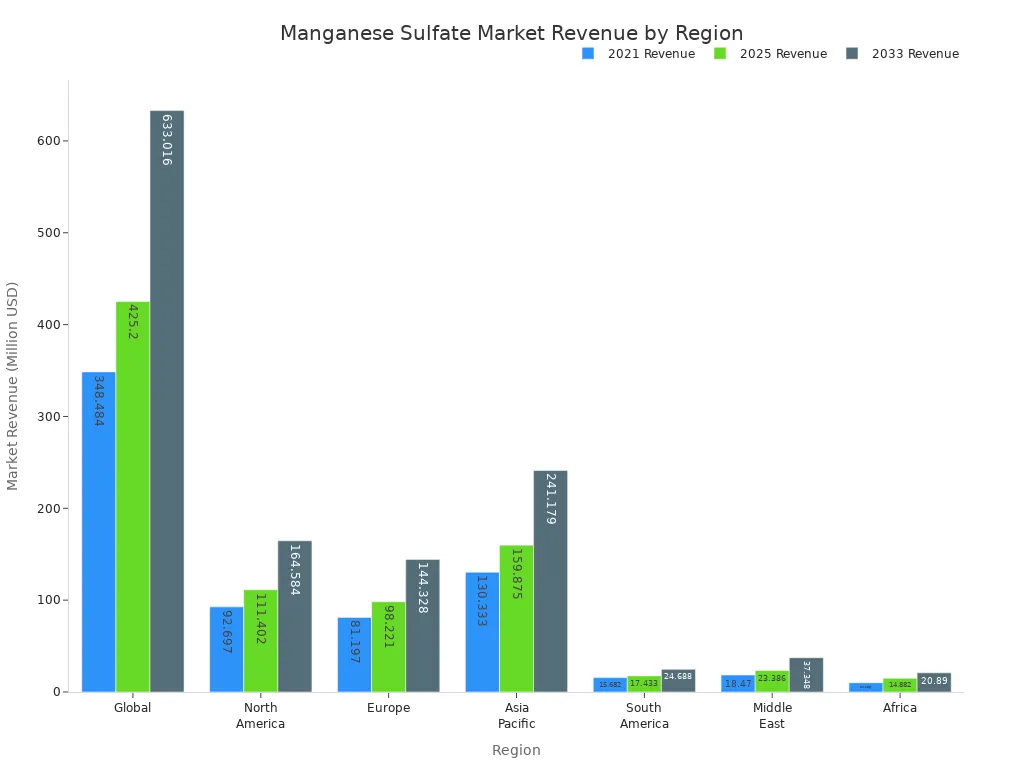
Sector / Application | Main Uses of Manganese Sulfate | Supporting Statistics and Insights |
|---|---|---|
Agriculture | It is a micronutrient in fertilizers. It fixes manganese problems in soil. It helps crops grow, make food, and give more yield. Governments want farmers to use these fertilizers. This helps make more food. | The market was USD 1.2 billion in 2023. Asia Pacific uses the most because of big farms. The market may grow 5.1% each year. It could reach USD 1.8 billion by 2032. |
Animal Feed | It is an important mineral for animals. It helps them grow, have babies, build bones, and use enzymes. It stops health problems from not having enough manganese. | More people want meat and dairy. This makes more need for manganese sulfate in animal feed. North America and Europe are growing fast because of better farming. |
Industry | It is used to make other manganese compounds. It is also used more in batteries for electric cars. | The market grows because of more factories and electric cars. More people want industrial manganese sulfate for clean energy. |
Human Health (Pharmaceuticals) | It is in some medicines and health supplements. It gives manganese for healthy bones and body functions. | This part is smaller but keeps growing. People care more about health and want more supplements. |
Knowing about manganese sulfate helps people pick the best choices for farming, nutrition, and factories.
Manganese sulfate helps plants grow strong. It fixes soil problems. It makes crops grow more.
It helps animals stay healthy. It makes bones stronger. It helps animals digest food better when in feed.
Factories use manganese sulfate for batteries. They use it for ceramics. They use it for fuel additives.
Workers should wear gloves and masks. This keeps them safe from health risks.
Using manganese sulfate the right way protects soil. It keeps water safe. It helps the environment stay healthy.
Manganese Sulfate Properties
Chemical Structure
Manganese(ii) sulfate’s formula is MnSO₄. Each molecule has one manganese, one sulfur, and four oxygen atoms. This structure lets manganese join with other elements. It can make different compounds. Manganese(ii) sulfate dissolves fast in water. This makes it more useful than manganese dioxide. It can also form special compounds with water and other molecules. These features make it good for fertilizers, animal feed, and batteries. The structure helps it react with acids and water. This is why it is used in many industries and farming.
Below is a table with important facts about manganese sulfate:
Property | Details |
|---|---|
Chemical formula | MnSO₄ |
Molar mass | 151.001 g/mol (anhydrous), 169.02 g/mol (monohydrate), 223.07 g/mol (tetrahydrate), 277.11 g/mol (heptahydrate) |
Appearance | White crystals (anhydrous), pale pink solid (hydrates) |
Density | 3.25 g/cm³ (anhydrous), 2.95 g/cm³ (monohydrate), 2.107 g/cm³ (tetrahydrate) |
Melting point | 710 °C (anhydrous), 27 °C (tetrahydrate) |
Boiling point | 850 °C (anhydrous) |
Solubility in water | 52 g/100 mL (5 °C), 70 g/100 mL (70 °C) |
Solubility in solvents | Very slightly soluble in methanol, insoluble in ether and ethanol |
Crystal structure | Orthogonal (anhydrous), monoclinic (monohydrate and tetrahydrate) |
Chemical reactions | Reacts with water and sulfuric acid to form useful compounds |
Note: These facts show why manganese(ii) sulfate works well in fertilizers, batteries, and animal supplements.
Forms and Solubility
Manganese sulfate comes as powder or granules. These forms help people choose what works best. Powder mixes with water very fast. Granules are easier to use and spread.
Manganese(ii) sulfate mixes well with water. This helps plants and animals take it in easily.
Farmers use it to fix soil that needs manganese. The water-mixing type helps crops grow strong.
In animal feed, it helps animals get enough manganese for bones and body health.
Factories use manganese(ii) sulfate in batteries and cleaning water. Its ability to mix with water helps remove bad stuff and helps chemical changes.
Manganous sulfate is another name for manganese(ii) sulfate. It is picked because it is easy to use and works well in many jobs.
Choosing powder or granules depends on how it will be used. Both types make manganese sulfate helpful in farming, animal food, and factories.
Agricultural Benefits of Manganese Sulfate
Manganese sulfate helps farming in many ways. Farmers use it to fix soil and help plants grow. This nutrient is needed for healthy crops and good harvests. It makes soil better and helps plants give more food.
Soil Fertilizer
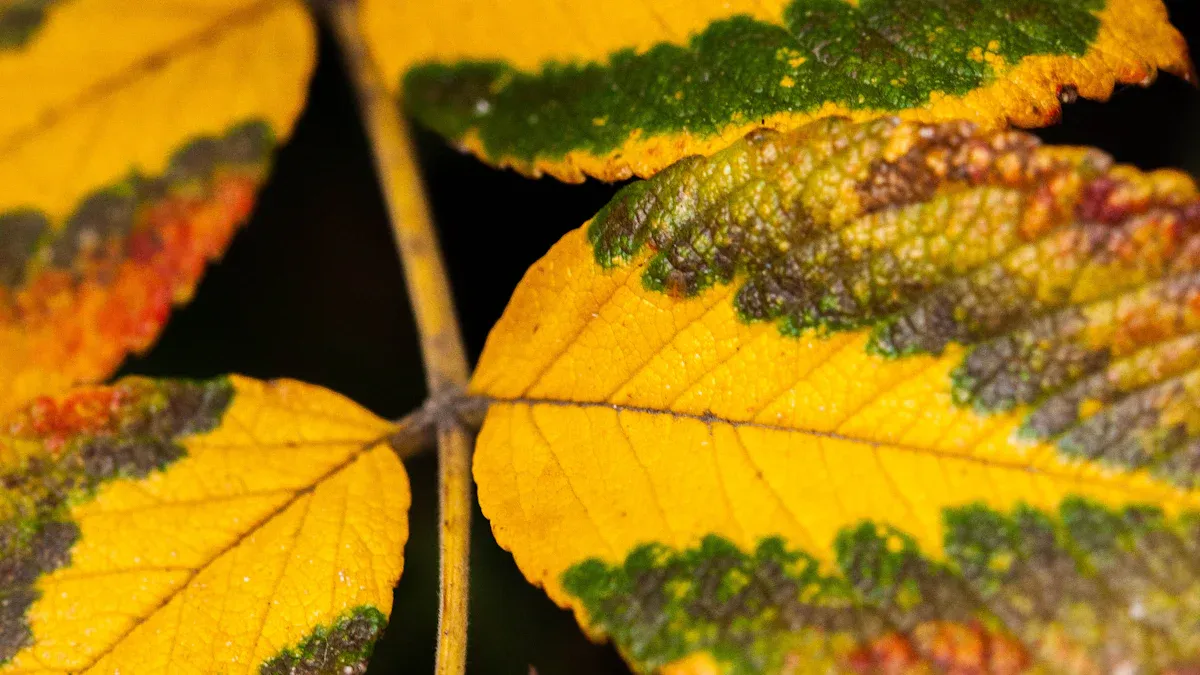
Manganese sulfate is a main fertilizer for many farms. It fixes soil problems that stop plants from growing well. If soil does not have enough manganese, plants get yellow leaves and weak stems. This happens a lot in sandy soil or when the soil pH is high. Farmers add manganese sulfate to give plants what they need.
Farmers can use manganese sulfate in different ways. They can use it as granules, powder, or spray on leaves. Each way has its own good points and fits different needs. The table below shows how much to use and how to use it for different crops:
Crop Types | Application Form | Application Method | Recommended Rate (lbs/acre) | Notes |
|---|---|---|---|---|
Tomatoes, Peppers, Brassicas | Manganese Sulfate (28-32% Mn) | Soil Broadcast or Banded | Broadcast: 20-25 lbs/acre | Pre-planting corrections; soil pH 6.0-6.8 optimal; avoid over-liming to prevent Mn deficiency |
Tomatoes, Peppers, Brassicas | Manganese Sulfate or Chelated Manganese (5-12% Mn) | Foliar Spray | 1-2 lbs/acre | Used for in-season deficiency correction during critical growth stages (flowering, fruit set, head formation) |
Tomatoes, Peppers, Brassicas | Manganese Sulfate | Fertigation (via drip irrigation) | Variable, split applications recommended | Effective in sandy soils to minimize leaching and deliver Mn directly to root zone |
Tip: Test your soil and plants before using manganese sulfate. This stops you from using too much and keeps crops safe.
Farmers should keep soil pH between 6.0 and 6.8 for best results. Too much lime or calcium can block manganese from getting to plants. Using the right fertilizer and watering helps plants take in this nutrient. Spraying leaves works fast to fix problems you can see. Testing often helps farmers change how much they use and keeps plants safe.
Crop Yield Improvement
Manganese sulfate helps plants make food and grow strong. It is important for photosynthesis and enzyme work. When crops get enough manganese, they make more fruit and better harvests.
New studies show manganese sulfate with iron helps citrus crops. In 2025, a study in Punjab tested sprays on Daisy mandarin trees. The best results came from spraying both manganese sulfate and ferrous sulfate together. Trees with this spray had the biggest fruit, most fruits, and highest yield.
Treatment Description | Fruit Weight (g) | Number of Fruits per Tree | Yield per Tree (kg) |
|---|---|---|---|
Control (no spray) | ~107 | ~374 | ~40 |
0.3% MnSO₄ alone | ~132 | ~393 | ~52 |
0.3% FeSO₄ alone | ~139 | ~415 | ~58 |
0.3% MnSO₄ + 0.3% FeSO₄ (optimal combo) | ~157 | ~480 | ~75 |
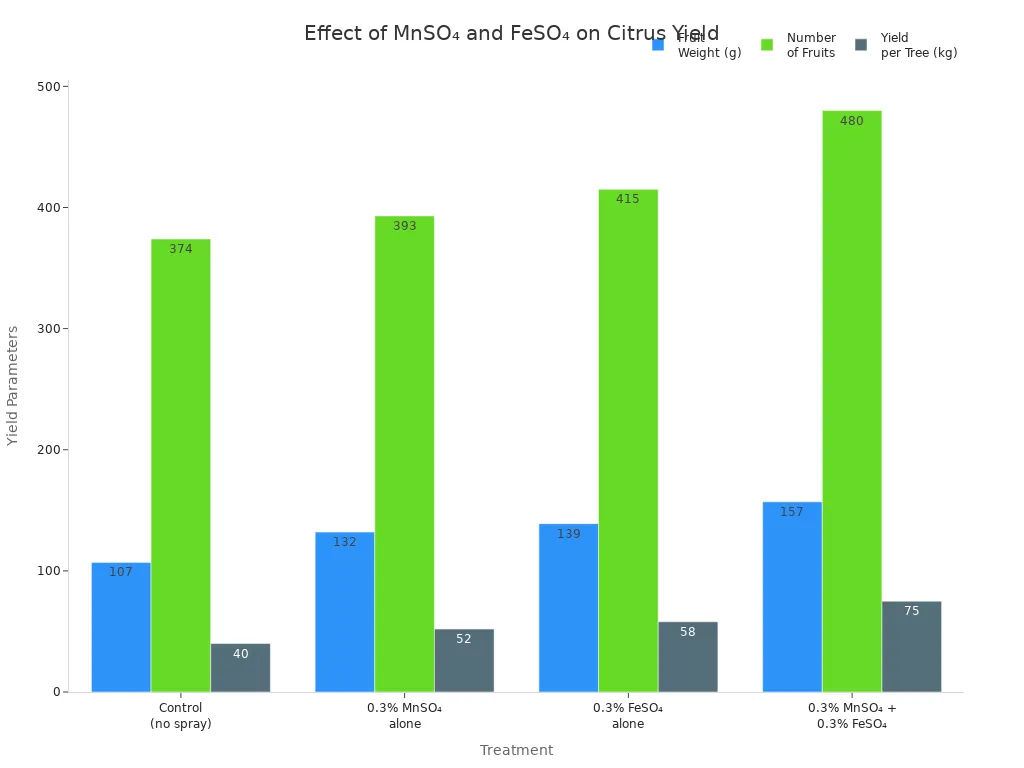
These results show manganese sulfate can increase yield and fruit quality. Spraying leaves helps plants get nutrients fast. This works well for fruit crops that need quick fixes.
Note: Always follow safety rules when using manganese sulfate. Wear gloves and do not breathe in dust. Keep it dry and away from kids and pets.
Manganese sulfate helps farmers fix soil, grow healthy crops, and get better yields. These uses make it a good fertilizer for many crops.
Animal Feed Applications
Livestock Nutrition
Animal feed helps keep farm animals healthy. Farmers add supplements to animal food. This makes sure animals get all their nutrients. Manganese is important for cows and sheep. It helps enzymes work in the body. It also helps animals digest food. Manganese keeps nerves working right. Manganese sulfate is used in feed. Animals can absorb it easily.
The table below explains how manganese sulfate helps animals. It also shows how experts check if it works:
Aspect | Role / Effect in Livestock Nutrition | Measurement of Effectiveness |
|---|---|---|
Biological Role | Needed mineral; helps enzymes; protects cells | – |
Growth Performance | No big change in weight or growth at normal levels | Growth checks (body weight, daily gain, feed ratio) |
Liver Manganese Concentration | Goes up with more manganese in feed | Liver tests for manganese levels |
Hepatic Enzyme Activity | Makes liver enzymes work better | Tests on liver tissue |
Hepatic Gene Expression | Increases gene activity for cell protection | Gene tests |
Serum Metabolites | Checks blood sugar and other things | Blood tests |
Overall Conclusion | Helps metabolism and keeps cells healthy | Tests on liver and blood |
Farmers use different amounts for each animal. Beef cattle often get about 2,000 ppm of manganese in their mix. Dairy cows may need 14-75 ppm. This depends on age and milk amount. These uses help animals stay healthy and do well.
Deficiency Prevention
Good feed stops many animal health problems. Manganese is needed for strong bones and good fertility. It helps enzymes work right. If animals do not get enough manganese, they may have weak bones. Their legs may twist or they may not grow well. Other problems are small babies, stillbirths, or trouble having calves.
Manganese in feed keeps bones strong and healthy.
It helps animals have healthy babies and lowers abortion risk.
Feed with manganese sulfate works better than some other types.
Animals absorb manganese sulfate easily.
Grass alone may not give enough manganese, so adding it helps.
Too much phosphorus, calcium, or iron can block manganese. Farmers must balance all nutrients.
Adding manganese sulfate to animal feed has many good effects. It helps stop diseases from lack of manganese. It keeps farm animals healthy.
Industrial and Chemical Uses of Manganese(II) Sulfate
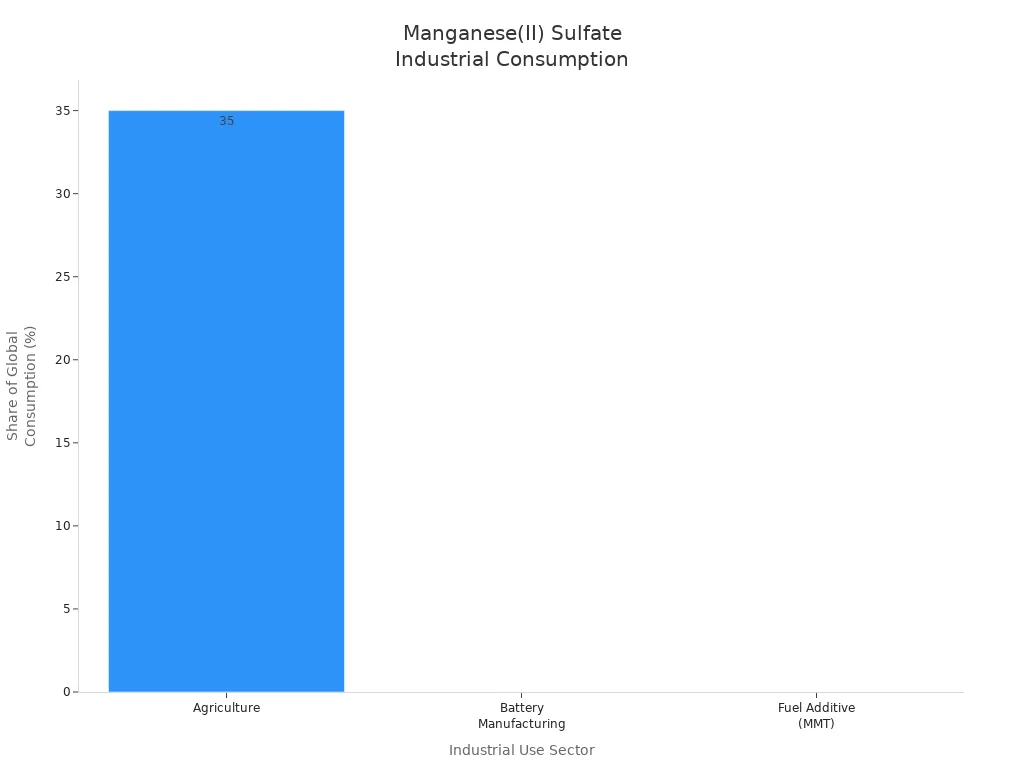
Manganese(ii) sulfate is important in many industries. Its special features make it useful for many jobs. The table below shows how companies use it and how much they need.
Industrial Use Sector | Description | Scale of Consumption / Market Share / Impact |
|---|---|---|
Agriculture | Used mostly as fertilizer and animal food to fix manganese problems in soil. | |
Battery Manufacturing | Needed for lithium-ion batteries in electric cars and energy storage. | This part is growing fastest; more electric cars mean more need; Asia Pacific leads. |
Fuel Additive (MMT) | Added to gasoline to help engines run better. | About half of China’s refineries use manganese compounds like MMT. |
Ceramics, Glazes, Varnishes | Used to make glazes, varnishes, ceramics, and some crop sprays. | These are smaller but still important uses. |
Global Production | About 2.5 million metric tons made in 2022. | Manganese sulfate is needed for many jobs in different areas. |
Battery Manufacturing
Battery companies use manganese(ii) sulfate to make pure materials for lithium-ion batteries. These batteries power electric cars, storage systems, and electronics. The compound helps make battery parts called cathodes, like lithium manganese oxide and lithium nickel manganese cobalt oxide. In 2024, over 70% of manganese(ii) sulfate is used for lithium-ion batteries. This market is growing quickly, especially in Asia Pacific. Companies now work to make the compound even more pure, over 99.5%, for safer and better batteries.
Aspect | Details |
|---|---|
Utilization in Battery Manufacturing | Used to make pure manganese sulfate for battery cathodes (LMO, NMC) |
Key Battery Chemistries | Lithium manganese oxide (LMO), lithium nickel manganese cobalt oxide (NMC) |
Applications | Electric cars, energy storage, electronics, medical tools, backup power |
Market Share by Application | Lithium-ion batteries use more than 70% of manganese sulfate (2024) |
Market Growth Drivers | More electric cars, more clean energy, higher need for pure manganese sulfate |
Purity Trends | Moving to over 99.5% purity for better battery safety and performance |
Note: More electric cars and clean energy storage make this market grow fast.
Ceramics and Fungicides
Factories use manganese(ii) sulfate in ceramics, glazes, and varnishes. It gives color and makes ceramic items look better. The compound is also in some fungicides. These help protect crops from bad fungi and keep plants healthy. These uses are smaller than batteries or farming, but they are still needed in many places.
Other Industrial Uses
Manganese(ii) sulfate is used as a helper in chemical factories. It makes reactions happen faster and helps save time. Water plants use it to take out iron and manganese from water, making it safer. The compound is also in fuel additives, mostly in China, to make gasoline better. As more batteries and clean energy are needed, factories want more manganese(ii) sulfate. This changes how they plan and build new places to make it.
Safety and Environmental Impact
Handling Precautions
People working with manganese sulfate need to follow safety rules. Breathing in dust or touching it a lot can hurt your body. If you are around it for a long time, it can harm your brain and nerves. Some health problems are memory loss, trouble moving, and stiff muscles. The risk depends on how much you touch or breathe in, and your health.
Workers should wear gloves, masks, and safety glasses. Good airflow keeps dust down. Washing hands after using it stops skin contact. Keep manganese sulfate in dry, closed containers to avoid spills. If it spills, clean it up fast to stop dust. Employers must teach workers how to handle it safely and what to do in emergencies.
Tip: Always check the safety label before using manganese sulfate. Training and the right gear help keep people safe.
Environmental Role
Manganese sulfate can change soil and water in farm areas. When farmers add it to soil, it makes the soil less basic and changes how metals act. This helps form iron-manganese oxides that trap bad metals like cadmium and arsenic. These oxides stop the metals from getting into rice and other crops. Manganese sulfate also changes the types of bacteria in the soil. It helps bacteria that make toxic metals safer for plants.
In rivers and lakes, manganese moves easily because Mn(II) dissolves well. Planting more conifers or changing land can send more manganese into water. Acidic soil and water make this happen faster. Too much manganese in water can hurt fish and other animals. But some tiny living things can break down manganese and make it safer. These natural ways help protect the environment and people.
Farmers and factories need to think about these effects when using manganese sulfate. Careful use and checking help keep soil and water safe.
This compound helps in farming, animal care, factories, and medicine. Farmers get better crops and soil. Animals grow stronger bones and get healthier. Factories use it for batteries, ceramics, and cleaning water. New studies find safer ways to use it.
As technology gets better, this compound will stay useful for food, energy, and health everywhere.
FAQ
What is manganese sulfate used for in farming?
Farmers add manganese sulfate to soil missing manganese. This helps plants grow better and make more food. It is good for crops like citrus, tomatoes, and grains.
Is manganese sulfate safe for animals?
Manganese sulfate is safe for animals if used right. It helps animals have strong bones and grow well. Farmers should listen to experts so they do not use too much.
Can people use manganese sulfate as a supplement?
Doctors sometimes put manganese sulfate in vitamins or medicine. It helps the body work right and keeps bones strong. People should only take it if a doctor tells them to.
How should workers handle manganese sulfate safely?
Workers need gloves, masks, and safety glasses. Air should move well to keep dust down. Washing hands after using it keeps skin safe.
Does manganese sulfate harm the environment?
Manganese sulfate can change soil and water if used a lot. Farmers and factories must use it with care. Testing often helps keep plants, animals, and people safe.
Related Products

manganese dioxide

manganese carbonate

manganese sand
Related Posts

I am Edward lee, founder of manganesesupply( btlnewmaterial) , with more than 15 years experience in manganese products R&D and international sales, I helped more than 50+ corporates and am devoted to providing solutions to clients business.