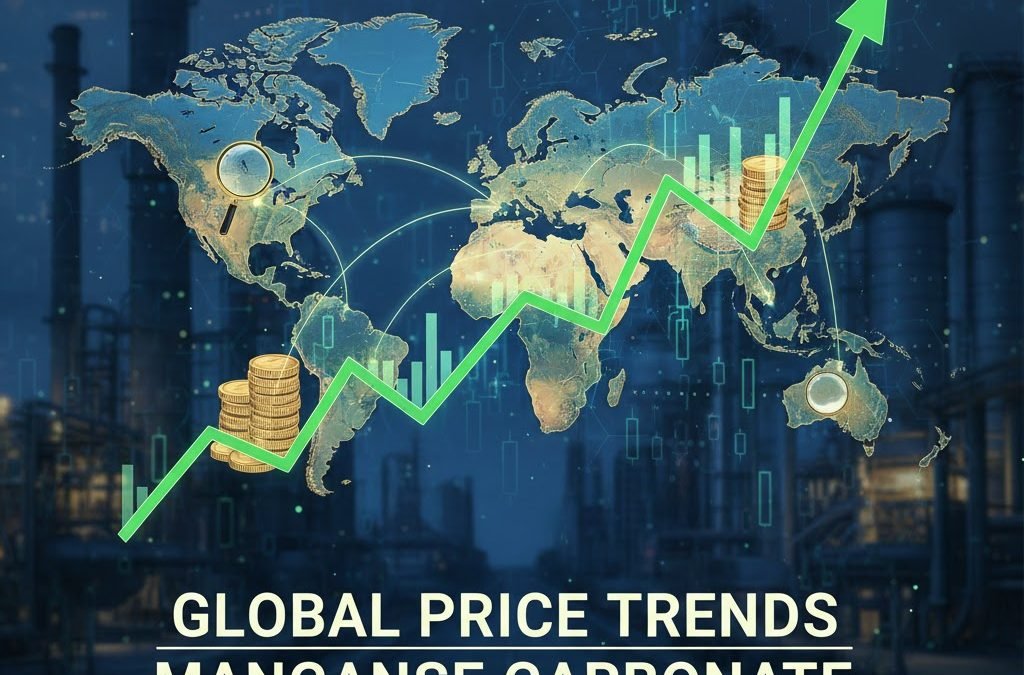
In 2025, manganese carbonate (MnCO₃) prices remain highly uneven worldwide.
China: USD 620–1,200/ton
India: USD 800–1,500/ton
Southeast Asia: USD 1,500–2,800/ton
United States: USD 4,800–6,200/ton
Europe: USD 5,000–6,500/ton
China continues to dominate global supply due to low production costs and abundant ore resources. In contrast, the United States and Europe record the world’s highest prices, mainly because of import logistics, tariffs, environmental compliance, and demand for high-purity, battery-grade materials.
2. Current Global Price Overview (2025)
| Region | Price Range (USD/ton) | Remarks |
|---|---|---|
| China | 620 – 1,200 | Industrial and battery-grade both available; low labor and energy cost. |
| India | 800 – 1,500 | Mix of domestic production and imports. |
| Southeast Asia | 1,500 – 2,800 | Import-dependent, moderate demand growth. |
| United States | 4,800 – 6,200 | High-grade import costs + EV battery demand. |
| Europe | 5,000 – 6,500 | Strict environmental and purity standards; heavy logistics cost. |
Chinese domestic price serves as the base reference for global markets. The price gap between China and Western countries can exceed 400%–700% depending on grade and logistics.
3. Key Factors Driving Price Differences
3.1 Production Costs
Production cost depends mainly on ore price, chemical reagents, and energy.
In China, average electricity cost for industrial use in 2024 was 0.08 USD/kWh, while in Europe it exceeded 0.20 USD/kWh (Source: IEA, 2024).
This difference alone adds 15–25% to the European product cost.
3.2 Logistics and Tariffs
Exporting from China to Europe by sea costs around 80–120 USD/ton, plus EU import tariffs (≈5%) and local handling costs (≈150 USD/ton) (Source: Freightos Index, 2024).
For U.S. importers, total landed cost can reach +1000–1500 USD/ton higher than China’s FOB price.
3.3 Purity and Specification
Battery-grade manganese carbonate requires Mn ≥ 44%, Fe ≤ 0.01%, Moisture ≤ 0.5% (Source: GB/T 27789–2011, China National Standard).
High-purity materials require extra purification steps—raising cost by 20–35% over industrial-grade MnCO₃ used in ceramics or fertilizers.
3.4 Environmental and Regulatory Costs
EU REACH registration and U.S. EPA import compliance add 2–5% of total cost (Source: European Chemicals Agency, 2024).
Chinese plants generally operate under local emission standards (GB 25466-2010), less strict and lower-cost than EU ones.
3.5 Demand from Battery Industry
Battery-grade manganese carbonate is used as a precursor for manganese dioxide and lithium manganese oxide (LiMn₂O₄) cathodes.
In 2024, global EV battery production grew 28%, and battery-grade MnCO₃ demand rose 17% year-over-year (Source: BloombergNEF, 2025).
This demand surge keeps Western prices high due to limited refining capacity.
4. Historical Price Movement (2020–2025)
| Year | China (USD/ton) | EU (USD/ton) | US (USD/ton) | Trend Notes |
|---|---|---|---|---|
| 2020 | 550–950 | 2,500–3,200 | 2,200–3,000 | Pandemic disruptions, shipping issues. |
| 2021 | 600–1,000 | 3,200–4,500 | 3,000–4,000 | Demand recovery, freight surge. |
| 2022 | 650–1,050 | 4,000–5,500 | 4,200–5,000 | Battery market growth. |
| 2023 | 700–1,100 | 4,500–5,800 | 4,400–5,800 | Stable but tight supply. |
| 2024 | 720–1,150 | 4,800–6,000 | 4,700–6,000 | Energy costs, EV boom. |
| 2025 | 620–1,200 | 5,000–6,500 | 4,800–6,200 | Slight adjustment but high volatility. |
Source: Trading Economics, Metal.com, and industry estimates (2020–2025)
From 2020 to 2025, the average price increased 60–70% globally, mainly due to energy cost and EV demand. However, China remains the stabilizing force, with domestic price fluctuations under 15% yearly.
5. Cost Breakdown Example (Battery-Grade MnCO₃, 2025)
| Cost Component | China (USD/ton) | Europe (USD/ton) | United States (USD/ton) |
|---|---|---|---|
| Raw Material (ore, reagents) | 300 | 1,100 | 1,000 |
| Energy & Labor | 120 | 500 | 420 |
| Environmental/Compliance | 50 | 300 | 250 |
| Logistics & Tariffs | 80 | 1,000 | 1,200 |
| Profit & Misc. | 100 | 700 | 700 |
| Final Market Price | 650–1,200 | 5,000–6,500 | 4,800–6,200 |
(Source: internal manufacturing data + IEA + ECHA + Freightos, 2024)
6. Future Outlook (2026–2030)
6.1 Price Forecast
China: Expected to stabilize between 700–1,300 USD/ton, driven by steady ore supply and process optimization.
Europe/US: May stay high at 4,500–7,000 USD/ton, unless new refining capacity is established domestically.
Battery-grade materials likely to increase by 10–15% per year through 2027 due to cathode material expansion.
(Source: Fastmarkets Battery Materials Outlook, 2025)
6.2 Market Growth
The global manganese carbonate market size is projected to grow from USD 431.8 million (2024) to USD 560 million (2030), CAGR ≈4.4%.
Battery-grade segment expected to reach USD 310 million by 2030 (Reports Valuates, 2024).
6.3 New Production Regions
Vietnam and Indonesia are considering new MnCO₃ projects to reduce dependence on China.
However, infrastructure and environmental approvals are likely to delay significant output until 2027 or later.
7. Recommendations for Buyers
Track China’s market weekly. Chinese FOB prices usually move ahead of global changes.
Lock long-term contracts. If you need high-purity MnCO₃, long-term pricing can save 10–20% versus spot.
Diversify sourcing. Combine Chinese base supply with secondary local refiners for resilience.
Verify purity standards. Always check Mn content and impurity specs according to GB/T 27789–2011 or ASTM D3649.
Optimize logistics. Sea freight from Shenzhen or Qingdao to Marseille typically costs 100–120 USD/ton (Freightos, 2024).
8. Conclusion
In summary:
China remains the global benchmark supplier, offering MnCO₃ between 620–1,200 USD/ton.
Western markets face 4–6× higher prices, mainly due to logistics, purity, and environmental costs.
The global price trend is upward but stable, with a forecast growth of 4–5% annually through 2030.
Buyers seeking competitive pricing should prioritize direct partnerships with Chinese factories, ensuring purity documentation and stable shipping routes.
A reliable Chinese factory can help balance cost and quality—especially as the demand for battery-grade manganese carbonate continues to rise worldwide.
9. FAQ
Q1: What is the current global average price of manganese carbonate?
A1: As of late 2025, the average global range is USD 620–6,500 per ton, depending on region and grade
Q2: Why is the EU price 5–6× higher than China?
A2: Freight, tariffs, REACH compliance, and stricter purity requirements add heavy costs to European imports.
Q3: Which industries drive demand?
A3: EV battery materials, ceramics, fertilizers, pigments, and chemical catalysts.
Q4: What standards define battery-grade MnCO₃?
A4: Mn ≥ 44%, Fe ≤ 0.01%, moisture ≤ 0.5%, based on GB/T 27789–2011 (China) and ASTM D3649 (US).
Q5: How will prices move in 2026–2030?
A5: Likely steady growth at 4–5% per year, with China remaining the price leader and exporter of choice.
Related Products

manganese dioxide

manganese carbonate

manganese sand
Related Posts

I am Edward lee, founder of manganesesupply( btlnewmaterial) , with more than 15 years experience in manganese products R&D and international sales, I helped more than 50+ corporates and am devoted to providing solutions to clients business.