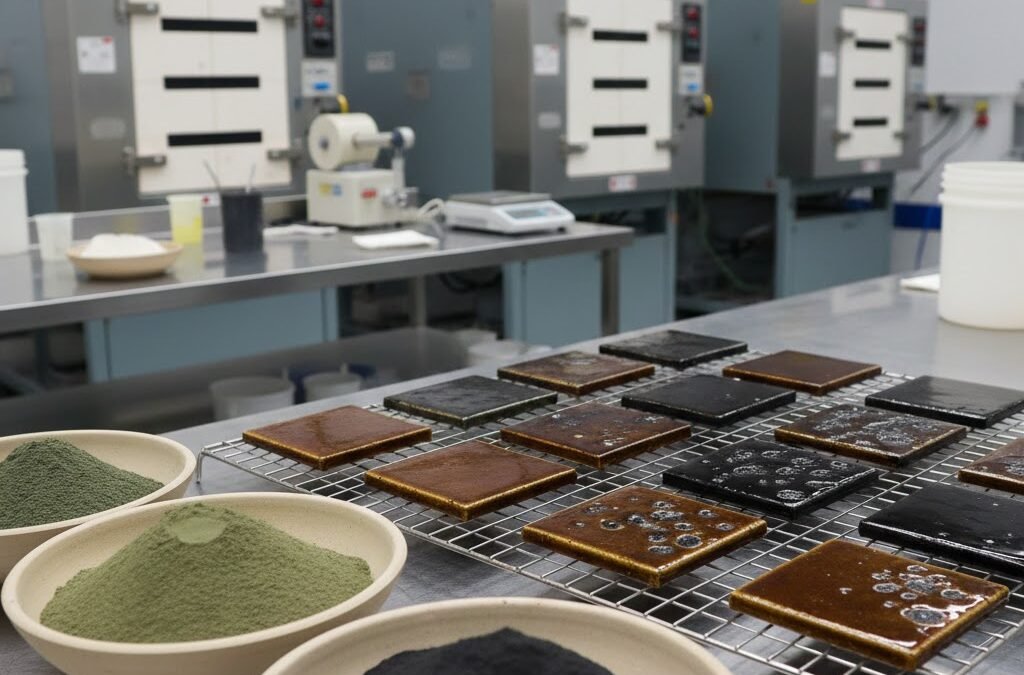
Manganese oxide plays a critical functional role in ceramic glazes and pigment systems by acting as a colorant, flux modifier, and redox-active oxide. Depending on its oxidation state, purity, and particle size, manganese oxide can generate brown, black, purple, and earth-tone hues while also influencing melt behavior and surface texture. In industrial ceramic applications, typical MnO or MnO₂ additions range from 1–8 wt% in glaze formulations, with impurity levels (Fe, Cu, Ni) often required below 200–300 ppm to ensure color consistency. Controlled manganese oxide specifications improve color reproducibility, firing stability, and batch-to-batch uniformity, making precursor quality a decisive factor for both aesthetic and process performance.
2. Technical Background: Manganese Oxide in Ceramic Systems
2.1 Chemical Forms Used in Ceramics
In ceramic glaze and pigment production, manganese is typically introduced as:
Manganese(II) oxide (MnO)
Manganese dioxide (MnO₂)
Occasionally manganese carbonate, which decomposes to MnO during firing
During kiln firing (typically 900–1,300 °C), higher-valence manganese oxides are reduced to MnO, which is the thermodynamically stable form in most glaze melts.
2.2 Role in the Glaze Matrix
Manganese oxide functions in ceramics as:
A transition-metal colorant
A secondary flux influencing melt viscosity
A redox-active oxide affecting iron and copper color development
Its behavior depends strongly on kiln atmosphere (oxidation vs. reduction) and glaze composition (alkali, boron, silica ratios).
3. Key Benefits of Manganese Oxide in Ceramic Glazes
3.1 Purity (%) → Color Stability and Reproducibility
Mechanism
Impurities such as iron, copper, or nickel can shift hue and saturation due to overlapping d–d electron transitions.
Typical ceramic-grade requirements
MnO purity: ≥98.0–99.0%
Total metallic impurities: <0.5 wt%
Fe content: <0.2 wt% (2,000 ppm) for industrial tiles
High-end pigments: <300 ppm Fe
Impact
Stable brown/black tones
Reduced batch color drift
Fewer kiln-to-kiln corrections
3.2 Particle Size (D50) → Dispersion and Color Uniformity
Mechanism
Finer manganese oxide particles disperse more evenly in glaze slurries, reducing local over-concentration and spotting.
Typical ranges
D50: 5–20 µm (glaze-grade)
Pigment-grade: <5 µm
Oversize fraction (>45 µm): <1%
KPIs influenced
Surface homogeneity
Reduced speckling
Improved slip stability during storage
Laser diffraction per ISO 13320 is commonly used for PSD verification.
3.3 Loss on Ignition (LOI) → Firing Predictability
Mechanism
High LOI introduces gas evolution during firing, leading to pinholing or blistering.
Typical limits
MnO LOI (1,000 °C): ≤1.0%
MnO₂ LOI (1,000 °C): ≤10–12% (oxygen release)
Impact
Smoother glaze surfaces
Reduced firing defects
More predictable melt behavior
3.4 Impurity Control → Defect and Shade Risk Reduction
| Impurity | Typical Limit (ppm) | Why It Matters |
|---|---|---|
| Fe | <300–2,000 | Alters brown → black tone |
| Cu | <100 | Unwanted green/blue tint |
| Ni | <100 | Grey or muddy coloration |
| Pb | <50 | Regulatory compliance |
| As | <10 | Safety and export control |
Elemental analysis is usually performed by ICP-OES or ICP-MS.
4. Specification Table
| Parameter | Typical Ceramic Grade Range | Why It Matters |
|---|---|---|
| MnO purity (%) | 98.0–99.0 | Color consistency |
| Mn content (%) | 75–76 | Stoichiometric accuracy |
| Particle size D50 (µm) | 5–20 | Dispersion uniformity |
| Fe (ppm) | 300–2,000 | Shade control |
| Heavy metals (ppm) | <100 each | Defect and compliance |
| Moisture (%) | ≤0.5 | Storage stability |
| LOI (%) | ≤1.0 | Firing behavior |
5. Impact on Ceramic Performance KPIs
5.1 Color Development
Brown to black shades at 1–5 wt% MnO
Purple hues when combined with cobalt or under specific redox conditions
Earth tones in high-iron stoneware bodies
5.2 Firing Stability
Stable color from cone 06 to cone 10
Reduced volatilization compared with some copper compounds
Compatible with both fast-firing tiles and traditional kiln cycles
5.3 Manufacturing Yield
Consistent manganese oxide quality reduces:
Rejected batches due to shade mismatch
Rework caused by surface defects
Kiln adjustment time between lots
6. Quality Control & Testing Methods
6.1 COA Review Items
Chemical purity and Mn %
Impurity breakdown (ppm)
PSD curve, not just average size
LOI at specified temperature
6.2 Analytical Methods
ICP-OES / ICP-MS: elemental impurities
Laser diffraction (ISO 13320): particle size
Thermogravimetric analysis (TGA): LOI behavior
XRD: phase confirmation (MnO vs Mn₃O₄ contamination)
6.3 Sampling Principles
Multi-point sampling from bulk bags
Avoid surface-only samples
Re-test after long storage periods
7. Purchasing & Supplier Evaluation for Ceramic Use
7.1 Grade Differentiation
Industrial grade: tiles, sanitaryware
Pigment grade: decorative ceramics, tableware
Technical ceramic grade: strict impurity control
7.2 Packaging & Storage
Moisture-barrier bags (25 kg)
Palletized, shrink-wrapped
Avoid prolonged exposure to humidity
7.3 Common Sourcing Risks
Mixed oxidation states
Uncontrolled iron contamination
Inconsistent PSD between batches
Missing LOI data on COA
8. FAQ
What manganese oxide purity is recommended for ceramic glazes?
Typically 98–99%, depending on color sensitivity.
What particle size works best for glaze applications?
A D50 between 5 and 20 µm ensures good dispersion.
Does manganese oxide act as a flux?
Yes, it lowers melt viscosity at higher additions.
Why is LOI important in glaze firing?
High LOI can cause pinholes and surface defects.
Can manganese oxide be used in fast-firing tiles?
Yes, with controlled LOI and fine particle size.
9. Final Practical Checklist for Procurement & QA
Verify MnO purity and Mn %
Confirm PSD with ISO 13320 data
Check Fe, Cu, Ni ppm limits
Review LOI at firing-relevant temperatures
Demand batch-specific COA
Conduct trial firing before scale-up
Related Posts

I am Edward lee, founder of manganesesupply( btlnewmaterial) , with more than 15 years experience in manganese products R&D and international sales, I helped more than 50+ corporates and am devoted to providing solutions to clients business.