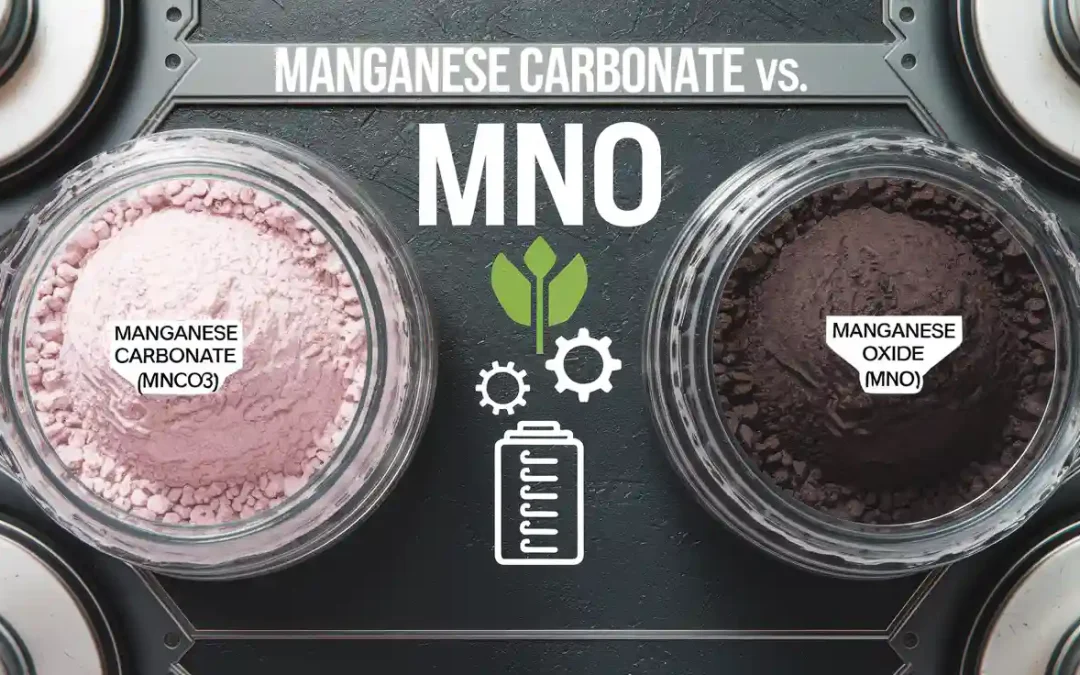
Manganese carbonate vs. MnO is a key comparison in the manganese industry. Manganese carbonate, known as MnCO₃, is widely used in agriculture and medicine. When examining manganese carbonate vs. MnO, it’s clear they have distinct properties. MnCO₃ contains a carbonate group, while MnO features a simple oxide structure. These chemical differences influence their behavior in industrial processes. Both manganese carbonate and MnO play important roles in the production of ceramics and batteries. Understanding the differences between manganese carbonate vs. MnO helps experts determine their effectiveness and cost in various applications.
Manganese carbonate and manganese oxide have different structures and colors. These differences change how they act and how people use them. MnCO₃ is mostly used in fertilizers and medicine. It is also used to make battery parts. MnO is important for making steel and concrete. It is also used in batteries and cleaning water. MnCO₃ is safer and less harmful. This makes it good for health and farming. MnO can handle high heat better. It works well for making steel and concrete. Picking MnCO₃ or MnO depends on what you need. You should think about cost, purity, and safety. This helps you get the best results. Both are important for new things like batteries and cleaning the environment. They help us build a cleaner and more energy-saving future.
Manganese Carbonate vs. MnO
Chemical Structure
Manganese carbonate and MnO have different chemical structures. MnCO₃ has a carbonate group attached to a manganese ion. MnO has a simple oxide structure with manganese and oxygen atoms. Their chemical formulas and crystal shapes make them unique.
Compound | Chemical Formula | Crystal Structure | Coordination Geometry |
|---|---|---|---|
Manganese carbonate | MnCO₃ | Hexagonal-rhombohedral (calcite-like) | Manganese(II) ions in octahedral coordination |
Manganese(II) oxide | MnO | Rock salt structure | Both cations and anions octahedrally coordinated |
MnCO₃ has a hexagonal-rhombohedral shape, like calcite. The carbonate group in MnCO₃ forms a strong network around the manganese ion. MnO has a rock salt structure. Both manganese and oxygen ions are arranged in octahedral shapes. This makes MnO stable as an oxide.
The manganese ion in these compounds has different oxidation states. In manganese carbonate, the manganese ion is in the +2 state. This makes MnCO₃ stable and not very reactive. Manganese oxides, including MnO, can have higher oxidation states, like +3 or +4. These higher states make manganese oxides more reactive. For example, manganese oxides with Mn(III) or Mn(IV) can be strong oxidants and catalysts. The difference in oxidation states explains why manganese oxides work better than manganese carbonate in some uses.
Physical Properties
Manganese carbonate and MnO have different physical properties. MnCO₃ is a white or faint pink solid. The mineral rhodochrosite is rose-red, but can be pale pink or cinnamon brown because of impurities. MnO is usually dark, often black or dark green.
Property | Manganese Carbonate (MnCO₃) | Manganese Oxide (MnO) |
|---|---|---|
Color | White to faint pink; natural rhodochrosite is rose-red to cinnamon brown | Generally dark or blackish |
Solubility | Negligible in water; soluble in dilute acids; insoluble in alcohol and ammonia | Insoluble in water |
Stability | Stable under ambient conditions; decomposes at ~200 °C to MnO and CO₂ | Stable oxide; formed by thermal decomposition of MnCO₃ |
MnCO₃ does not dissolve in water, but it dissolves in dilute acids. It does not dissolve in alcohol or ammonia. MnO does not dissolve in water. Both compounds are stable at room temperature. MnCO₃ breaks down at about 200 °C, making MnO and carbon dioxide. This change is important when comparing manganese carbonate and MnO.
Manganese carbonate is found in nature as rhodochrosite. MnO is made when MnCO₃ or other manganese minerals break down. The carbonate group in MnCO₃ gives it lighter colors and special ways it dissolves. MnO is a stable oxide. It does not break down easily and keeps its shape when heated.
Note: The differences in chemical and physical properties between MnCO₃ and MnO affect how they are used in industry, technology, and the environment. Knowing these differences helps people choose the right compound for each job.
Industrial Uses
Mn-Carbonate in Industry
Manganese carbonate is important in many industries. Fertilizer makers use mn-carbonate to help crops grow better. It gives soil the manganese plants need. This helps plants make food and keeps leaves from turning yellow. More than half of all mn-carbonate made is used in fertilizers. This shows how much farmers need it.
Ceramics makers use mnco₃ for color and strength in glazes. The carbonate gives steady, natural colors. It also makes porcelain glazes last longer. Mn-carbonate helps make smooth ceramic surfaces. Using main mn-carbonates in ceramics keeps colors and quality the same.
Drug companies put manganese carbonate in health supplements. It helps keep blood healthy and supports wellness. Mn-carbonate treats anemia and helps people grow strong. The drug industry likes that manganese carbonate is safe and not very toxic. This makes it good for medicine.
Manganese carbonate is used to make manganese dioxide. Factories heat mnco₃ in air to get manganese oxides. These oxides are treated to make manganese dioxide. Manganese dioxide is needed for battery parts and other new materials. Breaking down carbonate in a controlled way keeps the product good.
Manganese carbonate sales are growing in chemical and drug industries. More people want mn-carbonate because it works well, is safe, and can be used in many ways.
MnO in Industry
MnO helps chemical and drug industries grow. It is used in ceramics, glass, steel, batteries, and water cleaning. Ceramics and glass makers use manganese oxide for color. It gives color to bricks, tiles, and glass. MnO also removes unwanted color from glass and ceramics.
Steelmakers add manganese oxide to make alloys harder and stronger. It also helps stop rust. Builders use MnO in cement and concrete. It makes concrete stronger and adds manganese. MnO is important for making steel for cars and machines.
Battery makers use manganese oxide in battery parts. MnO helps store energy and makes batteries last longer. Water cleaning plants use manganese oxide to clean water. It acts as a helper, grabbing and removing metals and other things. MnO-covered filters clean water and make it safer.
Workers must be careful with manganese oxide in factories. Safe handling keeps workers and the environment safe.
Applications Table
Application Area | Manganese Carbonate (MnCO₃) | Manganese(II) Oxide (MnO) |
|---|---|---|
Fertilizers | Corrects manganese deficiency, promotes crop growth | Not commonly used |
Ceramics & Pigments | Glaze colorant, pigment, flux, enhances durability | Pigment, coloring agent, decolorization |
Medicine | Hematinic agent, supports blood health, low toxicity | Limited use, safety concerns |
Precursor for MnO₂ cathodes, ensures consistent quality | Active cathode material, supports energy storage | |
Glass & Concrete | Not typical, but precursor for oxides used in concrete | Coloring agent, improves concrete durability |
Water Treatment | Not used directly | Catalyst, adsorbent for purification |
Mn-carbonate is useful as a starter and helper. MnO is best for batteries, steel, and cleaning water.
Battery and Technology
Battery Applications
The battery industry is changing how much mnco₃ and MnO people need. Asia-Pacific is the top market because electric cars are popular there. Battery factories are growing fast in this region. North America and Europe are also building more battery plants. Governments give money and support to help these industries grow. High-purity mnco₃ is now more important than before. It is used to make lithium manganese oxide cathodes for lithium-ion batteries. These batteries are found in electric cars, phones, and energy storage systems.
Factories turn mnco₃ into MnO2 by heating it with air. This makes good battery materials. The battery industry has created new ways to clean and process these chemicals. Companies recycle old batteries and use local supply chains to get manganese. People want batteries that last longer and store more energy. This makes mnco₃ and MnO very important for making batteries.
Scientists have found new uses for mnco₃ nanoparticles. They use supercritical CO2 to make these tiny particles. The particles help make MnO for supercapacitors. These materials can hold a lot of energy and work well for many cycles. This makes them good for new types of energy storage.

Other Tech Uses
Mnco₃ and MnO are useful for more than just batteries. In environmental cleanup, mnco₃ is used in a process called MICP. Bacteria help turn dissolved manganese into solid mnco₃ minerals. This method helps stop manganese from polluting water, especially when cleaning steel slag. The small mnco₃ particles can be used as helpers in chemical reactions and as filters. They can also be used in devices that store or use electricity.
Mnco₃ nanostructures help make new materials for sensors and photocatalysts. For example, mnco₃ mixed with carbon fibers and special polymers can find toxins. MnO and other manganese oxides are being tested for use in new batteries and supercapacitors. These new uses help mnco₃ and MnO become even more important in energy and environmental technology.
Mnco₃ and MnO help make better batteries, supercapacitors, and clean up the environment. They are important for new technology because they work well in many ways.
Selection Guide
Choosing the Right Compound
Picking between mn-carbonate and MnO depends on many things. How they act in chemical reactions is very important. MnO reacts with carbon and gases when it gets very hot. This changes how much energy is used and how much CO2 is made. Mn-carbonate lets out CO2 when heated. This can mean more energy and carbon are needed in making concrete and steel. What you need for purity also matters. Batteries and medicine need very pure mn. Concrete and ceramics can use less pure forms.
Cost is important when making a lot of product. MnO is usually cheaper to use in steel and concrete. Mn-carbonate is better for fertilizers because it gives manganese slowly. Safety and toxicity are always important. Both need careful handling. Mn-carbonate is less toxic, so it is safer for health and medicine. These safety rules help protect workers and nature.
How you recycle or throw away these compounds is different. MnO waste can help clean water by grabbing heavy metals. Mn-carbonate waste can help fix acid problems in the environment. These ways to recycle help chemical and drug companies. They also help keep the earth cleaner.
Tip: Always check safety and toxicity before picking a manganese compound for any job.
Typical Scenarios
Scenario | Recommended Compound | Reasoning |
|---|---|---|
Fertilizer for crop growth | Mn-carbonate | Provides controlled manganese release, low toxicity, supports plant growth |
Concrete and steel production | MnO | Stable at high temperatures, cost-effective, improves concrete durability |
Battery and electronics | High-purity MnCO₃ | Needed for consistent mn supply in cathode production |
Water treatment | MnO | Acts as a sorbent for heavy metals, supports environmental safety |
Pharmaceutical and health uses | Mn-carbonate | Low toxicity, safe for health supplements |
Scientists use mn-carbonate to study plant growth and health. They pick MnO to test concrete strength and clean up the environment. Each compound helps its industry by matching what is needed for the job.
Manganese carbonate and MnO are not the same. They have different structures and uses. Their properties make them good for certain jobs. The table below shows how they work in batteries, ceramics, and farming:
Application Area | Manganese Carbonate (MnCO₃) | MnO (as Mn₂O₃) |
|---|---|---|
Batteries | ||
Ceramics | Pigment, colorant | Magnetic materials |
Agriculture | Fertilizer, micronutrient | Not applicable |
You need to pick the right one for your needs. Think about what the job requires and how much it costs. Manganese carbonate is often easy to get and not too expensive. That is why many companies like to use it.
FAQ
What are the main differences between manganese carbonate and MnO?
Manganese carbonate and MnO are not the same. They have different chemical properties and colors. MnCO₃ has a carbonate group. MnO is an oxide. These differences change how they work in batteries and ceramics. They also affect concrete production.
How does manganese carbonate support plant growth?
Manganese carbonate gives crops the manganese they need. Farmers use it to fix problems in plants. It helps plants grow better and stay healthy. This compound is used in farming and medicine.
Is manganese carbonate safe for health applications?
Manganese carbonate is not very toxic. Drug companies use it in health products. Safety rules help decide how much to use. Too much can be bad for health, so people must be careful.
Why do battery makers prefer manganese carbonate?
Battery makers use manganese carbonate to make MnO₂. More batteries mean more need for pure mn-carbonate. Its chemical traits help make battery parts the same every time.
Can MnO improve concrete durability?
MnO makes concrete stronger for building things. Its chemical traits help builders make tough structures. MnO is also used as a color in ceramics and glass.
Related Products

manganese dioxide

manganese carbonate

manganese sand
Related Posts

I am Edward lee, founder of manganesesupply( btlnewmaterial) , with more than 15 years experience in manganese products R&D and international sales, I helped more than 50+ corporates and am devoted to providing solutions to clients business.