Executive Summary
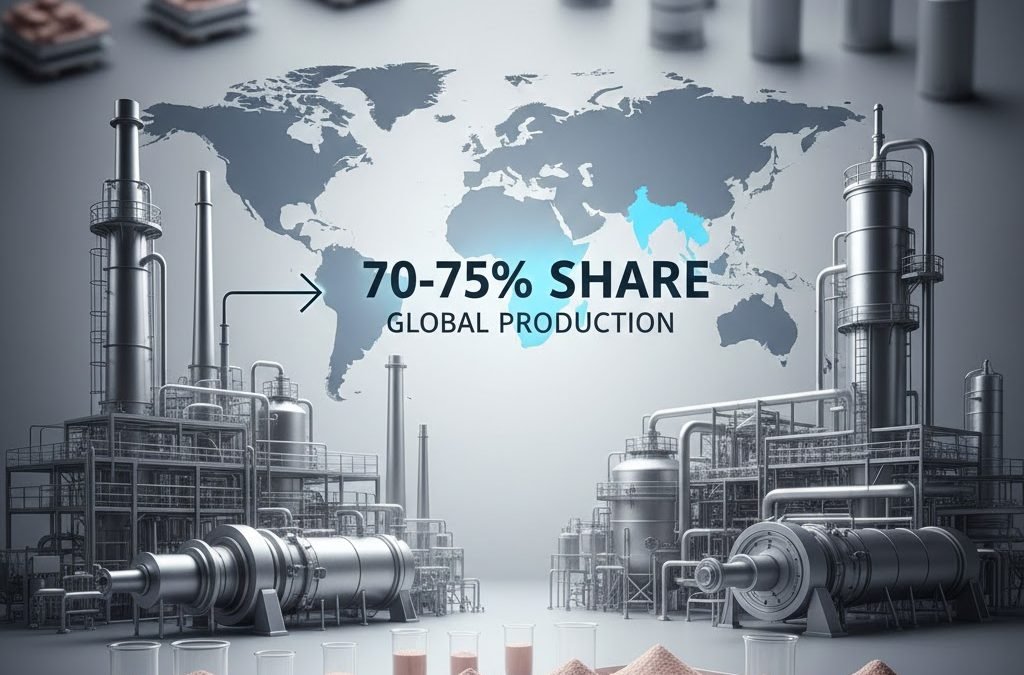
Global manganese carbonate production statistics show a highly concentrated supply structure, with China accounting for approximately 70–75% of global output capacity. Battery-grade manganese carbonate, used primarily as a precursor for lithium manganese oxide (LMO), NMC, and high-purity manganese sulfate, represents the fastest-growing segment, driven by lithium-ion battery demand. Typical global production capacity is estimated at 650,000–750,000 metric tons per year, but only 30–35% meets battery-grade purity requirements (>99.0% MnCO₃). Key measurable factors such as impurity control (<50 ppm Fe), particle size distribution (D50: 5–12 µm), and loss on ignition (LOI: 31.5–32.5%) determine usable yield for downstream battery and electronic applications. Understanding these production statistics is critical for procurement teams assessing long-term supply reliability and quality risk.
1. Technical Background: What Is Manganese Carbonate?
Manganese carbonate (MnCO₃) is an inorganic manganese salt primarily used as:
A precursor material for manganese oxides (MnO, Mn₃O₄, MnO₂)
A feedstock for battery-grade manganese sulfate
A functional additive in ceramics, pigments, and specialty chemicals
Role in Battery and Industrial Supply Chains
In lithium-ion battery manufacturing, manganese carbonate is rarely used directly. Instead, it is thermally decomposed or chemically converted, making precursor quality more important than final form.
Key reactions include:
MnCO₃ → MnO + CO₂ (≥ 350 °C)
MnCO₃ → Mn₃O₄ / MnO₂ (controlled oxidation)
Any variability in carbonate purity, moisture, or trace metals directly propagates into oxide or sulfate quality.
2. Global Manganese Carbonate Production Overview
Estimated Global Production Capacity
| Region | Estimated Capacity (t/y) | Share (%) |
|---|---|---|
| China | 480,000–550,000 | 70–75 |
| Africa (South Africa, Gabon) | 70,000–90,000 | 10–12 |
| Europe | 40,000–50,000 | 6–7 |
| Others (India, Japan) | 40,000–60,000 | 6–8 |
Global total capacity: approximately 650,000–750,000 t/y
However, effective battery-grade output is significantly lower due to purification constraints.
3. Production Methods and Yield Efficiency
Dominant Industrial Routes
Manganese Ore → MnSO₄ → MnCO₃ (Precipitation Route)
Most common in China
Allows impurity control via solution purification
Electrolytic Manganese Residue Utilization
Cost-efficient
Higher impurity risk (Fe, Na, Ca)
Natural Rhodochrosite Processing
Limited globally
Variable composition
Typical Yield Statistics
| Process Stage | Yield (%) |
|---|---|
| Leaching | 92–96 |
| Purification | 85–90 |
| Carbonation | 95–97 |
| Drying & Classification | 96–98 |
Overall yield: 72–80% (battery-grade compliant)
4. Battery-Grade vs Industrial-Grade Production Split
Global manganese carbonate production statistics show a clear grade stratification:
| Grade | Share of Output | Typical Purity |
|---|---|---|
| Industrial grade | 55–60% | 97.0–98.5% |
| Battery grade | 30–35% | ≥99.0% |
| Electronic / high-purity | <10% | ≥99.5% |
Only battery-grade manganese carbonate is suitable for:
Lithium battery cathode precursors
High-purity manganese sulfate monohydrate
Controlled MnO₂ synthesis
5. Key Quality Metrics Affecting Usable Production
5.1 Purity Level (% MnCO₃)
Battery-grade requirement: ≥99.0%
Typical industrial-grade: 97–98%
Each 0.1% impurity increase raises oxide defect risk measurably
5.2 Particle Size Distribution (PSD)
Recommended D50: 5–12 µm
D90 typically <25 µm
Oversized particles reduce calcination uniformity
5.3 Moisture and LOI Control
Moisture: ≤0.5%
LOI (900 °C): 31.5–32.5%
Deviations indicate contamination or incomplete carbonation
5.4 Heavy Metal Impurities (ppm)
| Element | Typical Battery-Grade Limit |
|---|---|
| Fe | ≤50 ppm |
| Cu | ≤10 ppm |
| Ni | ≤20 ppm |
| Zn | ≤30 ppm |
| Na | ≤300 ppm |
6. Mandatory Specification Table
| Parameter | Typical Battery-Grade Range | Why It Matters |
|---|---|---|
| Purity (MnCO₃, %) | ≥99.0 | Determines oxide/sulfate conversion quality |
| Mn content (%) | 47.5–48.0 | Stoichiometry consistency |
| D50 (µm) | 5–12 | Calcination uniformity |
| Moisture (%) | ≤0.5 | Prevents agglomeration |
| LOI (%) | 31.5–32.5 | Confirms chemical completeness |
| Fe (ppm) | ≤50 | Avoids cathode side reactions |
7. Impact on Battery Performance KPIs
High-quality manganese carbonate production directly affects downstream KPIs:
Cathode Material Metrics
Initial capacity: +2–4 mAh/g improvement
Capacity retention (500 cycles): +3–6%
Internal resistance growth: −5–10%
Manufacturing Metrics
Calcination yield: +3–5%
Scrap reduction: 2–4%
Batch consistency (CV): reduced from ~4% to <2%
These effects are statistically correlated with impurity control and PSD stability.
8. Quality Control & Testing Methods
Standard COA Items
Chemical composition (Mn, CO₃²⁻)
ICP-OES / ICP-MS for trace metals
Laser diffraction for PSD
Oven moisture (105 °C)
LOI (900 °C, 1 h)
Sampling Principles
Composite sampling from ≥10 bags
Minimum 1 kg retained sample
Lot-based traceability
9. Purchasing & Supplier Evaluation Considerations
Key Differentiation Points
Declared capacity vs effective battery-grade output
Internal purification capability (not outsourced)
Historical batch deviation data
Common Sourcing Risks
Industrial-grade material re-labeled as battery-grade
Uncontrolled sodium contamination from soda ash
Seasonal PSD variation due to drying instability
Packaging should be 25 kg PE-lined bags or 1,000 kg big bags, stored below 30 °C, <60% RH.
10. FAQ: Global Manganese Carbonate Production Statistics
Q1: How much manganese carbonate is produced globally each year?
Approximately 650,000–750,000 metric tons, with China as the dominant producer.
Q2: What percentage is suitable for battery applications?
Roughly 30–35% meets battery-grade specifications.
Q3: Why is China dominant in manganese carbonate production?
Integrated manganese refining infrastructure and cost-efficient purification processes.
Q4: What purity level is required for lithium batteries?
Minimum 99.0% MnCO₃ with controlled trace metals.
Q5: Is industrial-grade manganese carbonate interchangeable?
No. Impurity levels and PSD typically fail battery requirements.
Q6: How does LOI relate to product quality?
LOI confirms chemical completeness and carbonate integrity.
Related Products

manganese dioxide

manganese carbonate

manganese sand
Related Posts

I am Edward lee, founder of manganesesupply( btlnewmaterial) , with more than 15 years experience in manganese products R&D and international sales, I helped more than 50+ corporates and am devoted to providing solutions to clients business.