Buying manganese carbonate sounds simple, but it is not. Many buyers from water treatment, fertilizer, battery, and chemical industries have faced similar problems: purity does not match the COA, heavy metals exceed limits, shipment fails customs inspection, or product performance becomes unstable in production.
Most of these issues come from missing or unreliable certifications.
1.1 Common risks caused by missing certifications
| Risk | Example | Impact |
|---|---|---|
| Purity mismatch | Supplier claims Mn ≥ 44%, actual lab result Mn only 38% | Poor battery performance, low reaction efficiency |
| Heavy metals exceed limits | Pb > 50 ppm (EU RoHS limit is 1000 ppm) | Cannot enter EU market |
| Material not safe | No MSDS provided | Problems during transport or storage |
| Customs rejection | Supplier not REACH-registered | Shipment returned or destroyed |
| Wrong particle size | D50 larger than spec | Filtration issues in water treatment projects |
Real case:
In 2024, a European buyer reported that imported manganese carbonate failed customs inspection because the supplier did not have REACH registration. The buyer paid full freight and customs fees and lost more than USD 12,000 in one shipment.
This incident is very common in low-cost, uncertified suppliers.
This is why certifications are not “extra documents.”
They protect you from financial loss, project risks, and unstable quality.
2. The Most Important Certifications to Check
Below are the certifications that international buyers normally require.
Each certification includes what it means, what data to check, and real standards.
2.1 COA (Certificate of Analysis): The Most Critical Document
A COA is mandatory.
Without a COA, you should never buy manganese carbonate.
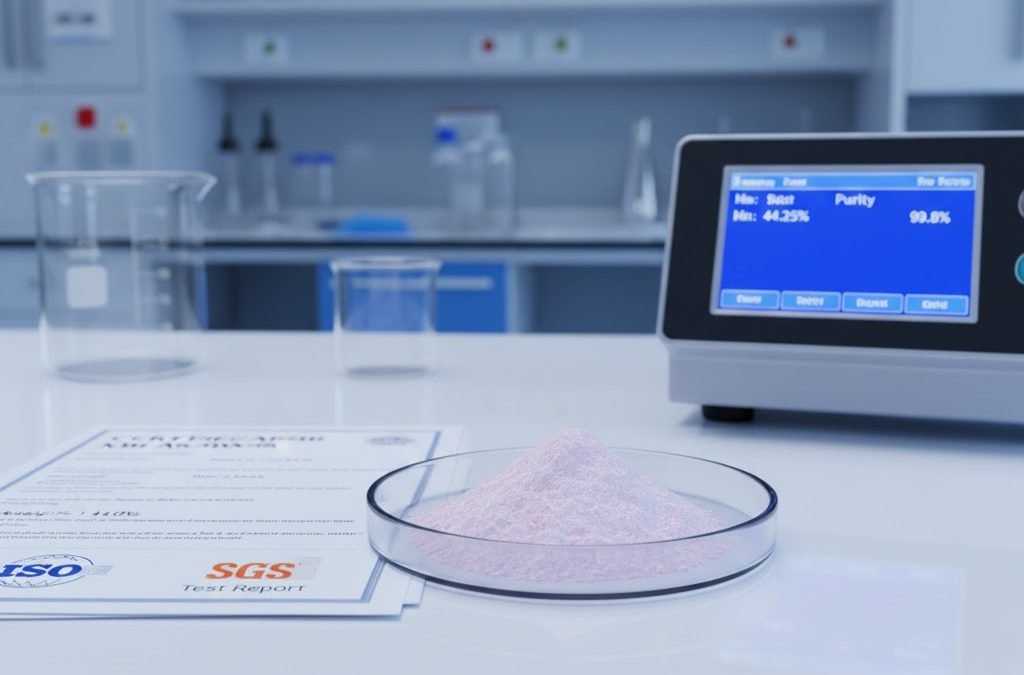
A typical COA for industrial manganese carbonate includes the following indicators:
Typical Specification Requirements (Based on GB/T 16117–2011 & common industry standards)
| Parameter | Required Standard | Why It Matters |
|---|---|---|
| Mn content | ≥ 44% | Determines reactivity and product value |
| Moisture | ≤ 5% | Affects weight, transport, and stability |
| HCl-insoluble matter | ≤ 0.3% | Indicates impurities like silica |
| Iron (Fe) | ≤ 0.02% | Influences battery performance |
| Chloride (Cl-) | ≤ 0.05% | Corrosion risk in some industrial processes |
| Sulphate (SO₄²⁻) | ≤ 0.5% | Affects catalyst and fertilizer applications |
| Heavy metals (Pb, As, Cd) | Pb ≤ 10 ppm, As ≤ 5 ppm, Cd ≤ 5 ppm | Based on EU regulations |
Example of real interpretation:
If a supplier gives you Mn = 44.2% and moisture = 3.8%, the batch meets the common industrial grade.
But if Mn = 41.8%, the material cannot meet battery-grade or fertilizer-grade standards.
2.2 ISO 9001: Quality Management System Certification
ISO 9001 ensures that the factory has a stable and repeatable production system.
Why ISO 9001 matters:
Ensures batch-to-batch quality stability
Ensures raw material control
Ensures full traceability
Reduces risk of inconsistent purity
According to ISO standards, a certified factory must:
Keep production records for at least 3 years
Calibrate testing equipment regularly
Maintain batch QC procedures
This directly reduces the chance of receiving a “good quality first batch” and “terrible second batch,” which many buyers have experienced.
2.3 REACH Registration: Required for Shipments to EU
If you ship manganese carbonate to the EU, the product must comply with:
REACH (EC 1907/2006)
For manganese carbonate, the typical requirement is:
Full registration for ≥ 1 ton/year import
Safety assessment report
Tonnage band compliance
Why REACH matters:
EU customs can reject or destroy unregistered chemicals
Buyers cannot use unregistered chemicals in regulated industries
Sellers may face penalties
A real example:
In 2023, more than 560 chemical shipments were delayed at Rotterdam Port due to missing REACH documents (EU Safety Report, 2024).
2.4 SGS or Intertek Test Reports: Verification of Purity and Safety
SGS/Intertek are trusted global testing companies.
Testing normally includes:
Mn percentage
Heavy metals
Moisture
Insoluble matter
Particle size distribution
Typical heavy metal limits (based on EU and WHO water standards):
| Element | Limit |
|---|---|
| Pb | < 10 mg/kg |
| As | < 5 mg/kg |
| Cd | < 5 mg/kg |
| Hg | < 1 mg/kg |
Why heavy metal tests matter:
In water treatment, high levels of Pb and As may enter the filtration system and cause contamination.
In batteries, impurities like Fe can reduce discharge capacity.
2.5 MSDS (Material Safety Data Sheet): For Transport, Storage, Customs
MSDS is required for:
Sea shipping (IMDG Code)
Air shipping (IATA)
Customs and warehouse storage
A correct MSDS includes:
Hazard classification
Handling precautions
Transport category
Storage temperature
First aid measures
Example:
Manganese carbonate is classified as non-hazardous, UN hazard class 0.
But some countries still require MSDS for chemicals.
2.6 RoHS (For Electronics, Battery-Related Uses)
RoHS (Directive 2011/65/EU) limits harmful substances.
For manganese carbonate used in battery or electronics, RoHS compliance is important.
Key RoHS limits:
| Substance | Max Limit (ppm) |
|---|---|
| Lead (Pb) | 1000 |
| Cadmium (Cd) | 100 |
| Mercury (Hg) | 1000 |
| Hexavalent chromium | 1000 |
This ensures the material can be used in electronics-related applications.
3. How to Verify If Certifications Are Real
Many buyers worry about fake COAs or copied ISO certificates.
Below are simple ways to verify authenticity.
3.1 Ask for test photos (not only PDF)
A real supplier can provide:
Testing machine photos
Fresh sample photos
Batch number on packaging
Lab technician signature
Fake suppliers cannot provide these because they don’t have real production.
3.2 Check certificate verification numbers
ISO 9001 certificates always have:
Certificate number
Issue date
Expiry date
Certifying body (e.g., TÜV, SGS, CNAS)
You can check the number on the official website.
3.3 Look at dates on COA
A COA older than 12 months is a red flag.
Real COAs are usually issued within 3–7 days before shipment.
3.4 Ask for random third-party testing
A serious supplier will allow:
SGS sampling during production
Intertek testing before shipment
If a supplier refuses third-party testing, it is a risk.
3.5 Compare COA with previous batches
Stable manufacturers’ data usually fluctuate only ±0.2% for Mn.
For example:
Batch 1: Mn = 44.3%
Batch 2: Mn = 44.2%
Batch 3: Mn = 44.4%
If a supplier gives:
42% → 44.8% → 43.5%
This means poor quality control.
4. What Happens When Certifications Are Missing
4.1 Water Treatment Industry
If particle size is not controlled:
Too fine particles → pressure drop increases
Too coarse particles → filtration efficiency drops
Example:
A water plant in Southeast Asia reported that manganese sand with D50 > 0.8 mm caused 27% lower filtration efficiency.
4.2 Battery Industry
Battery-grade manganese carbonate purity must be high.
If Mn < 44% or Fe > 0.02%, battery performance decreases.
Example:
A battery factory tested two batches:
| Batch | Mn (%) | Fe (%) | Discharge Result |
|---|---|---|---|
| A | 44.3 | 0.015 | Normal |
| B | 41.9 | 0.06 | Capacity dropped by 18% |
This is why COA and SGS are essential.
4.3 Fertilizer Industry
High sulphate or chloride affects crop growth.
Example:
FAO recommends sulphate in manganese-based fertilizers < 1%.
4.4 Customs Issues
Missing REACH or MSDS can delay shipment for 2–8 weeks.
5. Why Working With a Certified Chinese Supplier Matters
A certified manufacturer can provide:
Stable Mn content (batch variation ±0.2%)
Complete COA
ISO 9001 certification
SGS test reports
REACH compliance for EU shipments
This reduces risk and ensures stable long-term supply.
Example from our production data:
2024 average Mn content: 44.25%
Moisture: 3.6%
Heavy metals always below EU limits
Factories with real certifications can show multi-year batch records, not just a single COA.
6. Conclusion
Certifications are not optional documents.
They directly affect your project safety, customs clearance, and product performance.
When buying manganese carbonate, always check:
COA (Mn%, moisture, heavy metals)
ISO 9001
SGS/Intertek test reports
REACH (if shipping to EU)
MSDS
RoHS (if related to battery or electronics)
A reliable supplier will happily provide all documents and allow third-party testing.
Choosing a certified supplier protects your cost, quality, and business reputation.
7. FAQ
1. What is the most important certification when buying manganese carbonate?
The most important document is the COA showing Mn%, moisture, and heavy metals.
2. Do I need REACH certification?
Only if the product is shipped to the EU.
3. How do I know a COA is real?
Check batch numbers, test dates, lab photos, and request 3rd-party testing.
4. What purity is acceptable for industrial manganese carbonate?
Most buyers require Mn ≥ 44%.
5. Should I request SGS testing?
Yes. SGS or Intertek testing reduces risk and proves real purity.
Related Posts

I am Edward lee, founder of manganesesupply( btlnewmaterial) , with more than 15 years experience in manganese products R&D and international sales, I helped more than 50+ corporates and am devoted to providing solutions to clients business.