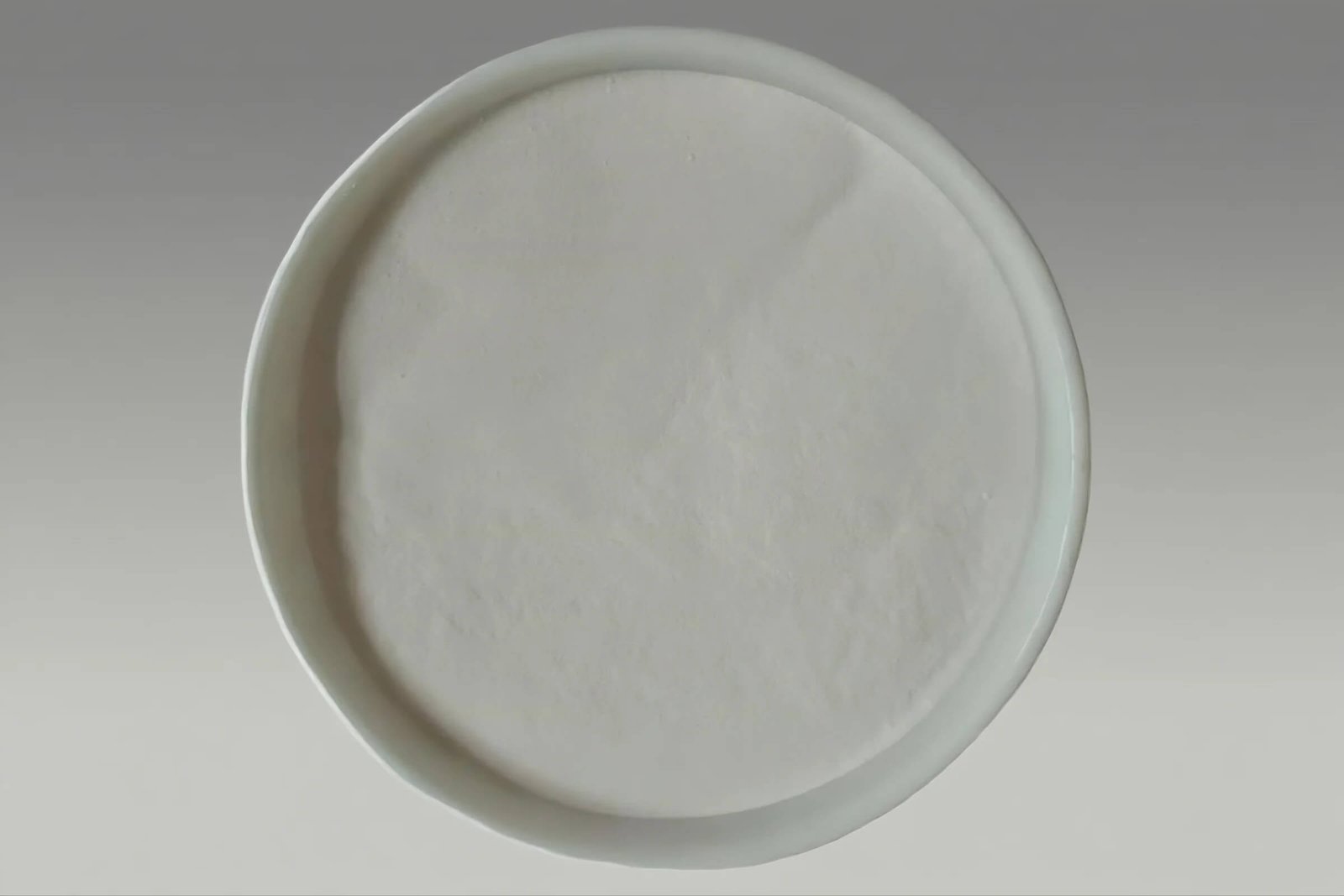
Manganese carbonate (MnCO₃) is an important manganese compound used in batteries, fertilizers, ceramics, pigments, and water treatment. To understand its value, two properties are especially important: solubility and reactivity. These determine how it behaves in industrial processes and why it is chosen over other manganese sources.
This article explains the chemical properties of manganese carbonate, its solubility, reactivity, and why these matter for different industries.
II. Chemical Properties of Manganese Carbonate
Manganese carbonate (MnCO₃) is a crystalline inorganic compound. It is widely recognized as a precursor material in metallurgy, chemical synthesis, and agriculture. Its physical and chemical properties explain why it is chosen for specific industrial uses.
1. Structural Characteristics
Crystal structure: Rhombohedral (calcite-type), space group R-3c (ICSD database).
Lattice parameters: a = 4.77 Å, c = 15.37 Å.
Coordination: Mn²⁺ ions are octahedrally coordinated by oxygen atoms from CO₃²⁻ groups.
???? This structure is similar to calcite (CaCO₃), which explains its low water solubility but high reactivity with acids.
2. Physical Properties
| Property | Typical Value | Notes | Source |
|---|---|---|---|
| Appearance | Pinkish to light brown crystalline powder | Color due to Mn²⁺ electronic transitions | Sigma Aldrich |
| Density | 3.12–3.13 g/cm³ | Higher than CaCO₃ due to heavier Mn²⁺ | CRC Handbook |
| Mohs Hardness | ~3.5 | Comparable to calcite | Mineralogical Data |
| Specific Heat Capacity | 0.565 J/g·K (25 °C) | Useful for thermal processing | Thermodynamic tables |
| Magnetic Properties | Antiferromagnetic ordering below 40 K | Research in solid-state physics | ScienceDirect |
3. Thermal Stability
Decomposition temperature: Begins around 200 °C under normal atmosphere.
Endothermic reaction:
Differential Scanning Calorimetry (DSC) studies show decomposition enthalpy ~89–95 kJ/mol (Thermochimica Acta).
At higher temperatures (600–800 °C), MnO can be oxidized to Mn₃O₄ or Mn₂O₃, depending on oxygen availability.
4. Impurities and Purity Standards
Industrial manganese carbonate is rarely 100% pure. Buyers look for:
Mn content ≥ 44–46% (battery grade may reach >47%).
Impurities: Fe, Pb, As, Cd must be below 0.001% for fertilizer or food applications.
Moisture content: <0.5% to ensure stability in storage.
III. Solubility of Manganese Carbonate
The solubility of MnCO₃ defines its behavior in different environments.
1. Solubility in Pure Water
Practically insoluble.
Solubility at 25 °C: 0.065 g/L (CRC Handbook).
Ksp (25 °C): 2.24 × 10⁻¹¹ (NIST Solubility Database).
???? This extremely low solubility means MnCO₃ is safe for storage and does not leach easily in water systems.
2. Solubility in Acidic Media
Dissolves readily in dilute acids, releasing CO₂.
Example with sulfuric acid:
In fertilizer production, MnCO₃ is used as a raw material to make manganese sulfate monohydrate (MnSO₄·H₂O), a highly soluble form used in agriculture.
3. Solubility under Environmental Conditions
Soils: In neutral to alkaline soils, MnCO₃ is stable; in acidic soils, it dissolves and releases bioavailable Mn²⁺.
Water Treatment: Its insolubility prevents excess manganese leaching but allows surface reactions with oxidizing agents.
4. Solubility Comparison Table
| Compound | Solubility in Water (25 °C) | Ksp | Industrial Notes |
|---|---|---|---|
| MnCO₃ | 0.065 g/L | 2.24 × 10⁻¹¹ | Insoluble, safe for transport |
| CaCO₃ | 0.013 g/L | 4.8 × 10⁻⁹ | Similar carbonate, slightly more soluble |
| MnSO₄·H₂O | 700 g/L | – | Highly soluble, fertilizer use |
| MnCl₂ | 723 g/L | – | Soluble, used in chemistry and nutrition |
???? MnCO₃ acts as a controlled-release manganese source, unlike soluble salts (MnSO₄, MnCl₂).
5. Industrial Implications of Solubility
Fertilizers: Acts as a slow-release source of Mn.
Batteries: Insolubility prevents contamination but allows conversion into soluble salts for further processing.
Water Treatment: Safe to use as a medium in sand filters.
IV. Reactivity of Manganese Carbonate
While insoluble in water, manganese carbonate is highly reactive in chemical and thermal processes.
1. Reaction with Acids
Manganese carbonate reacts strongly with mineral acids:
Hydrochloric Acid:
Sulfuric Acid:
Nitric Acid:
???? These reactions are rapid, exothermic, and produce effervescence due to CO₂ gas release.
Industrial use: Production of soluble manganese salts used in fertilizers, electroplating, and battery materials.
2. Thermal Decomposition
Onset temperature: ~200 °C.
Reaction:
At 600–700 °C in air: MnO further oxidizes to Mn₃O₄.
At ~800–1000 °C: Higher oxides like Mn₂O₃, MnO₂ may form depending on atmosphere (Thermochimica Acta).
Industrial importance:
In ceramics, this decomposition provides manganese oxides as pigments.
In metallurgy, MnO is used as a flux and raw material.
In batteries, decomposition is the first step in synthesizing electrolytic manganese dioxide (EMD) and lithium manganese oxide (LiMn₂O₄).
3. Redox Behavior
Mn²⁺ ions from MnCO₃ are easily oxidized.
With oxygen/oxidizing agents:
With potassium permanganate (laboratory reaction), Mn²⁺ can be oxidized to Mn⁴⁺.
Industrial importance: Controlled oxidation of Mn²⁺ is essential in producing battery-grade manganese dioxide.
4. Catalytic and Surface Reactivity
MnCO₃ nanoparticles have been studied for catalysis (oxidation of CO, organic compounds).
Reactivity increases with particle size reduction and higher surface area.
This is relevant for specialized uses in environmental catalysis.
5. Summary Table of Reactivity
| Reaction Type | Condition | Product(s) | Industrial Use |
|---|---|---|---|
| Acid dissolution | Room temp, dilute acids | Mn salts + CO₂ | Fertilizer salts, plating solutions |
| Thermal decomposition | ~200 °C+ | MnO + CO₂ | Ceramics, metallurgy, battery precursors |
| Oxidation | 600–900 °C, air/O₂ | Mn₂O₃, Mn₃O₄, MnO₂ | Cathode materials |
| Catalysis | High surface area MnCO₃ | Mn-based catalysts | Environmental applications |
V. Industrial Relevance of Solubility and Reactivity
Fertilizer Industry
Insolubility in water → slow-release nutrient.
Solubility in soil acids ensures bioavailability.
Used in micronutrient fertilizers.
Battery Industry
Precursor for MnO₂ and LiMn₂O₄ cathode materials.
Controlled reactivity ensures high-purity production.
Water Treatment
Insoluble → stable in filtration systems.
Reactivity with oxidizing agents helps remove Fe²⁺ and H₂S.
Ceramics and Glass
Thermal decomposition provides stable manganese oxides as pigments and decolorizers.
VI. Key Quality Parameters for Buyers
When buying manganese carbonate, industrial users check:
| Parameter | Typical Value | Importance |
|---|---|---|
| Mn Content | ≥ 44–46% | Determines efficiency in reactions |
| Particle Size | < 45 μm | Affects dissolution and reactivity |
| Moisture | < 0.5% | Prevents clumping, improves storage |
| Impurities (Pb, Cd, As) | < 0.001% | Meets fertilizer/battery standards |
| pH Stability | Neutral to slightly alkaline | Ensures product stability |
???? Compliance with GB/T 16124-2010, ISO standards, and ASTM is often required for export markets.
VII. Choosing a Reliable Supplier
A good supplier ensures consistent Mn content, controlled particle size, and low impurities.
Reliable testing methods: ICP-MS, XRD, SEM for structure and purity.
Factory advantages: bulk production, technical support, OEM packaging.
VIII. Conclusion
The low solubility and strong reactivity of manganese carbonate make it a versatile compound for fertilizers, batteries, ceramics, and water treatment. For industrial users, these properties mean safety in handling, flexibility in chemical processing, and efficiency in end-use applications.
If your industry requires a stable, high-quality source of manganese carbonate, working with a reliable manufacturer ensures consistent performance.
FAQs
1. Is manganese carbonate soluble in water?
No, it is practically insoluble in water (0.065 g/L at 25 °C).
2. How does manganese carbonate react with acids?
It dissolves easily, producing soluble manganese salts (like MnSO₄, MnCl₂) and releasing CO₂ gas.
3. What happens when manganese carbonate is heated?
It decomposes at ~200 °C, forming manganese(II) oxide (MnO) and releasing CO₂.
4. Why is manganese carbonate used in fertilizers?
Because it is insoluble in water but dissolves in soil acids, providing a slow-release manganese source for crops.
5. What industries use manganese carbonate?
Fertilizers, batteries, ceramics, pigments, and water treatment.
Related Products

manganese dioxide

manganese carbonate

manganese sand
Related Posts

I am Edward lee, founder of manganesesupply( btlnewmaterial) , with more than 15 years experience in manganese products R&D and international sales, I helped more than 50+ corporates and am devoted to providing solutions to clients business.