You see battery-grade manganese sulfate is very important. It helps make lithium-ion batteries safer and better. Manufacturers now want very pure manganese sulfate. This is needed for new cathode materials. In the last ten years, more manganese sulfate is used in batteries. This is mostly for electric cars and energy storage. The market for manganese sulfate battery materials is growing fast:
Year | Market Size (USD Billion) | CAGR (%) |
|---|---|---|
2024 | N/A | |
2025 | 0.62 | N/A |
2033 | 2.18 | 16.9 |
You get better battery performance, more safety, and lower costs because of these changes.
More high-purity manganese sulfate is used in cathode materials. This is because more electric cars are being made.
Very pure manganese sulfate is needed for nickel-cobalt-manganese cathodes. These are now in most new electric cars.
New technology can lower impurity levels to less than 10 parts per million. This makes battery quality better.
Manganese sulfate is very important for making lithium-ion batteries safer. It also helps batteries work better. High purity makes batteries perform well.
Using manganese sulfate in cathodes lowers costs. It also makes batteries more stable. This matters a lot for electric cars.
More people want battery-grade manganese sulfate now. This is because electric vehicles and energy storage are becoming popular.
New technology is making manganese sulfate production better. It is now cheaper and better for the environment.
Always check how pure manganese sulfate is. This helps make sure batteries are good quality. Pure manganese sulfate makes batteries safer and last longer.
Manganese Sulfate: Key Properties and Role
Chemical Features
Battery-grade manganese sulfate is needed for good lithium-ion batteries. This compound has manganese and sulfate ions. It looks like a white or light pink powder. The purity of manganese sulfate is very important. If the manganese sulfate is not pure, the battery works badly. Impurities can make the battery have problems. The battery might not last long or could be unsafe.
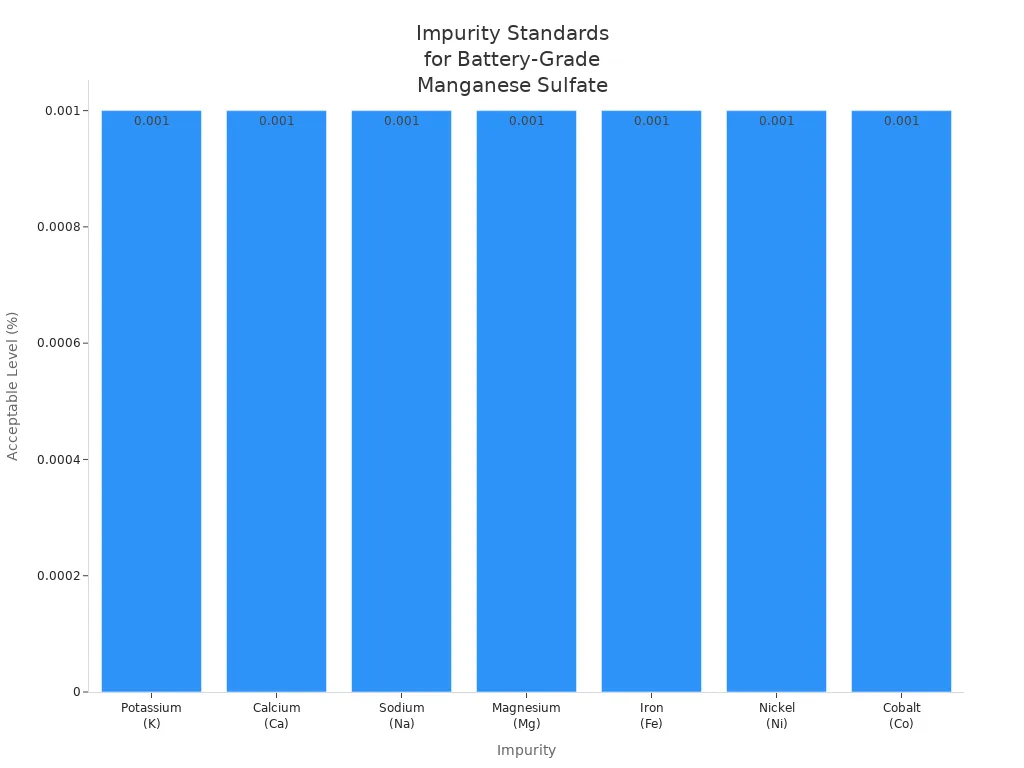
Manufacturers have strict rules for battery-grade manganese sulfate. Impurity levels must be very low. Here is a table that shows how much impurity is allowed:
Impurity | |
|---|---|
Potassium (K) | < 0.001 |
Calcium (Ca) | < 0.001 |
Sodium (Na) | < 0.001 |
Magnesium (Mg) | < 0.001 |
Iron (Fe) | < 0.001 |
Nickel (Ni) | < 0.001 |
Cobalt (Co) | < 0.001 |
All impurities must be less than 0.001%. This high purity helps batteries stay safe and work well.
Manganese sulfate with high purity gives better battery results. There are fewer problems in the battery. The battery lasts longer. These chemical features make manganese sulfate a good choice for battery makers.
Cathode Material Use
Manganese sulfate is used to make cathode materials. The cathode stores and releases energy in the battery. Most electric cars use nickel-cobalt-manganese cathodes. Manganese sulfate is needed to make these cathodes.
Using manganese sulfate helps make batteries safer. Manganese in the cathode makes the battery more stable. It also lowers the cost because manganese costs less than cobalt. Many companies use more manganese in their cathodes now. This is seen in new battery designs.
Manganese sulfate is a precursor. You start with manganese sulfate to make the cathode material. This gives better control over the final product. It also stops unwanted reactions in the battery. This makes batteries safer and more reliable.
Tip: Always check the purity of manganese sulfate if you want high-performance batteries. Pure manganese sulfate gives the best results.
Manganese sulfate is very important in the battery industry. It helps batteries work better, cost less, and stay safe when used in cathode production.
Manganese Sulfate Battery Applications
NMC and Other Cathodes
Manganese sulfate is used in many new batteries. Most electric cars use NMC cathodes. NMC stands for nickel, manganese, and cobalt. Manganese sulfate is a key starting material in these batteries. It helps make the cathode strong and steady. This makes the battery work better and more safely.
Manganese gives the cathode many good things. It helps keep the metals balanced. The battery works well in cars and for storing energy. Many companies pick manganese sulfate because it can take the place of some cobalt. Cobalt is more expensive and harder to get. Using more manganese lowers battery costs and makes them easier to build.
Manganese sulfate is also in other lithium-ion batteries. Some batteries use lithium manganese oxide cathodes. These work well in cars and for energy storage. Manganese sulfate lets you use different battery types.
Note: Using manganese sulfate helps make batteries safer and cheaper for electric cars and energy storage.
Performance and Safety
Manganese sulfate helps batteries work better and stay safe. Manganese is important in the battery’s chemistry. It keeps the cathode steady when charging and using the battery. This means your battery lasts longer and works well in many places.
Batteries with manganese sulfate can hold more energy. Your devices or cars can run longer before charging. Manganese also helps stop the battery from getting too hot. You can trust these batteries in cars and for storing energy.
Here is a table that shows how manganese sulfate helps batteries:
Feature | Benefit for You |
|---|---|
Higher Stability | Longer battery life |
Greater Capacity | More energy for your devices |
Lower Cost | Affordable batteries |
Improved Safety | Fewer risks of overheating |
More new batteries use manganese sulfate now. This helps make batteries safer, stronger, and able to hold more energy. Manganese helps your battery work better and cost less.
Tip: If you want a battery that lasts long and stays safe, pick one with manganese sulfate.
Processing and Supply Chain

Production and Refinement
Have you ever thought about how battery-grade manganese sulfate is made? First, workers mine manganese ore from the ground. Then, they crush and grind the ore into small pieces. After that, they clean the ore to get rid of things they do not want. The cleaned ore is mixed with sulfuric acid. This step helps take out the manganese. Next, iron and other heavy metals are removed from the mixture. The last step is refining, which makes the manganese sulfate very pure for batteries.
Here is a simple table that shows the main steps:
Step Number | Process Step |
|---|---|
1 | Mining of ore |
2 | Crushing and Grinding |
3 | Pre-treatment of the ore |
4 | Leaching of the treated ore in sulfuric acid |
5 | Iron removal |
6 | Heavy metal removal |
7 | Final refining |
New technology helps make manganese sulfate even better. Some factories use special methods to get more manganese out. Other factories can use many types of battery materials. These new ideas help make purer manganese sulfate for batteries.
Global Supply and Demand
Most manganese sulfate comes from China. Factories in China use smart ways to make high-quality manganese sulfate. This makes China very important for the world’s supply. If you use batteries in electric cars or for storing energy, you depend on this supply. China’s part in the manganese sulfate market keeps getting bigger as more people want electric cars.
The need for battery-grade manganese sulfate is going up. This is because more companies want cheaper and greener batteries. From 2026 to 2033, experts think the manganese sulfate market will grow fast. More electric cars and new rules for clean energy make this need even bigger.
Note: If you work in the EU or with electric cars, you might have trouble getting enough manganese sulfate. Many companies are looking for new partners and better ways to get what they need for batteries.
Companies that try new things and build strong teams will do well in this changing market. You will see more money spent on making manganese sulfate in better ways and on stronger supply chains soon.
Benefits and Challenges of Manganese Sulfate
Cost and Sustainability
Manganese in batteries gives many good things. Batteries with manganese cathodes work better and last longer. You get more energy and faster power. Electric cars can go farther and speed up quicker. Manganese helps keep batteries safe. It controls heat and lowers the chance of overheating.
Here is a table that shows the main benefits:
Benefit | Description |
|---|---|
Improved performance | Manganese-based cathodes provide high energy density and excellent power output, enhancing EV driving ranges and acceleration. |
Safety enhancement | Manganese contributes to thermal stability, reducing risks of overheating and thermal runaway, ensuring battery safety. |
Cost-effectiveness | Manganese is abundant and relatively low-cost compared to other metals, making it an economically viable option for battery production. |
Sustainability | Manganese-based cathodes reduce reliance on expensive and environmentally harmful materials, aligning with sustainable practices in the EV industry. |
You save money because manganese costs less than cobalt or nickel. Manganese sulfate is easy to find and does not cost much. This makes it a smart choice for battery makers.
But there are some problems too. Making pure manganese sulfate uses lots of energy. The process makes greenhouse gases. Factories must work hard to remove impurities. This makes production harder and can hurt the environment. How factories make manganese sulfate changes how much pollution they make. You should think about these things if you want greener batteries.
Tip: If you care about the planet, pick batteries made with cleaner manganese methods.
Quality and Sourcing Issues
You want your battery to work well, so you need high-quality manganese. If manganese sulfate has impurities, your battery may not last long or could be unsafe. Battery makers have strict rules for purity. You should always check where your manganese comes from.
Most manganese comes from a few countries. China makes most of the world’s manganese sulfate. This can cause problems if you need a steady supply. You may face delays or price changes if something happens in those regions. Supply chain transparency and environmental rules are important. You should ask your supplier about how they make and ship manganese sulfate.
Note: Good sourcing and strict quality checks help you get the best battery performance.
Future Trends
Market Growth
Big changes are coming for manganese sulfate in the next ten years. More people want manganese because electric cars are getting popular. Car makers use new batteries that need more manganese, like lithium manganese iron phosphate. This helps batteries work better and cost less money. The market for battery-grade manganese sulfate will grow fast. Here are some important numbers:
The world market could go from USD 1.25 billion in 2024 to USD 6.12 billion by 2033, with a CAGR of 17.9% from 2025 to 2033.
Another guess says it may grow from USD 1.12 billion in 2024 to USD 2.65 billion by 2033, with a CAGR of 10.3% from 2026 to 2033.
More electric cars mean more batteries with lots of manganese. This will make companies use more manganese sulfate and change how they build batteries.
Technology Advances
New technology is making manganese sulfate better for batteries. Companies like Vibrantz Technologies are building new plants for high-purity manganese sulfate. Their test plant in Mexico wants to make up to 45,000 metric tons each year. This helps meet the need for electric car batteries and supports cleaner ways to make them.
Better processing now lets you get high-purity manganese for less money. These new ways help battery makers use manganese in better batteries. You will also see new green methods and better cleaning steps. These changes help keep the supply chain strong and protect the environment.
Technology Advance | Impact on You |
|---|---|
High-purity production | Better battery performance |
Lower-cost processing | More affordable batteries |
Eco-friendly synthesis | Cleaner environment |
Stronger supply chain | Reliable access to manganese sulfate |
You will see more new ideas for making and using manganese. These changes will help make batteries safer, cheaper, and better for the planet.
Battery-grade manganese sulfate is important for lithium-ion batteries. It helps make batteries safer and cheaper. Batteries also work better because of it. Electric cars and energy storage use more of this material now. Its role keeps getting bigger every year. You should find new ways to make and move manganese sulfate. Learn more about how it helps the battery industry change. Stay updated as things keep improving.
FAQ
What is battery-grade manganese sulfate?
Battery-grade manganese sulfate is used in lithium-ion batteries. This kind has almost no impurities. High purity helps batteries last longer and stay safe.
Why does purity matter for manganese sulfate in batteries?
If there are impurities, batteries can break or get too hot. Pure manganese sulfate gives strong and steady battery power. Makers check every batch to make sure it is good.
How does manganese sulfate improve battery safety?
Manganese sulfate helps keep the battery from getting too hot. This lowers the chance of fire or overheating. It makes your car or device safer to use.
Where do you find most manganese sulfate for batteries?
Most battery-grade manganese sulfate is made in China. Other countries may build new factories soon. Companies want safer and stronger supply chains.
Can manganese sulfate help lower battery costs?
Using manganese sulfate helps save money on batteries. It is cheaper than cobalt or nickel. Battery makers use more manganese to make cars and devices cost less.
Related Products

manganese dioxide

manganese carbonate

manganese sand
Related Posts

I am Edward lee, founder of manganesesupply( btlnewmaterial) , with more than 15 years experience in manganese products R&D and international sales, I helped more than 50+ corporates and am devoted to providing solutions to clients business.