Executive Summary
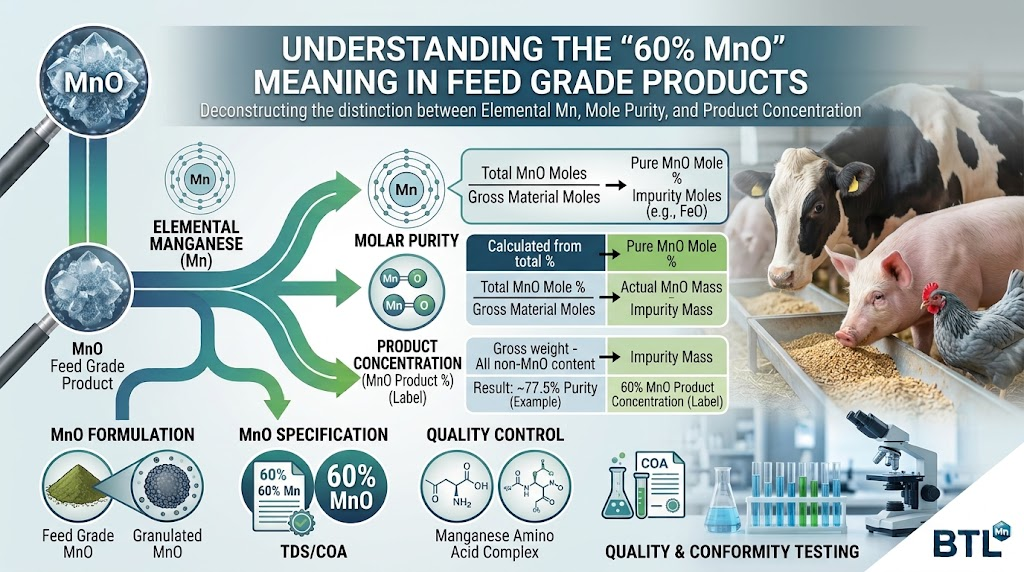
“60%” is manganous oxide (MnO) purity. It is not elemental manganese.
- 60% MnO equals about 46–47% elemental Mn.
- Conversion factor: Mn% = MnO% × 0.774.
- Feed formulas are calculated on elemental Mn.
- Buyers must convert before comparing dosage or price.
A typical feed-grade TDS lists: MnO ≥ 60%, Mn ≥ 46–47%, 80–200 mesh, solubility in 2% citric acid ≥ 85–90%, moisture ≤ 1.5%, As ≤ 5 ppm, Pb ≤ 10 ppm, Cd ≤ 5 ppm.
Each number answers a purchasing question:
- MnO % tells you product purity.
- Mn % tells you nutrient content.
- Particle size, solubility, moisture, and heavy metals tell you blending, availability, handling, and compliance.
Verify every number on the COA. Test samples. Then order bulk.
The Short Answer: “60%” Means MnO Purity — Equal to About 46–47% Elemental Manganese
“60%” describes how much of the powder is MnO. The rest is carrier and natural impurities.
Manganese is 77.4% of MnO by weight.
60% × 0.774 = 46.5%.
That is why the same TDS lists “MnO ≥ 60%” and “Mn ≥ 46–47%”.
What “60% Manganous Oxide” Means on a Product Spec Sheet
The number is an assay result, not a marketing claim.
| Spec term | What it means |
|---|---|
| MnO ≥ 60% | Minimum manganous oxide purity |
| Mn ≥ 46–47% | Minimum elemental manganese |
| Moisture ≤ 1.5% | Maximum water content |
| 80–200 mesh | Controlled particle size range |
Assay values are minimums. Typical production values may run slightly higher.
Check the assay basis (as-received or dry) stated on the TDS.
The Conversion: 60% MnO ≈ 46–47% Elemental Mn
The Mn/MnO weight ratio is 54.94 / 70.94 = 0.7745.
60% × 0.7745 = 46.5%.
Suppliers quote 46–47% because batch assays vary within a small tolerance.
One tonne of 60% MnO delivers about 465 kg of elemental Mn.
Why Feed Formulas Care About Elemental Manganese, Not MnO Percentage
Nutrient requirements are expressed as mg elemental Mn per kg of feed.
Typical supplemental levels range from roughly 20 to 120 mg/kg depending on species and stage.
Formulators dose by Mn, not by MnO.
Two products both labeled “60% MnO” must still be checked for actual Mn content.
Convert, compare, then buy.
Buyer warning: a product listed as “60% Mn” is not the same as “60% MnO”. “60% Mn” would mean roughly 77% MnO. Check which basis the label uses before you compare quotes.
Manganous Oxide vs. Manganese Oxide: The Same Compound, Different Names
Chemical Identity: MnO, Manganous Oxide, Manganese(II) Oxide
Manganous oxide is manganese(II) oxide.
The chemical formula is MnO.
“Manganese oxide” is a loose trade term. In feed, it usually means MnO.
All three labels refer to the same compound.
| Label | Chemical form |
|---|---|
| Manganous oxide | MnO |
| Manganese(II) oxide | MnO |
| Manganese oxide (feed grade) | Predominantly MnO |
Why Suppliers Use Different Labels for the Same Product
Labels vary by regional habit, catalog style, and translation.
The chemistry does not change.
If the label is unclear, ask for the assay.
A spec sheet that states “MnO ≥ 60%” is the same chemistry under any name.
How to Recognize Feed-Grade MnO in Any Spec Sheet
Four markers:
- A grade statement: “feed grade” or “for animal nutrition”.
- A MnO or Mn assay with minimum values.
- Heavy metal limits (As, Pb, Cd).
- Particle size and solubility data.
Industrial MnO sheets lack feed-specific data. Check for these markers before comparing quotes.
How to Convert MnO % to Elemental Mn % (With Examples)
The Conversion Formula: Mn% = MnO% × 0.774
Mn% = MnO% × 0.774.
0.774 is the Mn/MnO molecular weight ratio.
The formula works for any MnO assay.
Worked Example: 60% MnO = 46–47% Mn
60 × 0.774 = 46.4%.
With assay tolerance, suppliers state 46–47%.
| MnO % | Equivalent Mn % |
|---|---|
| 55% | ≈ 42.6% |
| 60% | ≈ 46.5% |
| 62% | ≈ 48.0% |
| 70% | ≈ 54.2% |
Use the Mn column for formulation and cost comparisons.
Why Some TDS List Both “MnO ≥ 60%” and “Mn ≥ 46–47%”
MnO % identifies the product grade.
Mn % identifies the nutrient content.
Feed buyers use Mn %.
Quality teams use both.
Listing both removes ambiguity and makes verification faster.
What Else the “60% Product” Spec Tells You Beyond the Number
A TDS carries more than purity. These values affect blending, availability, handling, and compliance.
Particle Size (80–200 Mesh): Why Premix Blending Needs a Controlled Range
Controlled particle size supports homogeneous dispersion.
Coarse particles segregate in the premix.
Ultra-fine powder creates dust and handling losses.
Typical feed-grade ranges are 60–100 or 80–200 mesh. This product: 80–200 mesh.
Match the range to your premix equipment. Confirm it on the COA. Very fine fractions may need extra dust control in dosing lines.
Citric Acid Solubility (≥ 85–90%): A Key Bioavailability Indicator
2% citric acid solubility is a lab indicator of manganese availability.
Higher solubility suggests better release in the digestive tract.
Feed-grade MnO typically specifies ≥ 85–90%.
If the TDS omits solubility, ask.
Moisture (≤ 1.5%) and Bulk Density: Practical Handling and Mixing Factors
Moisture ≤ 1.5% keeps the powder free-flowing and prevents caking.
Low moisture also reduces microbial risk.
Bulk density of 1.0–1.5 g/cm³ affects bag fill, dosing, and mixer volume.
Check both against your batching system.
Heavy Metal Limits (As, Pb, Cd): Feed Compliance Basics
Feed materials must meet regulatory heavy metal limits.
Typical feed-grade values: As ≤ 5 ppm, Pb ≤ 10 ppm, Cd ≤ 5 ppm.
Confirm limits against your target market (EU, US AAFCO, China GB 13078).
Compliance starts with the raw material, not the finished feed.
Full TDS summary:
| Parameter | Typical value |
|---|---|
| MnO purity | ≥ 60% |
| Manganese (Mn) content | ≥ 46–47% |
| Particle size | 80–200 mesh |
| Moisture | ≤ 1.5% |
| Bulk density | 1.0–1.5 g/cm³ |
| Solubility in 2% citric acid | ≥ 85–90% |
| Arsenic (As) | ≤ 5 ppm |
| Lead (Pb) | ≤ 10 ppm |
| Cadmium (Cd) | ≤ 5 ppm |
60% MnO vs. Other Manganese Sources in Animal Feed
MnO 60% vs. Manganese Sulfate (MnSO₄): Mn Content, Cost, and Bioavailability
| Property | MnO 60% | MnSO₄·H₂O |
|---|---|---|
| Typical Mn content | ≈ 46–47% | ≈ 32% |
| Cost per kg Mn | Lower | Higher |
| Solubility | High (≥ 85–90% citric acid) | Very high |
| Handling | Stable dry powder | Hygroscopic, can cake |
| Common use | Premixes, compound feed | Premixes, highly soluble systems |
MnO delivers more Mn per kilogram.
Sulfate dissolves more readily.
Many premix plants compare cost per kg Mn first, then choose by line setup.
MnO vs. Manganese Carbonate (MnCO₃): Which Source Fits Which Formulation
MnCO₃ carries ≈ 44–47% Mn depending on grade.
Its Mn content is similar, but solubility and cost differ.
Carbonate suits formulations that need a less reactive manganese source.
MnO 60% is the standard choice for high-Mn premixes.
Compare delivered cost per kg Mn, solubility, and mixing behavior.
Why Feed Grade (Not Industrial Grade) Matters for Safety and Compliance
Industrial MnO has looser impurity control.
Feed-grade MnO is produced and tested for feed safety.
It carries heavy metal limits, controlled particle size, and traceability.
Never substitute industrial grade in feed.
How to Verify the “60%” Before You Buy
What to Check on the COA: MnO %, Mn %, and Heavy Metals
Every lot ships with a COA.
Check five lines:
- MnO %
- Mn %
- Moisture and particle size
- Citric acid solubility
- As, Pb, Cd
Compare the COA with the agreed specification. The lot number must match the shipment. Ask for the test method (for example, ICP or titration) so results are comparable across suppliers.
Lab Testing and Independent Verification of Delivered Batches
- Request pre-shipment samples.
- Run an in-house check on arrival.
- Use third-party analysis for critical lots.
- Test the product in your premix line before full-scale orders.
Verification is a process, not a single document.
Frequently Asked Questions
Does 60% MnO Mean 60% Manganese?
No.
It means 60% manganous oxide.
Elemental manganese is about 46–47%.
Is a Higher MnO Percentage Always Better for Feed?
Not automatically.
Compare cost per kg of elemental Mn.
A 60% product at the right price can beat a 70% product per unit Mn.
Also check particle size, solubility, and compliance.
Fit matters more than the label number.
How Much MnO 60% Do I Need to Hit My Target Manganese Level?
Formula: kg MnO per tonne of feed = target Mn (g per tonne) ÷ 0.465.
Example: target 80 g Mn per tonne of feed.
80 ÷ 0.465 ≈ 172 g ≈ 0.17 kg MnO per tonne.
Confirm inclusion with your nutritionist. Premix design changes the calculation.
Conclusion: Read the Number, Understand the Chemistry, Buy Confidently
Key Takeaways: MnO % vs. Mn % in One Paragraph
“60%” is MnO purity. Mn content is about 46–47%. Convert before comparing. Check particle size, citric acid solubility, moisture, and heavy metals. Verify with COA, lab tests, and samples. Buy on elemental Mn value, not label.
Request Our TDS, COA, and Samples for Feed-Grade MnO 60%
BTLnewmaterial supplies [feed-grade manganese oxide (MnO) 60% powder] for premixes and compound feed, including livestock, poultry, and aquaculture lines.

I am Edward lee, founder of manganesesupply( btlnewmaterial) , with more than 15 years experience in manganese products R&D and international sales, I helped more than 50+ corporates and am devoted to providing solutions to clients business.