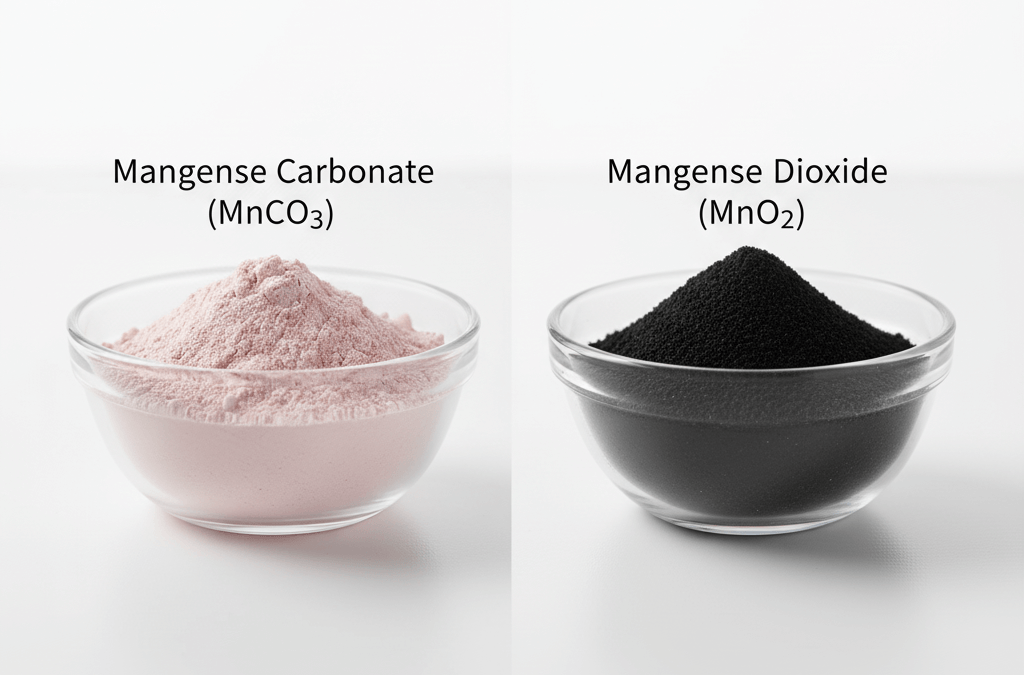
Manganese compounds are essential in many industrial applications: steel production, batteries, catalysts, ceramics, pigments, agriculture, and water treatment. Two of the most commonly discussed manganese compounds are manganese carbonate (MnCO₃) and manganese dioxide (MnO₂). Industrial buyers often compare them because they serve different roles, have different chemical and physical properties, and thus different price, supply, handling, and suitability.
2. Chemical and Physical Properties
Here are the key chemical and physical properties of MnCO₃ and MnO₂, with data from established sources.
| Property | Manganese Carbonate (MnCO₃) | Manganese Dioxide (MnO₂) |
|---|---|---|
| Chemical formula | MnCO₃ | MnO₂ (PubChem) |
| Molar Mass | ~ 114.95 g/mol | ~ 86.94 g/mol (PubChem) |
| Appearance / Color | White to faint pink solid (crystalline) | Brown-black solid / powder |
| Density (specific gravity) | ~ 3.12 g/cm³ | ~ 5.0 g/cm³ (INCHEM) |
| Solubility in water | Very slightly soluble, “negligible” in pure water; soluble in dilute acids or in presence of CO₂ | Essentially insoluble in water (PubChem) |
| Thermal behavior / Melting / Decomposition | Decomposes when heated (carbon dioxide loss), melting point not sharply defined due to decomposition prior to melting; approximate decomposition range ~200-300°C in some data sources. | Decomposes at ~535°C, loses oxygen above that; no stable melting under ordinary conditions. (INCHEM) |
| Crystal structure | Hexagonal-rhombohedral structure | Tetragonal (rutile type) for β-MnO₂; many polymorphs (α, β, δ etc.) with different structural features. (SpringerLink) |
Key takeaways:
MnCO₃ has lower density, lighter molar mass, and is more reactive (with acids, CO₂) than MnO₂.
MnO₂ is more stable at ambient conditions, higher density, strong oxidizing behavior, multiple polymorphic forms.
3. Production Methods
Understanding how each compound is produced helps in assessing cost, purity, possible contaminants, yield, and suitability.
Manganese Carbonate (MnCO₃)
Typically produced by reacting a soluble manganese(II) salt (e.g. manganese sulfate, MnSO₄) with a carbonate salt (e.g. sodium carbonate, Na₂CO₃) in aqueous solution. The reaction precipitates MnCO₃.
Another route: extraction from natural minerals like rhodochrosite (MnCO₃) when available.
Important parameters in precipitation include pH, temperature, reaction time, concentration of reagents. For example, in a study, precipitation yield ~ 98.4% under conditions of pH ≈ 8.5, 25°C, 1 hour for Mn recovery. ResearchGate
Manganese Dioxide (MnO₂)
Natural MnO₂ occurs in mineral form (pyrolusite, etc.). That natural ore is mined.
Synthetic MnO₂ can be made by oxidizing lower-valence manganese compounds (e.g. from Mn(II) or Mn(III)) using chemical oxidants or electrochemical (electrolytic) methods.
Also, MnO₂ can be derived by calcination (thermal decomposition) of MnCO₃ (or other manganese carbonates / precursors). One study showed converting MnCO₃ (precipitated) by calcination at 370-470°C over 1-4 hours led to MnO₂ formation with mass loss increasing with temperature/time. ResearchGate
Purity and Grade
Battery-grade MnO₂ demands very high purity, low levels of iron, heavy metals, etc. Impurities affect performance (battery capacity, stability).
For MnCO₃ used in agriculture or feed, purity requirements are less strict, but still important for toxic elements (e.g. Pb, Cd) and particle size.
4. Industrial Applications
Each compound finds different uses, depending on its chemical nature.
| Application Area | Manganese Carbonate (MnCO₃) – Common Uses | Manganese Dioxide (MnO₂) – Common Uses |
|---|---|---|
| Steel & Alloys | As a source of manganese in ferroalloys; as a precursor to manganese metal or manganese salts used in steel processes. | MnO₂ less directly used for adding manganese in steel; more used when oxide form is acceptable, but costs and reduction steps matter. |
| Battery / Energy Storage | Used in precursor roles: MnCO₃ can be converted into other manganese salts or oxides which then are processed for battery cathode materials. Not usually directly used in battery cathode in raw carbonate form. | Major use: MnO₂ is a standard cathode material in alkaline batteries and primary batteries; also in lithium-manganese, zinc-manganese, and other types. Different polymorphs (α, β, δ etc.) have different electrochemical properties. (SpringerLink) |
| Ceramics, Pigments, Glass | As a pigment or colorant upon firing; gives hues depending on firing, and used in glazes. Also used in ceramics for decorative effects. | MnO₂ used in glass to decolorize, to neutralize green/blue tint from iron; also used in glazes and pigments; used where oxide form needed. |
| Agriculture / Feed | Important as micronutrient manganese in fertilizers and animal feed. Plants require manganese(II). MnCO₃ is a way to supply manganese in less oxidized form. | Less used in agriculture directly; sometimes in soil / water treatments where oxidation is useful. |
| Water Treatment | Carbonate forms less used directly for oxidation; may be used in processes to adjust pH or supply manganese(II) in controlled settings. | Oxidizing agent; MnO₂ can help remove certain impurities; used in filtration media; also in catalytic applications to remove organics or decompose contaminants. |
| Catalysis & Chemical Oxidation | MnCO₃ less often used directly as catalyst; may be converted into oxides or salts for catalytic purposes. | Widely used. MnO₂ is a strong oxidant; in chemical reactions, catalysis, decomposition of oxidizable compounds; also in organic chemistry and environmental remediation. |
5. Market Demand & Pricing
Here are some data and trends for market size, growth, and price considerations.
Market Size & Growth
The global market revenue for manganese carbonate was valued at USD 1.2 billion in 2024 and is estimated to reach USD 2.5 billion by 2033, with a compound annual growth rate (CAGR) ~ 8.9 %. Verified Market Reports
The global manganese dioxide powder market (all grades) was valued at about USD 1.5 billion in 2022, with forecasted CAGR ~ 6.5 % from 2023 to 2030. Verified Market Reports
Pricing – MnO₂
Electrolytic manganese dioxide (EMD), which is a high-grade product for batteries etc., has seen spot price fluctuations in recent years around US$2,200–US$3,000 per metric ton.
Cost drivers include raw manganese ore, energy / electricity, reagents / chemicals, labor, and environmental compliance. For example, one cost-breakdown indicates ore may account for ~ 37% of cost, electricity ~ 28-30%, chemicals ~ 16-18%, and rest overhead etc.
Pricing – MnCO₃
6. Safety and Handling
Both compounds require certain precautions, but risks differ because of chemical nature.
Manganese Carbonate (MnCO₃)
As a solid (powder or granules), inhalation of dust is the main concern. Wearing dust masks or respirators, controlling dust, ventilation are standard.
Reacts with acids: produces CO₂, may release manganese(II) ions; if ingested in high amounts, manganese can be toxic. Environmental concerns if spilled.
Storage: keep dry, avoid strong acids or CO₂ rich atmospheres if decomposition is a concern.
Manganese Dioxide (MnO₂)
Strong oxidizer: can react with combustible materials, organic material, reducing agents. Heating may lead to oxygen evolution. INCHEM
Dust inhalation hazard. Also safety data sheets report that MnO₂ is not flammable, but when heated with reducing agents / metals it can contribute to fire risk. MilliporeSigma+1
Toxicity: acute toxicity is relatively low, LD₅₀ (oral, rat) > 3478 mg/kg in some studies. Prolonged exposure (especially inhalation of fine dust) can lead to neurological effects.
7. Choosing the Right Material for Your Industry
When a buyer must choose between MnCO₃ and MnO₂, several factors come into play:
Intended Application
If you need an oxidizer, catalyst, or battery cathode, MnO₂ is almost always required.
If you need a precursor, a micronutrient, feed/ fertilizer additive, or intermediate, MnCO₃ might suffice or be preferable.
Purity Requirement
Battery applications require high-purity MnO₂ or intermediates. Impurities like iron, copper, lead, etc. degrade performance.
Agricultural or pigment/ceramic uses have more tolerance for lesser purity.
Cost & Supply Chain
MnCO₃ is often cheaper to produce (less energy in oxidation), but converting to MnO₂ adds cost (oxidation, calcination, purification).
Transportation cost: heavier materials cost more to ship; MnO₂’s higher density may increase freight cost per volume.
Handling & Regulatory Issues
If handling oxidizers is a concern, or safety/regulation compliance (transportation, storage) is tight, MnO₂ may impose more responsibilities.
Environmental regulations may mandate certain emissions when producing or disposing of oxidizing waste.
Availability & Market Trends
As demand for battery materials increases, availability of high-grade MnO₂ may fluctuate, pushing prices up. Buyers may consider sourcing MnCO₃ and converting in-house or through supplier.
Also, regional variations: in some countries MnCO₃ is more readily available; in others, MnO₂ is easier to obtain.
A simplified decision table:
| If your need is… | Best choice |
|---|---|
| Battery cathode / oxidizing reactions | MnO₂ |
| Supplying manganese(II) form / micronutrient in agriculture / feed | MnCO₃ |
| Pigments / ceramics | Both possible, but choice depends on firing, color, cost; often oxide is used for richer or darker colors. |
| Lower cost, simpler handling | MnCO₃ |
| Strong oxidizer needed / catalyst function | MnO₂ |
8. Why Source from China
China is one of the major producers of manganese ore and manganese chemicals. It has infrastructure and established supply chains to produce both MnCO₃ and MnO₂ at scale.
Competitive pricing: due to lower labor cost, access to raw ores, and economies of scale.
Ability to offer various grades: battery-grade, industrial-grade, feed-grade, etc. Buyers can request certificates, compositional analyses (e.g. % Mn, impurity profile).
Good export experience: many manufacturers in China comply with international quality & safety standards (ISO, ASTM, etc.), which helps with purchasing & import compliance.
Flexibility / customization: particle size, moisture content, packaging, purity can often be adjusted to buyer needs.
Summary of Key Differences
| Aspect | Manganese Carbonate (MnCO₃) | Manganese Dioxide (MnO₂) |
|---|---|---|
| Oxidation state of Mn | +2 | +4 |
| Reactivity / oxidizing ability | Lower | Higher (oxidizer) |
| Density | Lower (~3.1-3.7 g/cm³) | Higher (~5.0 g/cm³) |
| Solubility | Slightly soluble in acids; very low in water | Insoluble in water |
| Thermal stability | Decomposes at lower temps; carbonates decompose to oxides + CO₂ | Decomposes / loses oxygen at higher temperature (≈ 535°C) |
| Main applications | Micronutrient, precursor, pigment / ceramics, agriculture | Batteries, oxidizing, catalysts, glass / water treatment |
| Cost / energy requirement | Generally lower cost to produce; fewer conversion steps | More expensive; oxidation, calcination, purification required |
| Safety / handling complexity | Moderate (dust, reaction with acid) | Higher (oxidizer, more regulatory concern) |
Conclusion
Manganese carbonate and manganese dioxide are both valuable industrial chemicals, but they are not interchangeable. Their differences in chemical form (Mn oxidation state), physical properties (density, solubility, thermal stability), and function (oxidizing capacity, precursor vs end-use) mean that the choice between them should be driven by your application, purity needs, cost constraints, and safety / handling capacity.
If your product requires oxidative behavior—battery cathodes, catalysts, or strong oxidants—MnO₂ is the appropriate choice despite higher cost and handling requirements. If you need a less reactive, more benign form of manganese for feed, agriculture, or as an intermediate, MnCO₃ often makes more sense.
Related Products

manganese dioxide

manganese carbonate

manganese sand
Related Posts

I am Edward lee, founder of manganesesupply( btlnewmaterial) , with more than 15 years experience in manganese products R&D and international sales, I helped more than 50+ corporates and am devoted to providing solutions to clients business.