When sourcing bulk chemical raw materials, a Certificate of Analysis (COA) is one of the most important quality documents provided by a manufacturer.
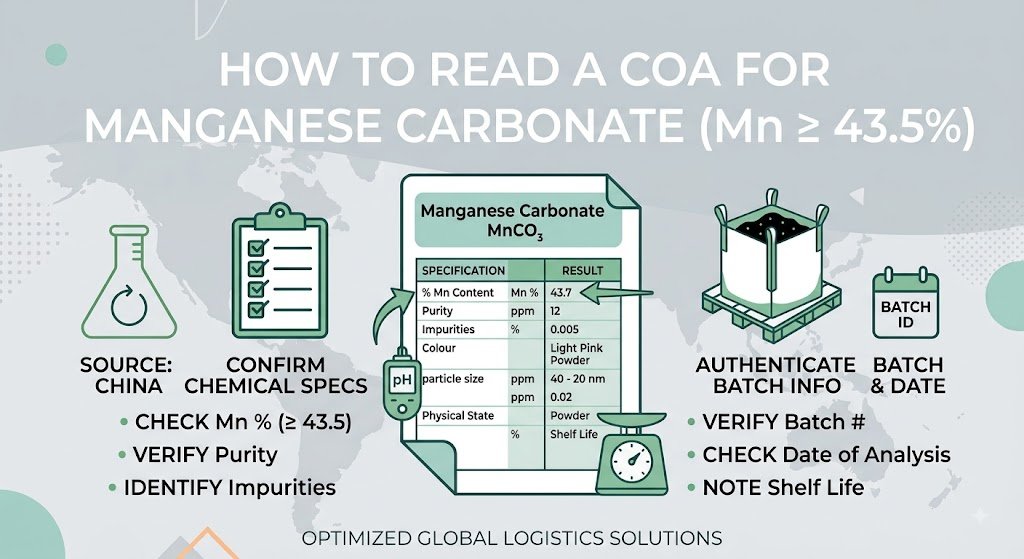
A COA confirms that a specific production batch of material has been tested and meets the agreed technical specifications. For buyers importing Fertilizer-Grade Manganese Carbonate (MnCO₃, CAS No. 598-62-9), understanding how to read a COA helps verify product consistency, evaluate supplier reliability, and ensure the material is suitable for agricultural applications.
This guide explains the key sections of a manganese carbonate COA and highlights the most important parameters procurement managers should review before purchasing.
1. Check Basic COA Information First
Before reviewing chemical analysis results, confirm that the COA matches the shipment documentation.
Important information includes:
Product Name
The product name should clearly identify:
Manganese Carbonate (MnCO₃) – Fertilizer Grade
This avoids confusion with other manganese compounds such as:
- Manganese Oxide (MnO)
- Manganese Dioxide (MnO₂)
- Manganese Sulfate (MnSO₄)
CAS Number
The CAS number confirms the chemical identity:
CAS No.: 598-62-9
This number should be consistent across:
- COA
- Commercial Invoice
- Packing List
- Technical Data Sheet (TDS)
Batch / Lot Number
The batch number connects the COA to the actual shipment.
For bulk imports, buyers should ensure the lot number matches the physical bags or jumbo bags received.
2. Key Parameters to Review on a MnCO₃ COA
A typical COA compares:
Specification Limit → the agreed product requirement
Test Result → the actual laboratory measurement of that batch
A. Manganese (Mn) Content
Typical Specification:
Mn ≥ 43.0% – 44.5%
The manganese content is the most important indicator of nutrient value.
Pure manganese carbonate theoretically contains approximately 47.7% elemental manganese. Commercial fertilizer-grade MnCO₃ normally contains slightly lower levels due to manufacturing conditions and trace components.
A result of:
Mn = 43.90%
indicates a high manganese concentration suitable for agricultural micronutrient applications.
Higher manganese content means:
- More active nutrient per ton of product
- Lower transportation cost per unit of manganese
- Better formulation efficiency for fertilizer manufacturers
B. Heavy Metal Content (As, Pb, Cd)
Heavy metal control is a critical factor for agricultural applications.
Typical specifications:
| Element | Specification |
|---|---|
| Arsenic (As) | ≤10 ppm |
| Lead (Pb) | ≤10 ppm |
| Cadmium (Cd) | ≤10 ppm |
Typical quality results:
| Element | Example Result |
|---|---|
| As | <6 ppm |
| Pb | <5 ppm |
| Cd | <4 ppm |
Low heavy metal levels help ensure compliance with agricultural regulations and provide safer raw materials for fertilizer production.
C. Moisture Content
Typical Specification:
Moisture ≤3.0%
Example result:
2.10%
Moisture control is important because excessive moisture may cause:
- Powder agglomeration during storage
- Poor flowability during blending
- Increased handling difficulty during transportation
D. Other Chemical Impurities
Additional parameters commonly reviewed include:
| Parameter | Typical Requirement |
|---|---|
| Iron (Fe) | ≤0.01% |
| Sulfate (SO₄) | ≤0.8% |
| Chloride (Cl) | ≤0.05% |
These indicators help evaluate raw material cleanliness and process control.
Lower impurity levels can improve compatibility when MnCO₃ is blended with other fertilizer ingredients.
3. Example Certificate of Analysis for Fertilizer Grade MnCO₃
| Parameter | Specification | Test Result |
|---|---|---|
| Manganese (Mn) | 43.0–44.5% | 43.90% |
| Moisture | ≤3.0% | 2.10% |
| Iron (Fe) | ≤0.01% | 0.01% |
| Sulfate (SO₄) | ≤0.8% | 0.75% |
| Chloride (Cl) | ≤0.05% | 0.04% |
| Arsenic (As) | ≤10 ppm | <6 ppm |
| Lead (Pb) | ≤10 ppm | <5 ppm |
| Cadmium (Cd) | ≤10 ppm | <4 ppm |
A complete COA provides buyers with confidence that the delivered manganese carbonate matches the agreed product specifications.
4. Common Questions About MnCO₃ COA
What information should a manganese carbonate COA include?
A professional MnCO₃ COA normally includes:
- Product name
- CAS number
- Batch number
- Production date
- Test date
- Chemical composition
- Impurity analysis
- Moisture content
- Manufacturer information
Is the testing method required on a COA?
Testing methods are often included by third-party laboratories, but the most important information for buyers is:
- Parameter tested
- Specification requirement
- Actual result
For technical evaluation, some buyers may request additional testing methods such as ICP analysis.
Why is CAS No. 598-62-9 important?
CAS No. 598-62-9 identifies manganese carbonate and helps avoid confusion during:
- Import documentation review
- Customs declaration
- Technical communication between suppliers and buyers
Choose a Reliable Manganese Carbonate Supplier
At BTL New Material Co., Ltd., we supply Fertilizer-Grade Manganese Carbonate (MnCO₃) with controlled manganese content, stable quality, and complete export documentation.
Each shipment can be provided with:
✓ Batch-specific Certificate of Analysis (COA)
✓ Product specification sheet (TDS)
✓ Quality inspection records
✓ Export packaging options
✓ Customized documentation support
For COA samples, product specifications, or manganese carbonate quotations, contact our export team.

I am Edward lee, founder of manganesesupply( btlnewmaterial) , with more than 15 years experience in manganese products R&D and international sales, I helped more than 50+ corporates and am devoted to providing solutions to clients business.