Executive Summary
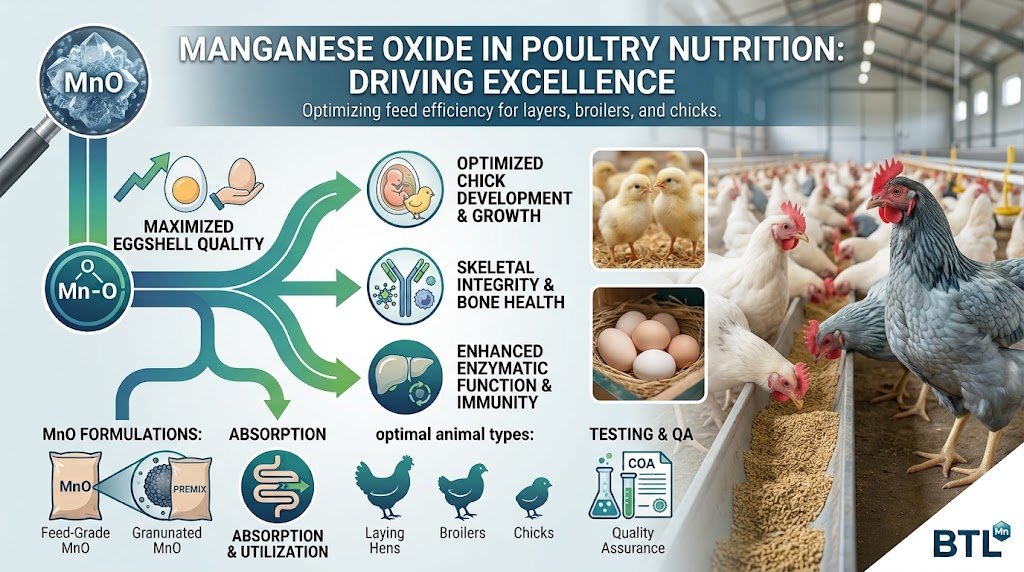
Poultry are the most manganese-sensitive livestock. MnO 60% is the most common manganese source in poultry premixes.
- Typical supplementation: 60–120 mg Mn per kg of complete feed.
- That equals 0.13–0.26 kg of MnO 60% per tonne of feed.
- MnO 60% delivers ≥ 46–47% Mn at the lowest cost per kg Mn.
- Stable, non-hygroscopic, pelleting-safe.
| Item | Value |
|---|---|
| Product | Feed-grade manganous oxide, MnO ≥ 60% |
| Elemental Mn | ≥ 46–47% |
| Typical inclusion | 60–120 mg Mn / kg feed |
| MnO 60% per tonne | 0.13–0.26 kg |
Quick Answer: What MnO 60% Does in Poultry Feed and How Much Is Used
Poultry need supplemental manganese in every diet, and MnO 60% is the default source in vitamin-mineral premixes. Typical supplementation runs 60–120 mg Mn per kg of complete feed. At 46.5% Mn, that requires 0.13–0.26 kg of MnO 60% per tonne. See Low Heavy Metal MnO for Poultry Feed Additives & Premix Production for the product grade used in poultry lines.
Why Poultry Need Manganese More Than Other Livestock
Manganese activates enzymes in bone formation, cartilage development, lipid and carbohydrate metabolism.
Poultry show deficiency faster and more visibly than mammals:
| Function | Deficiency sign in poultry |
|---|---|
| Bone and cartilage formation | Perosis (slipped tendon), leg weakness |
| Eggshell formation | Thin, cracked shells; poor shell breaking strength |
| Embryo development | High embryonic mortality, chondrodystrophy in breeders |
| Metabolism | Reduced growth, poor feed conversion |
Feed ingredients (corn, soybean meal) supply only 10–25 mg Mn/kg naturally. Absorption of this basal Mn is low. Supplementation is mandatory in intensive poultry production.
Typical Manganese Levels for Broilers, Layers, and Breeders
| Bird type | NRC basal requirement | Typical commercial supplementation |
|---|---|---|
| Broiler starter | ~60 mg/kg | 80–120 mg/kg |
| Broiler grower/finisher | ~60 mg/kg | 60–100 mg/kg |
| Layer pullet | ~30–60 mg/kg | 60–80 mg/kg |
| Layer in lay | ~20–30 mg/kg | 60–100 mg/kg |
| Breeder hen | ~60 mg/kg | 80–120 mg/kg |
NRC values are minimums to prevent deficiency under lab conditions. Commercial formulations add a safety margin for feed processing losses, ingredient variation, and antagonists (Ca, Fe, P). Many nutritionists now follow genetic-line guides, which exceed NRC.
Why MnO 60% Is the Default Manganese Source in Poultry Premixes
| Property | MnO 60% | Why premix plants prefer it |
|---|---|---|
| Elemental Mn | ≥ 46–47% | Highest Mn density of common inorganic sources |
| Hygroscopicity | None | No caking in premix storage |
| Chemical stability | Stable | No degradation in warehouse heat |
| Cost per kg Mn | Lowest | Best economics at scale |
| Oxidizing action | Minimal | Safer for vitamins than MnO₂ |
A premix plant buying MnO handles roughly half the tonnage it would need with manganese sulfate for the same Mn contribution.
How MnO Performs in Premix Manufacturing: Stability, Compatibility, and Particle Size
Particle size controls mixing uniformity. Feed-grade MnO is milled to 80–200 mesh.
| Factor | Effect |
|---|---|
| 80–200 mesh powder | Disperses into premix carriers; supports low CV in finished feed |
| Non-hygroscopic surface | Flows through dosing and mixing equipment year-round |
| Water-insoluble | No migration or spot-wetting of premix |
MnO is less aggressive toward fat-soluble vitamins than manganese sulfate in humid premixes. Sulfates carry crystal water and can trigger localized reactions. Manganous oxide stays inert.
Uniformity matters because a bird eats one daily ration. A 0.2 kg/tonne inclusion must distribute evenly across every tonne.
What Happens to MnO in the Feed Mill: Mixing, Pelleting, and Storage
| Process | MnO behavior |
|---|---|
| Mixing | Inert powder, no static or clumping |
| Pelleting (80–90 °C) | No decomposition, no volatilization |
| Cooling | Unchanged |
| Storage (moisture ≤ 1.5%) | No caking in bags or silos |
| Container shipping | Tolerates humidity swings in transit |
MnO survives pelleting with no measurable loss. Feed mills need no special handling. The low moisture spec keeps bagged product free-flowing through long sea voyages.
MnO vs. Manganese Sulfate for Poultry: Bioavailability and Cost Trade-offs
Research on poultry Mn bioavailability is genuinely mixed. MnO values from 70% to 100% relative to MnSO₄ appear in the literature, depending on the study, the response criterion, and the oxide’s citric-acid solubility.
| Factor | MnO 60% | MnSO₄·H₂O |
|---|---|---|
| Mn content | 46–47% | ~31.8% |
| Bioavailability | 70–100% (source-dependent) | 100% (reference) |
| Hygroscopic | No | Yes |
| Cost per kg Mn | Lower | Higher |
A high-solubility MnO (≥ 85–90% in 2% citric acid) closes most of the gap to sulfate in practical diets. For most broiler and layer programs, the lower cost per kg Mn outweighs the bioavailability difference.
Full source-by-source comparison: see our guide comparing manganese oxide, manganese sulfate, and other feed Mn sources.
Dosage Math: How Much MnO 60% Do You Need per Tonne of Feed
Formula:
kg MnO 60% per tonne = target Mn (mg/kg) ÷ 465
Because 1 kg of MnO 60% contains 465 g (0.465 kg) of elemental Mn.
Worked examples:
| Target inclusion | Mn needed per tonne | MnO 60% per tonne |
|---|---|---|
| 60 mg/kg | 60 g | 60 ÷ 0.465 = 129 g ≈ 0.13 kg |
| 80 mg/kg | 80 g | 80 ÷ 0.465 = 172 g ≈ 0.17 kg |
| 100 mg/kg | 100 g | 100 ÷ 0.465 = 215 g ≈ 0.22 kg |
| 120 mg/kg | 120 g | 120 ÷ 0.465 = 258 g ≈ 0.26 kg |
Premix check: at 0.5% premix inclusion (5 kg per tonne), a 100 mg/kg Mn target needs 2% MnO in the premix: 215 g ÷ 5 kg = 4.3%.
Remember to subtract basal feed Mn (10–25 mg/kg from raw materials) when setting the supplemented level.
Compliance and COA Checks for Poultry Feed Applications
Check every batch COA against feed safety limits.
| Item | Typical MnO 60% spec | Reference limit |
|---|---|---|
| As | ≤ 5 ppm | EU, AAFCO, GB 13078 compliant |
| Pb | ≤ 10 ppm | EU, AAFCO, GB 13078 compliant |
| Cd | ≤ 5 ppm | EU, AAFCO, GB 13078 compliant |
| Citric acid solubility | ≥ 85–90% | Mn availability indicator |
| Moisture | ≤ 1.5% | Storage and flow |
Also verify:
- MnO assay basis: as-received or dry.
- Batch-to-batch consistency across shipments.
- Particle size matches your mixing line (80–200 mesh standard).
Third-party SGS or Intertek verification is available on request.
Frequently Asked Questions About MnO in Poultry Feed
Can I use MnO in layer feed for eggshell quality?
Yes. MnO 60% at 60–100 mg/kg Mn inclusion supports shell matrix formation. Layers on MnO alone maintain standard shell quality in most commercial programs.
Is MnO bioavailability too low for poultry?
No. Oxide bioavailability varies 70–100% by study. High citric-soluble grades perform near sulfate levels in practical diets. The cost advantage usually compensates for any gap.
Can MnO replace MnSO₄ 1:1?
No. MnO 60% holds 46.5% Mn versus 31.8% in the sulfate. To match 1 kg of MnSO₄ Mn, you need only 0.68 kg of MnO. Recalculate by elemental Mn, not by product weight.
Does pelleting destroy MnO?
No. MnO is thermally stable at feed-pelleting temperatures. No volatilization or decomposition occurs.
Conclusion: A Proven, Cost-Effective Mn Source for Poultry Lines
Poultry need manganese in every ration. MnO 60% supplies it at the highest density and lowest cost per kilogram of Mn, with stable handling through premix, pelleting, and shipping. Dose by elemental Mn: 60–120 mg/kg feed equals 0.13–0.26 kg MnO per tonne. Verify As, Pb, and Cd on every COA.
We supply feed-grade manganous oxide for poultry premix and complete-feed lines. Particle size and heavy-metal specs can be customized to your formulation. TDS, COA, and samples available on request — contact us for a quote.

I am Edward lee, founder of manganesesupply( btlnewmaterial) , with more than 15 years experience in manganese products R&D and international sales, I helped more than 50+ corporates and am devoted to providing solutions to clients business.