Executive Summary
Forage Mn varies widely and antagonists block absorption. Supplementation is routine in beef, dairy, and sheep programs.
- Typical total Mn in cattle rations: 40–60 mg/kg dry matter.
- Product: feed-grade manganous oxide, MnO ≥ 60%, elemental Mn ≥ 46–47%.
- Primary vehicle: mineral mixes, TMR premix, pressed blocks.
- Non-hygroscopic: no caking in salt-based loose minerals.
- Lowest cost per kg Mn of the common inorganic sources.
Quick Answer: Why Cattle Need Manganese Supplementation and Where MnO Fits
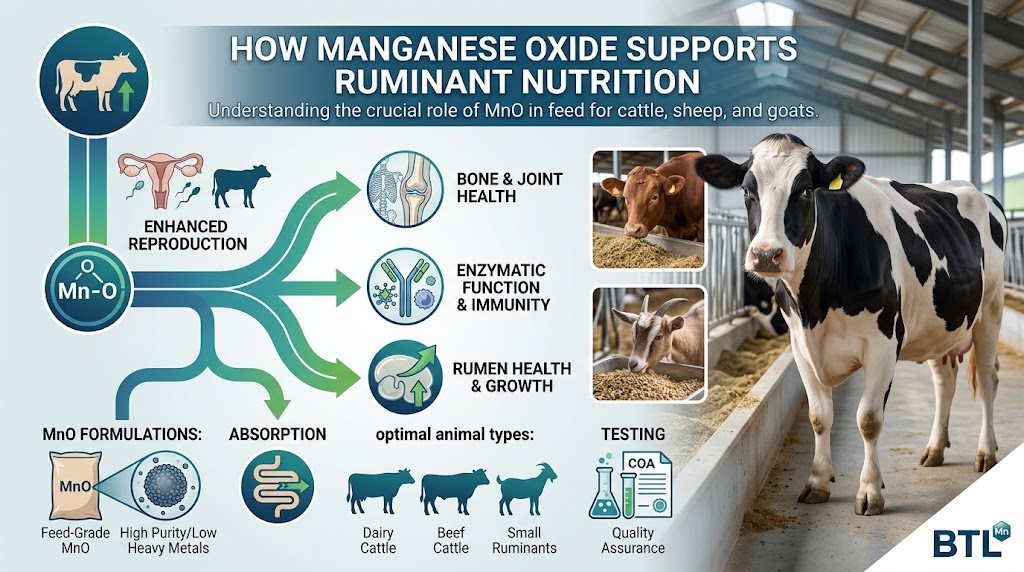
Forage Mn content swings with soil and maturity, and high calcium, high iron, and high potassium diets suppress Mn absorption. Beef and dairy rations typically target 40–60 mg/kg total Mn on a dry matter basis. MnO 60% is the most common source in free-choice minerals, TMR premixes, and blocks. See Feed Grade Manganese Oxide (MnO) 60% for the product grade.
What Manganese Does for Cattle: Bones, Joints, Fertility, and Newborn Calves
Manganese activates enzymes for cartilage, bone matrix, and reproductive hormone function.
| Function | Deficiency consequence in cattle |
|---|---|
| Bone and joint development | Stiff joints, swollen knees, abnormal stance |
| Cow fertility | Silent heat, delayed estrus, poor conception |
| Newborn calves | Weak legs, joint laxity, slow standing |
| Bull fertility | Lower libido, reduced semen quality |
| Growth | Poorer gains, reduced feed efficiency |
The typical field signal: reproduction problems appear before skeletal problems. Unexplained infertility, silent heats, or weak newborn calves on apparently adequate diets are classic Mn-response cases.
Why High-Forage Diets Don’t Guarantee Enough Manganese: Antagonists and Variability
Three factors make ruminant Mn status worse than the forage test suggests.
| Factor | Mechanism |
|---|---|
| Forage variability | Mn swings from 20 to 200+ mg/kg with species, soil, and maturity |
| High calcium | Limestone supplementation and legume forages suppress Mn absorption |
| High iron | Soil-contaminated forage and iron oxide in minerals compete at absorption sites |
| High potassium | Fertilized grasses interfere with trace mineral uptake |
A forage test showing 60 mg Mn/kg can still leave cows deficient when dietary Ca and Fe run high. Commercial programs supplement 40–60 mg/kg total regardless of basal levels.
Typical Manganese Levels for Beef Cattle, Dairy Cows, and Sheep
| Animal | NRC basal requirement | Typical commercial total Mn |
|---|---|---|
| Beef cow | ~20 mg/kg DM | 40–60 mg/kg DM |
| Feedlot cattle | ~20 mg/kg DM | 40–60 mg/kg DM |
| Lactating dairy cow | ~13–14 mg/kg DM | 40–60 mg/kg DM |
| Dry cow / transition | ~14 mg/kg DM | 60 mg/kg DM |
| Sheep | ~20 mg/kg DM | 40–60 mg/kg DM |
| Milk replacer / starter | — | 40–100 mg/kg |
NRC values prevent deficiency under controlled conditions. Commercial levels add margin for antagonists, forage variability, and the cost of falling short. Transition cows and calves get the top of the range.
Why MnO 60% Is the Standard Mn Source in Ruminant Mineral Mixes
Salt-based loose minerals sit in open troughs for days, in weather. Source selection is decided by handling, not just chemistry.
| Property | MnO 60% | MnSO₄·H₂O |
|---|---|---|
| Hygroscopicity | None | High |
| Behavior in salt-based mineral | Stays free-flowing | Cakes, hardens, bridges |
| Mn density | 46–47% | ~31.8% |
| Cost per kg Mn | Lowest | Higher |
A mineral mix that cakes stops delivering every nutrient it carries. Manganous oxide keeps salt, magnesium oxide, calcium, and trace mineral blends pouring through all seasons. This single property explains why oxide dominates ruminant mineral programs.
How MnO Performs in Mineral Mixes, TMR, Blocks, and Boluses
| Vehicle | MnO performance |
|---|---|
| Loose mineral (salt-based) | Free-flowing, weather-tolerant, no bridging |
| TMR premix | Inert with common carriers; 80–200 mesh disperses evenly |
| Pressed blocks | Withstands block compression; slow weathering release |
| Boluses | Dense oxide sustains slow release over weeks |
MnO is inert with the common mineral-mix components — salt, calcium carbonate, magnesium oxide, and copper and zinc oxides. No interactions, no segregation.
Block hardness affects release. Harder pressed blocks slow intake of all minerals, including Mn. Match block compression to target consumption before relying on a block as the sole Mn vehicle.
MnO vs. Manganese Sulfate for Ruminants: The Bioavailability Debate
The ruminant debate is sharper than in pigs or poultry.
| Argument | Detail |
|---|---|
| Against MnO | Low solubility in rumen fluid; some trials show lower absorption than sulfate |
| For MnO | Lower cost per kg Mn; non-hygroscopic; practical handling in weathered minerals |
Practical split used by many nutritionists:
| Group | Source choice |
|---|---|
| Large herd, mid-gestation, grazing | MnO 60% |
| Transition cows, high-antagonist diets | Partial sulfate or organic substitution |
| Problem-herd reproduction cases | Injectable or organic Mn under vet direction |
At 40–60 mg/kg total Mn, manganous oxide supplies adequate absorbable Mn for most herds at the lowest cost. Reserve premium sources for critical groups. Full source comparison: see our guide comparing manganese oxide, manganese sulfate, and other feed Mn sources.
Dosage Math: How Much MnO 60% Do You Need per Tonne of Ruminant Feed or Mineral Mix
Two calculations, depending on the delivery vehicle.
Formula 1 — TMR or complete feed:
kg MnO 60% per tonne = target Mn (mg/kg DM) ÷ 465
| Target total Mn | Basal forage Mn | Supplemental Mn | MnO 60% per tonne DM |
|---|---|---|---|
| 40 mg/kg (beef) | 25 mg/kg | 15 mg/kg | 15 ÷ 0.465 = 32 g |
| 50 mg/kg (dairy) | 25 mg/kg | 25 mg/kg | 25 ÷ 0.465 = 54 g |
| 60 mg/kg (transition) | 25 mg/kg | 35 mg/kg | 35 ÷ 0.465 = 75 g |
Formula 2 — Free-choice mineral mix:
Step 1: target supplemental Mn per head per day ÷ expected mineral intake = Mn concentration in the mix.
Step 2: Mn concentration ÷ 0.465 = kg MnO per tonne of mineral.
Example — dairy cow, 100 g mineral intake per day, 25 mg supplemental Mn target:
- 25 mg ÷ 0.1 kg = 250 mg Mn per kg mineral.
- 250 ÷ 0.465 = 538 g MnO per tonne of mineral mix.
Always calculate against expected intake. If cattle eat 70 g instead of 100 g, Mn delivery drops 30% with the same mix.
Grazing Herds: Delivering Mn Through Free-Choice Minerals and Blocks
Grazing cattle can’t be dosed daily through feed. Delivery options:
| Method | Strength | Risk |
|---|---|---|
| Loose free-choice mineral | Standard, cheap, flexible | Intake varies 50–150 g/day between animals |
| Pressed block | Weather-proof, controlled | Slower, more variable intake |
| Injectable Mn | Precise, guaranteed | Labor, vet-directed, special cases only |
Intake variation is the hidden problem. Individual cows consume from half to double the herd average. Formulate mixes that cover below-average consumers without exceeding tolerances for above-average ones.
Compliance and COA Checks for Ruminant Feed Applications
Check every batch COA against target-market limits.
| Item | Typical MnO 60% spec | Notes |
|---|---|---|
| As | ≤ 5 ppm | EU, AAFCO, GB 13078 compliant |
| Pb | ≤ 10 ppm | EU, AAFCO, GB 13078 compliant |
| Cd | ≤ 5 ppm | EU, AAFCO, GB 13078 compliant |
| Fluorine | Low in MnO; verify for mineral blends | Ruminant programs with phosphate sources must track total dietary F |
| Citric acid solubility | ≥ 85–90% | Mn availability indicator |
| Moisture | ≤ 1.5% | Free-flow guarantee |
Also verify the assay basis (as-received or dry), particle size for the vehicle (80–200 mesh for mixes and blocks), and batch-to-batch consistency. Third-party SGS or Intertek verification is available on request.
Frequently Asked Questions About MnO in Cattle Feed
Do forages provide enough Mn for cows?
Sometimes. Forage Mn varies 20–200+ mg/kg, and antagonists cut absorption. Supplementing to 40–60 mg/kg total is the reliable approach.
Is MnO available enough for ruminants?
For most herds, yes. Ruminal solubility is lower than sulfate, but at commercial levels MnO maintains adequate Mn status at the lowest cost. Transition cows and problem herds may justify more available sources.
How do I add Mn to a free-choice mineral?
Blend 0.4–0.6 kg MnO 60% per tonne of mineral mix, calculated from expected intake and target supplemental Mn. The oxide stays free-flowing in salt-based mixes.
Do beef and dairy needs differ?
Basal requirements are similar. Dairy programs run higher total Mn (up to 60 mg/kg) because milk output and reproduction pressure demand a wider margin.
Conclusion: A Stable, Low-Cost Mn Source Built for Ruminant Programs
Cattle diets need 40–60 mg/kg total Mn against variable forages and strong antagonists. MnO 60% delivers it at the lowest cost per kilogram of Mn, and — critically for ruminants — never cakes in salt-based minerals, TMR, or blocks. Dose by elemental Mn and verify As, Pb, Cd, and F on every COA.
We supply feed-grade manganous oxide for ruminant mineral mix, TMR, and block production. Particle size and heavy-metal specs can be customized to your line. TDS, COA, and samples available on request — contact us for a quote.

I am Edward lee, founder of manganesesupply( btlnewmaterial) , with more than 15 years experience in manganese products R&D and international sales, I helped more than 50+ corporates and am devoted to providing solutions to clients business.