Executive Summary
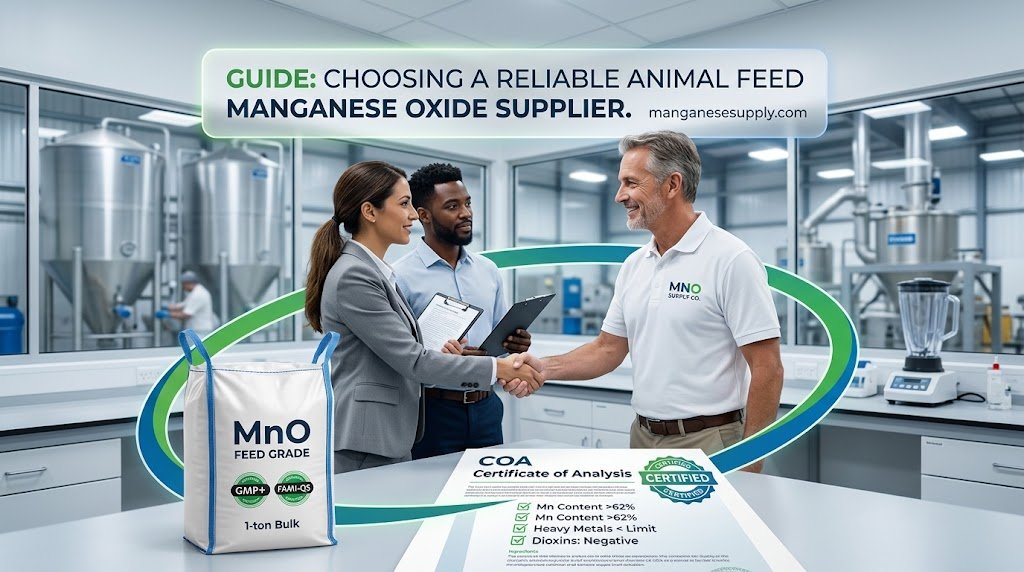
Choose an MnO supplier on five dimensions: product capability, quality system, regulatory documentation, supply reliability, and commercial practice. A supplier failing two or more is not a price problem — it is a risk problem. Qualify first, negotiate second.
- Five dimensions, one pass/fail gate.
- Supplier risk is asymmetric: a bad source costs more than a good one saves.
- Verify in stages, from documents to trial order.
Quick Answer: The Five-Dimension Framework for Evaluating an MnO Supplier
| Dimension | One-line test |
|---|---|
| Product capability | Does a real feed-grade line exist? |
| Quality system | Is the next batch as good as the sample? |
| Regulatory documentation | Can the goods clear your destination market? |
| Supply reliability | Will the container arrive when promised? |
| Commercial practice | How do they behave when something goes wrong? |
The rule: pass all five, then talk price. Feed-grade MnO is a trace mineral — inclusion rates are grams per tonne — but the consequences of a bad source scale to whole batches of feed. The cost of choosing wrong is far larger than the price difference you are trying to negotiate.
Why Supplier Choice Matters More for a Trace Mineral Than for Commodities
Manganese sits in feed at 30–120 mg/kg. The product volume is small. The exposure is not.
- Heavy metal or phase defects spread through every batch of feed made from that lot.
- A bad batch is not discovered at intake — it shows up in mixer CV, bird performance, or an inspection report months later.
- Switching costs are hidden: re-validation samples, formula adjustments, and QC paperwork for every new source.
This is the asymmetry: you save a fraction on price today, and you risk the whole production week tomorrow. Choosing carefully is not bureaucracy. It is the cheapest insurance in the supply chain.
Dimension 1 — Product Capability: Feed-Grade Range, Specs, and Customization
Product capability is the gate. Everything else is discussion after it.
Ask three questions:
- Is there a genuine feed-grade line? Not industrial MnO relabeled — a product made, milled, and tested for feed. The line between feed grade and industrial grade is heavy metal control and traceability; see What Is the Difference Between Feed Grade and Industrial Grade Manganese Oxide?
- What does the range cover? Typical feed-grade bands: 55%, 60%, 62% MnO — with 80–200 mesh particle size and heavy metals within As ≤ 5, Pb ≤ 10, Cd ≤ 5 ppm. The wider the real range, the better the match to your formula.
- Can they customize? Mesh range for your premix tower, a lower-heavy-metal variant for poultry lines, a specific assay band. A supplier who only offers “one size” is offering their convenience, not your requirement.
Work the details line by line in What Manganese Oxide Specifications Should Feed Manufacturers Check Before Buying?, then set the band in How Do Feed Manufacturers Choose the Right Grade of Manganese Oxide?
Dimension 2 — Quality System: Testing, Batch Consistency, and Traceability
A product capability is a claim. A quality system is the evidence machine behind it.
| Check | What it proves |
|---|---|
| In-house QC lab vs. outsourced testing | Faster feedback and tighter control, or a middleman without instrumentation |
| Complete COA per batch | Named methods, dual assay, solubility, heavy metals — the 10-item standard from What Should Be Included in a COA for Feed-Grade Manganese Oxide? |
| Last 3–5 batch COAs offered voluntarily | Batch consistency — a tight spread is process control; refusal is a process too |
| Lot number on every bag and container | Traceability from ore to your intake |
The question to ask: what happens between batches? A quality system is the only guarantee that the next shipment looks like the sample. The sample is a promise; the system is the delivery.
Dimension 3 — Regulatory Compliance and Documentation
Feed crosses borders on paper before it crosses them in containers.
Documentation to request, matched to your destination market:
- Heavy metal test reports per target-market limits (EU Directive 2002/32/EC framework, US AAFCO conformity, China GB 13078).
- SDS, COO (certificate of origin), and customs documentation.
- Feed-chain registration or equivalent status where the destination requires it.
- Documentation of the production site’s compliance program.
A supplier who produces these smoothly has export experience. Export experience means their material has cleared ports before — and that is a direct reduction of your supply-chain risk. A supplier who stalls on documents is telling you what the customs inspection will be like.
Dimension 4 — Supply Reliability: Capacity, Lead Time, and Export Track Record
A great product that arrives late is a production problem, not a sourcing win.
| Check | Why it matters |
|---|---|
| Capacity vs. your volume | Can they fill a repeat order, or just a sample? |
| Lead time: promised vs. actual | Ask for past shipment records, not a quote |
| Destination track record | Which ports and countries have they shipped to? |
| Packaging options | 25 kg bags, 1,000 kg big bags, container loading patterns |
| Repeat customers | References from buyers who reordered — not one-off deals |
For a continuous feed plant, a stock-out is not a scheduling hiccup. It is an unscheduled formula change, a QC event, and possibly a finished-feed recall decision. Reliability is a specification of the supplier, not of the product.
Dimension 5 — Commercial Practice: Samples, Trials, and How They Handle Problems
This dimension is the most predictive — and the easiest to test before you commit.
- Samples. Free samples and trial-batch support are standard for feed minerals. Reluctance here predicts reluctance everywhere.
- Technical answers. Email a technical question. A real answer with numbers and reasoning signals a technical team. A price quote in response signals a sales desk.
- Problem behavior. Ask how they handled a recent complaint — replacement, refund, or deflection. Pre-sales behavior is the best predictor of post-sales behavior. There is no better test than a small trial order that is slightly inconvenient to them.
Factory or Trading Company? An Honest Comparison for Feed Buyers
Both models exist for a reason. Neither is automatically right.
| Factor | Factory | Trading company |
|---|---|---|
| Price | Closer to cost of production | Adds a margin layer |
| Process control | Direct control of calcination and milling | Depends on their source |
| Flexibility | One product line, deep | Multiple sources, wider range |
| Language and logistics | Varies | Often a strength |
| Verification | Factory visit settles it | Visit reveals a warehouse, not a plant |
Two practical checks: can they arrange a factory visit, and who signs the quality commitment? The real question is not “factory or trader” — it is “who takes responsibility for quality, and what happens when they are wrong.” Verify the label by asking for a visit or a virtual plant tour.
The Verification Path: From Desktop Check to Trial Order
Turn the framework into a timeline with pass gates.
| Stage | Action | Pass criterion |
|---|---|---|
| 1. Document check | TDS, sample COA, compliance files | All ten COA items present; methods named |
| 2. Sample testing | Your lab or third party; include XRD / solubility | Mn, solubility, heavy metals within limits |
| 3. Trial order | One lot, your receiving workflow | Lot matches COA; plant performance holds |
| 4. Scale-up | Two to three full shipments | Batch spread stays tight |
| 5. Periodic review | Annual or per-major-change re-qualification | No drift in specs or behavior |
Each stage has a clear pass or fail. No stage is skipped for price.
Supplier Evaluation Scorecard: A One-Page Checklist
| Dimension | Check items | Weight | Score (1–5) |
|---|---|---|---|
| Product capability | Feed-grade line, spec range, customization | 25% | |
| Quality system | Lab, per-batch COA, batch history, traceability | 25% | |
| Regulatory documentation | Target-market reports, SDS, export record | 20% | |
| Supply reliability | Capacity, lead time, packaging, references | 15% | |
| Commercial practice | Samples, technical responses, problem handling | 15% |
Total across 100%. A score below 70 — or a zero on any single dimension — is a stop. Use the same sheet for every supplier; the discipline is in comparing like for like.
Frequently Asked Questions About Choosing an MnO Supplier
Should I buy from a factory or a trader?
Either can work. Judge by who takes responsibility for quality and what happens when a batch fails — not by the label. Verify with a factory visit or virtual plant tour.
How do I verify a Chinese MnO manufacturer?
Request business registration and export records, ask for the last 3–5 batch COAs with named methods, and arrange a factory visit or video tour. Cross-check the COA with third-party testing of your own sample.
What’s the minimum order for a trial?
A single lot or one pallet is typical for feed minerals. Any supplier unwilling to support a trial order is signaling what the relationship will be like.
How often should I re-qualify a supplier?
At least annually, plus after any major change — new production line, changed raw material source, ownership change. Batch spread from the last 3–5 COAs is the ongoing early-warning signal.
Conclusion: Qualify First, Negotiate Second
Five dimensions decide the supplier: product capability, quality system, regulatory documentation, supply reliability, and commercial practice. Verify in stages — documents, samples, trial order, scale-up, review. A supplier failing two dimensions is not a negotiating opportunity; it is a risk to price elsewhere.
We put the evidence on the table before you ask: factory introduction and production process, feed-grade TDS, recent batch COAs, samples, and a factory visit invitation. Start with Feed Grade Manganese Oxide (MnO) 60%, then request the documentation pack — contact us to begin qualification.

I am Edward lee, founder of manganesesupply( btlnewmaterial) , with more than 15 years experience in manganese products R&D and international sales, I helped more than 50+ corporates and am devoted to providing solutions to clients business.