Executive Summary
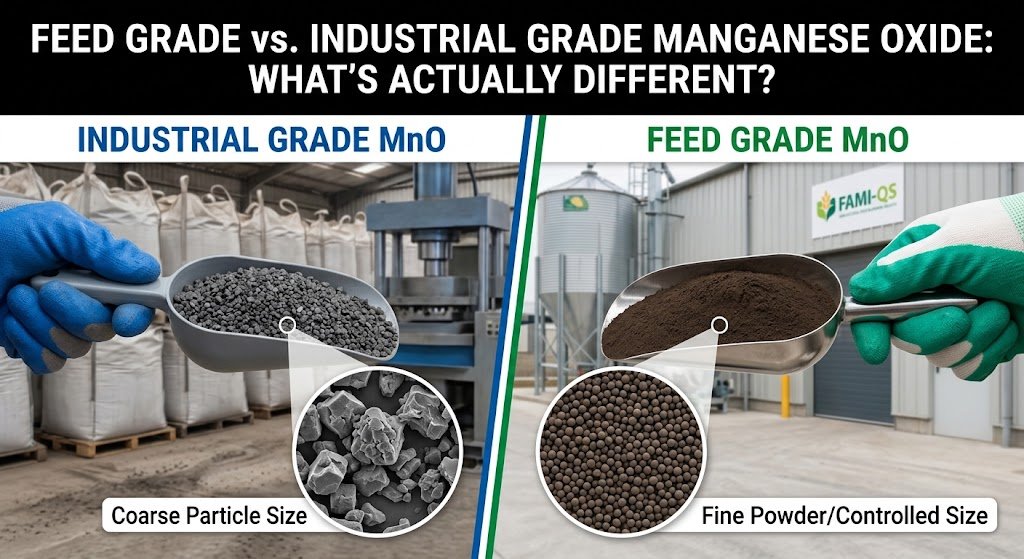
The difference is not manganese content. Feed grade and industrial grade MnO differ in heavy metal limits, particle size control, testing frequency, and traceability. Industrial grade is not produced or documented to feed-safety standards.
- Same chemistry, different safety standard.
- Hard limits on As, Pb, Cd separate the two grades.
- Substituting industrial grade in feed is a regulatory and food-safety risk.
- Read a COA like a checklist: name, limits, methods, batch number.
Quick Answer: Same Chemistry, Different Safety Standard
Both products are mainly manganese oxide. Feed grade is produced and tested to the standard that allows it into animal feed. Industrial grade is not.
| Looks the same | Actually differs |
|---|---|
| MnO assay around 60% | Heavy metal limits: As, Pb, Cd |
| Chemical form: MnO | Particle size control |
| Dark powder appearance | Citric acid solubility |
| — | Test frequency and batch traceability |
The chemistry overlaps. The safety standard does not.
Why Two Grades Exist: The Application Split
Industrial grade serves glass, ceramics, refractories, and smelting. In those processes, ppm levels of lead or arsenic do not reach animals or food. The product only needs the right assay and the right physical behavior.
Feed grade serves the animal digestive tract. From there, everything in the product has a route to the food chain. That changes which numbers matter.
| Application | What the grade must guarantee |
|---|---|
| Glass, ceramics, refractories | Assay, particle behavior, cost |
| Animal feed | Assay, heavy metals, solubility, traceability |
Same logic, different standards. The problem starts when one grade is substituted for the other.
Feed Grade vs. Industrial Grade: A Side-by-Side Spec Comparison
| Parameter | Feed grade (typical) | Industrial grade (typical) |
|---|---|---|
| MnO / Mn assay | ≥ 60% MnO, paired Mn ≥ 46–47% | Can be equal or higher; Mn line often absent |
| As / Pb / Cd limits | As ≤ 5, Pb ≤ 10, Cd ≤ 5 ppm, batch-tested | Often not tested or not guaranteed |
| Particle size | 80–200 mesh, controlled range | Broad, set per application |
| Citric acid solubility | ≥ 85–90%, measured | Not measured |
| Moisture | ≤ 1.5% | Variable |
| Test frequency | Every batch | Per lot or on request |
| Batch traceability | Batch COA plus production docs | Limited or absent |
The last five rows are where feed grade and industrial grade split. Feed Grade Manganese Oxide (MnO) 60% carries all seven lines on its TDS.
Heavy Metal Control: The Real Difference That Decides Safety
Industrial manganese oxide starts from mined ore and smelting. The raw material naturally carries lead, arsenic, and cadmium. At ppm levels these are harmless in a glass furnace. In a digestive tract they are not.
Feed grade carries hard limits: arsenic ≤ 5 ppm, lead ≤ 10 ppm, cadmium ≤ 5 ppm. Every batch is tested, and the number is written on the COA.
Why such tight numbers? Animals are long-term, low-dose accumulators. Lead and cadmium deposit in liver and kidney. They pass into eggs, meat, and milk. From there they reach the human table.
| Metal | Feed-grade limit | Where it accumulates |
|---|---|---|
| Arsenic | ≤ 5 ppm | Liver, kidney |
| Lead | ≤ 10 ppm | Bone, kidney, liver |
| Cadmium | ≤ 5 ppm | Kidney, liver, eggs |
This is the mechanism behind “a few lines of numbers change the product.” For a feed manufacturer, heavy metals are the one-vote veto: everything else can be discussed, a cadmium miss sends the container back. For poultry lines with the tightest exposure requirements, see Low Heavy Metal MnO for Poultry Feed Additives & Premix Production.
What Happens If You Substitute Industrial Grade in Feed
The savings are small and visible. The risks are large and delayed.
| If you save | You risk |
|---|---|
| A few percent on the MnO price | Regulatory non-compliance |
| — | Shipment rejected at export inspection |
| — | Heavy metal residues in liver, eggs, meat |
| — | Lost customer contracts and brand damage |
| — | Recall costs exceeding a year of savings |
Regulatory reality: feed law requires feed materials to come from registered feed-chain operators. The EU applies feed hygiene rules (Regulation (EC) 183/2005) and maximum levels for undesirable substances (Directive 2002/32/EC). The US uses AAFCO definitions; China uses GB 13078. None of them recognize “industrial grade” as a feed material.
A rejected container costs the full shipment value, plus demurrage, retesting, and quarantine. One recall costs more than years of grade savings. The “cheap” ton is usually the most expensive one.
How to Tell Them Apart on a Spec Sheet or COA
Five checks identify a feed-grade document in under a minute.
- Product name. Does it say “feed grade” or “for animal nutrition”? If not, it is not labeled as feed material.
- Heavy metal limits. Numbers present: As ≤ 5, Pb ≤ 10, Cd ≤ 5 ppm. “Complies” without numbers is not a limit.
- Solubility and particle size. Citric acid solubility and a mesh range are feed-grade lines. Industrial sheets rarely carry them.
- Test method. ICP-OES, AAS, or titration named per parameter. Unnamed methods are not comparable.
- Batch number and traceability. A batch COA ties numbers to a specific production run. Without it, the certificate proves nothing.
Missing lines are information. For the full eight-spec checklist, see What Manganese Oxide Specifications Should Feed Manufacturers Check Before Buying?
Why Headline Numbers Can Look the Same: Purity vs. Control
An industrial-grade COA can show the same MnO assay as a feed-grade sheet. Sometimes higher. The difference is in what is not on the page.
- Which metals were tested? Often none.
- What limits apply? Often none.
- How consistent is the product batch to batch?
- What documentation accompanies each shipment?
This is the “surface compliance” trap. A sheet that lists only MnO% looks fine until the inspection lab checks cadmium. The assay line sells the product; the control lines keep it legal.
Read the full picture, not the headline number.
How Much More Does Feed Grade Cost — and When Price Should Never Decide
The price gap comes from control costs, not margin:
- Selected raw material with a predictable heavy metal profile.
- Heavy metal testing on every batch.
- Tighter milling control for a defined particle size range.
- Documentation: COA, traceability, compliance files.
When you may negotiate: compare prices within feed grade, per kg of delivered elemental Mn. That is the honest comparison.
When you must not save: never downgrade the grade. If a supplier offers “the same product” at a discount without feed-grade documentation, the missing lines are the cost. See How Do Feed Manufacturers Choose the Right Grade of Manganese Oxide? for the full selection sequence.
Frequently Asked Questions About Feed Grade vs. Industrial Grade
Can industrial-grade MnO ever be used in feed?
Not as a compliant feed material in regulated markets. It is not produced, tested, or documented to feed-safety standards, so heavy metal levels are unverified. The legal and food-safety risk outweighs any price advantage.
How do I know my supplier’s product is really feed grade?
Check the COA: feed-grade labeling, numeric heavy metal limits, named test methods, batch number, and citric acid solubility. Ask for third-party verification and the last 3–5 batch COAs.
Are the heavy metal limits the same in every country?
No. EU (Directive 2002/32/EC), US (AAFCO), and China (GB 13078) differ in detail. Confirm the numbers against your destination market’s rules, and ask the supplier to provide reports matched to that market.
Why does feed-grade MnO cost more?
Because it carries extra control: selected raw material, batch heavy metal testing, tighter particle size control, and full documentation. The premium is the price of the safety standard.
Conclusion: Buy the Grade That Matches the Risk You’re Willing to Take
Same chemistry, different standard. Feed grade and industrial grade split on heavy metal limits, particle size control, testing frequency, and traceability. Industrial grade is not a cheaper version of feed grade — it is a different product with a different risk profile.
We publish feed-grade TDS and COA with full heavy metal panels, named test methods, and batch numbers. Reports can be prepared against the regulations of your target market. TDS, COA history, and samples on request — contact us for the documentation pack.

I am Edward lee, founder of manganesesupply( btlnewmaterial) , with more than 15 years experience in manganese products R&D and international sales, I helped more than 50+ corporates and am devoted to providing solutions to clients business.