Crystalline Manganese Sulfate for High-Nickel Cathode Materials
Short Product Description
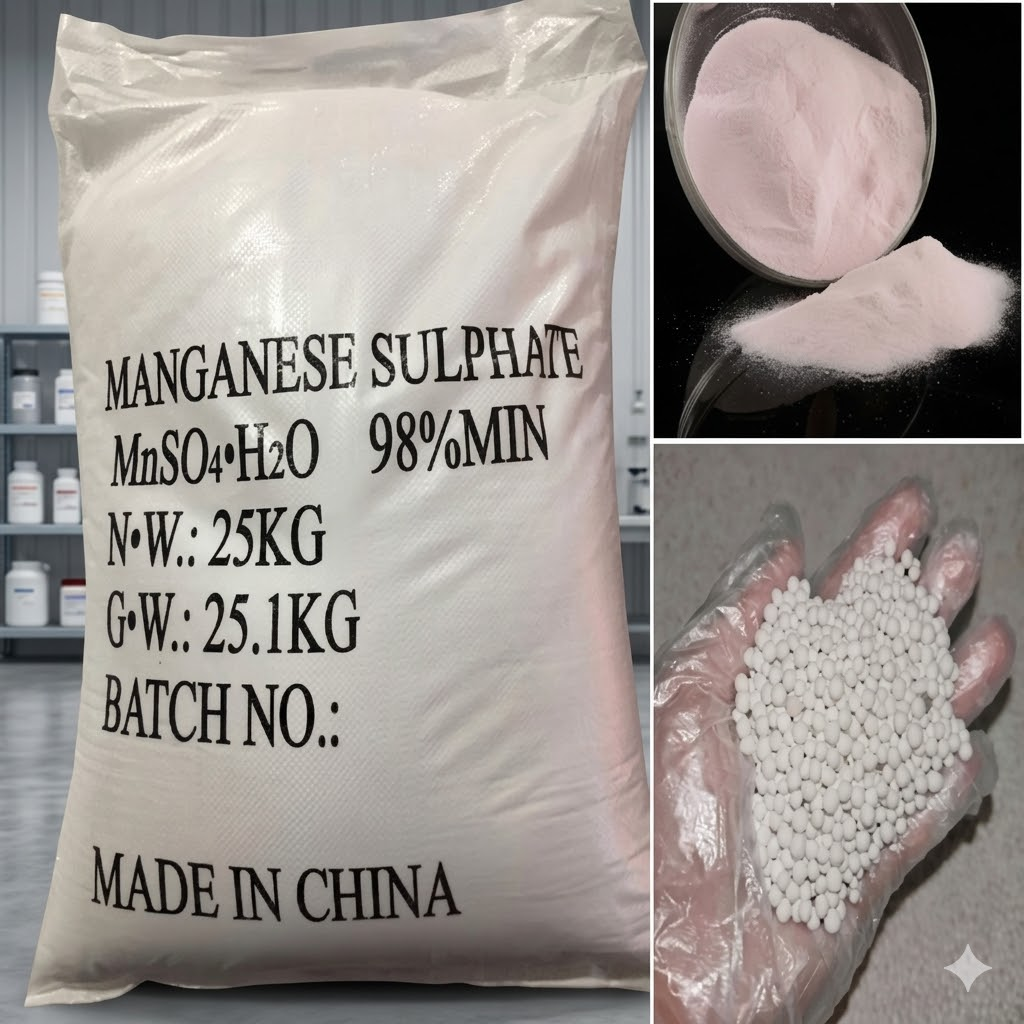
Crystalline manganese sulfate is a high-purity MnSO₄·H₂O material containing ≥32% manganese, designed for lithium-ion battery precursor synthesis. It is suitable for high-nickel NCM and NCMA cathode materials requiring strict impurity control. The product ensures stable crystallinity and consistent dissolution performance in cathode processing.
Technical Specifications
| Parameter | Typical Value |
|---|---|
| MnSO₄·H₂O Purity | ≥ 99.9% |
| Manganese (Mn) Content | ≥ 32.0% |
| Moisture | ≤ 0.3% |
| Crystal Form | Uniform crystalline |
| Bulk Density | 1.0–1.3 g/cm³ |
| Iron (Fe) | ≤ 10 ppm |
| Calcium (Ca) | ≤ 20 ppm |
| Magnesium (Mg) | ≤ 20 ppm |
| Lead (Pb) | ≤ 5 ppm |
| Copper (Cu) | ≤ 5 ppm |
| Zinc (Zn) | ≤ 5 ppm |
| Sodium (Na) | ≤ 50 ppm |
| Chloride (Cl⁻) | ≤ 50 ppm |
Notes:
Impurity elements such as Fe, Ca, and Mg affect cathode crystal structure and electrochemical stability, while trace heavy metals (Pb, Cu, Zn) directly impact battery cycle life and safety.
Key Features
- High-purity crystalline manganese sulfate (≥99.9%) for battery-grade applications
- Stable Mn content (~32%) ensuring consistent precursor stoichiometry
- Ultra-low Fe, Ca, Mg to minimize lattice defects in high-nickel cathodes
- Low heavy metals (Pb, Cu, Zn) for improved cycle life and safety
- Uniform crystal structure for controlled dissolution and reaction kinetics
- Crystalline Manganese Sulfate for High-Nickel Cathode Materials ensures high reproducibility in NCM synthesis
Applications
- High-nickel NCM/NCMA cathode materials – precursor for Ni-rich lithium-ion batteries requiring ultra-low impurities
- LMFP and modified LFP cathodes – manganese source for improved thermal stability
- Battery precursor production – consistent Mn²⁺ supply for co-precipitation processes
- Energy storage systems (ESS) – supports large-scale cathode manufacturing
- Crystalline Manganese Sulfate for High-Nickel Cathode Materials – tailored for advanced EV battery chemistries
Problems This Product Solves
- Impurity-driven capacity fading → ultra-low Fe and heavy metals improve cycle stability
- Inconsistent precursor reactions → uniform crystalline structure ensures predictable dissolution
- Cathode structural defects → controlled Ca/Mg minimizes lattice distortion
- Yield loss in co-precipitation → stable Mn content improves process control
- Battery safety risks → low Pb and trace metals reduce contamination impact
Packaging & Supply
- 25 kg kraft paper bags with PE inner liner
- Palletized export packaging
- Available in 20GP / 40HQ container shipments
- Samples available for laboratory validation
Customization & Technical Support
- Adjustable Mn content (31–32.5%)
- Ultra-low impurity grades (Fe ≤ 5 ppm available)
- Custom crystal size distribution
- Technical support for cathode precursor formulation and co-precipitation
FAQ
1. Why is crystalline manganese sulfate preferred over powder forms in battery production?
Crystalline material provides better flowability and controlled dissolution, improving consistency in co-precipitation processes. This is critical for high-nickel cathode uniformity.
2. What purity level is required for high-nickel cathode applications?
Battery-grade manganese sulfate typically requires ≥99.9% purity with extremely low impurities to avoid performance degradation.
3. How do Fe, Ca, and Mg impurities affect cathode materials?
These impurities can interfere with crystal lattice formation, causing reduced capacity and cycling stability. Tight control is essential for high-nickel systems.
4. What makes Crystalline Manganese Sulfate for High-Nickel Cathode Materials different from industrial grade?
It has significantly lower impurity thresholds (ppm-level control) and optimized crystallinity, ensuring compatibility with battery precursor synthesis.
5. How should manganese sulfate be stored?
Store in a dry, sealed environment to prevent moisture uptake and maintain crystal integrity. Stable storage ensures consistent processing performance.