Executive Summary
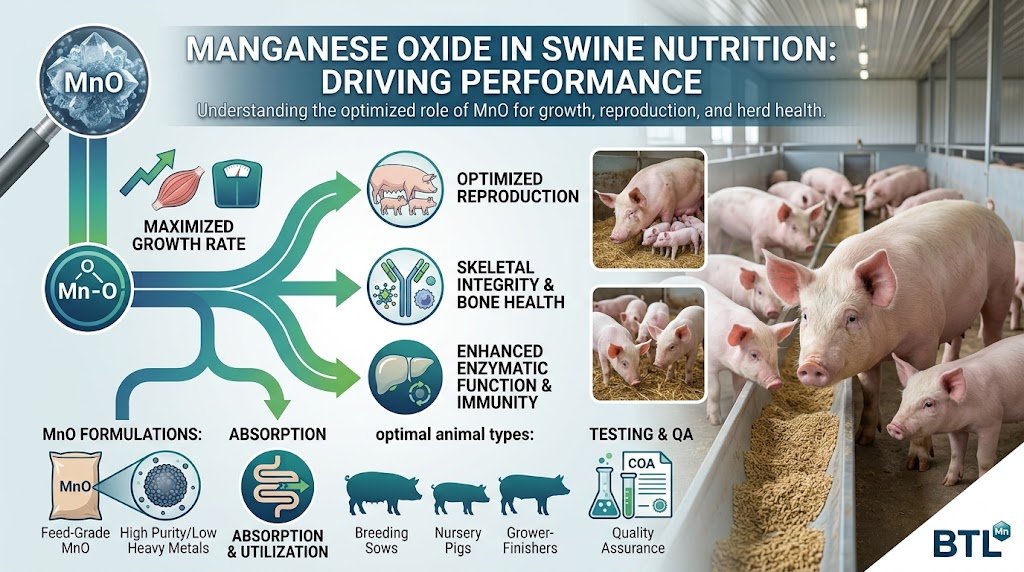
Corn-soy swine diets run marginal on manganese. Manganous oxide protects skeleton, hoof integrity, and sow reproduction.
- Typical total Mn in complete pig feed: 20–40 mg/kg.
- Supplemental MnO 60% needed: only 0.03–0.07 kg per tonne.
- MnO 60% delivers ≥ 46–47% Mn at the lowest cost per kg Mn.
- Stable, non-hygroscopic, pelleting-safe.
| Item | Value |
|---|---|
| Product | Feed-grade manganous oxide, MnO ≥ 60% |
| Elemental Mn | ≥ 46–47% |
| Typical total Mn in pig feed | 20–40 mg/kg |
| MnO 60% per tonne | 0.03–0.07 kg |
Quick Answer: Why MnO 60% Goes into Pig Feed and How Much Is Used
Corn and soybean meal supply 10–20 mg Mn/kg — enough to survive, not enough for optimal bone, hoof, and sow performance. MnO 60% closes the gap. Typical complete feed carries 20–40 mg/kg total Mn, requiring only 0.03–0.07 kg of Feed Grade Manganese Oxide (MnO) 60% per tonne.
What Manganese Does for Pigs: Skeleton, Cartilage, Hooves, and Reproduction
Manganese activates enzymes for proteoglycan synthesis in cartilage and bone matrix formation.
| Function | Deficiency consequence in pigs |
|---|---|
| Bone and cartilage development | Shortened, thickened limbs; lameness |
| Hoof integrity | Weak hoof wall, higher culling rates in sows |
| Sow reproduction | Irregular estrus, smaller litters |
| Boar fertility | Reduced libido, lower semen quality |
| Carbohydrate and lipid metabolism | Poorer growth, altered fat metabolism |
Why corn-soy diets fall short:
- Corn carries only 5–8 mg Mn/kg. Soybean meal 25–35 mg/kg.
- Phytate, calcium, and iron in the diet suppress Mn absorption.
- High-producing sow lines raise the demand above what basal ingredients deliver.
The result is a diet that prevents acute deficiency but leaves no margin. Supplementation covers the gap.
Typical Manganese Levels in Swine Diets: Grower, Finisher, and Sow Feeds
| Pig class | NRC basal requirement | Typical commercial total Mn |
|---|---|---|
| Nursery pig | ~2–4 mg/kg | 20–30 mg/kg |
| Grower | ~2–4 mg/kg | 20–30 mg/kg |
| Finisher | ~2–4 mg/kg | 20 mg/kg |
| Gestating sow | ~20 mg/kg | 30–40 mg/kg |
| Lactating sow | ~20 mg/kg | 30–40 mg/kg |
| Boar | ~20 mg/kg | 30–40 mg/kg |
NRC values reflect deficiency prevention in research settings. Commercial formulations supplement higher for three reasons:
- Antagonists (Ca, Fe, phytate) cut absorption.
- Genetic-line guides for modern high-performance animals exceed NRC.
- Lameness and reproduction losses cost more than the Mn itself.
Why MnO 60% Is the Standard Mn Source in Swine Premixes
| Property | MnO 60% | Why swine premix plants prefer it |
|---|---|---|
| Elemental Mn | ≥ 46–47% | Highest Mn density of common inorganic sources |
| Inclusion rate | 0.03–0.07 kg/tonne | Minimal premix space used |
| Hygroscopicity | None | No caking in premix storage |
| Chemical stability | Stable | No warehouse degradation |
| Cost per kg Mn | Lowest | Best economics at scale |
At swine inclusion rates, a 25 kg bag of MnO covers roughly 350–800 tonnes of feed. The physical footprint and mixing burden are negligible compared to sulfate sources at equal Mn.
How MnO Performs in Premix and Feed Manufacturing for Swine Lines
Swine inclusion is 3–10 times lower than poultry. Mixing uniformity becomes the critical issue.
| Factor | Effect |
|---|---|
| 80–200 mesh powder | Disperses into premix carriers; supports low CV at gram-level inclusions |
| Non-hygroscopic | Flows through micro-dosing equipment year-round |
| Water-insoluble | No migration or spot-wetting of premix |
A pig eats 2–3 kg per day. A 60 g/tonne MnO inclusion must reach every animal in the barn. Coarse or segregated powder creates deficient and over-dosed animals in the same pen. Fine, consistent particle size is not optional at these rates.
Process stability:
| Process | MnO behavior |
|---|---|
| Pelleting (80–90 °C) | No decomposition, no volatilization |
| Storage (moisture ≤ 1.5%) | No caking in bags or silos |
| Container shipping | Tolerates humidity swings in transit |
MnO vs. Manganese Sulfate in Pig Diets: Bioavailability and Cost Trade-offs
| Factor | MnO 60% | MnSO₄·H₂O |
|---|---|---|
| Mn content | 46–47% | ~31.8% |
| Bioavailability in pigs | Moderate; adequate at standard inclusions | High; common reference standard |
| Hygroscopic | No | Yes |
| Cost per kg Mn | Lower | Higher |
Swine studies show MnSO₄ absorbs better per gram of Mn. But pigs need only 20–40 mg/kg total. At those levels, manganous oxide supplies adequate absorbable Mn at a fraction of the cost, without the caking and vitamin-stability problems of sulfates in humid premixes.
When a switch is worth considering:
- Liquid feeding systems — sulfate only.
- Diets heavily loaded with antagonists (very high Ca or Fe).
- Veterinary-directed recovery rations.
For standard grower, finisher, and sow programs, MnO remains the economic default. Full source comparison: see our guide comparing manganese oxide, manganese sulfate, and other feed Mn sources.
Dosage Math: How Much MnO 60% Do You Need per Tonne of Pig Feed
Formula:
kg MnO 60% per tonne = target Mn (mg/kg) ÷ 465
Because 1 kg of MnO 60% contains 465 g of elemental Mn.
Worked examples:
| Target supplemental Mn | Mn per tonne | MnO 60% per tonne |
|---|---|---|
| 20 mg/kg | 20 g | 20 ÷ 0.465 = 43 g ≈ 0.043 kg |
| 30 mg/kg | 30 g | 30 ÷ 0.465 = 65 g ≈ 0.065 kg |
| 40 mg/kg | 40 g | 40 ÷ 0.465 = 86 g ≈ 0.086 kg |
Subtract basal Mn first. Corn-soy diets already carry 10–20 mg/kg. If total target is 30 mg/kg and basal is 15 mg/kg, supplement 15 mg/kg = 32 g MnO per tonne.
The numbers are small. A few grams of weighing error changes the inclusion rate measurably. Two practical rules:
- Never dose MnO directly into a batch mixer at gram levels. Pre-blend in the premix.
- Check scale calibration for the micro-ingredient line quarterly.
Can Pigs Get Too Much Manganese? Tolerances and Antagonisms
Yes. Manganese excess suppresses feed intake and competes with iron absorption.
| Reference point | Value |
|---|---|
| NRC max tolerable Mn for swine | ~400 mg/kg diet |
| Practical risk from MnO dosing errors | Gram-level errors move inclusions by mg/kg, not hundreds |
Antagonisms cut both ways: high calcium, high iron, and phytate all reduce Mn absorption.
This is why commercial levels stay at 20–40 mg/kg total. More is not better. The tolerance ceiling is far away, but the absorption floor is what matters.
Compliance and COA Checks for Swine Feed Applications
Check every batch COA against feed safety limits.
| Item | Typical MnO 60% spec | Reference limit |
|---|---|---|
| As | ≤ 5 ppm | EU, AAFCO, GB 13078 compliant |
| Pb | ≤ 10 ppm | EU, AAFCO, GB 13078 compliant |
| Cd | ≤ 5 ppm | EU, AAFCO, GB 13078 compliant |
| Citric acid solubility | ≥ 85–90% | Mn availability indicator |
| Moisture | ≤ 1.5% | Storage and flow |
Also verify:
- MnO assay basis: as-received or dry.
- Particle size matches your premix line (80–200 mesh standard).
- Batch-to-batch consistency across shipments.
Third-party SGS or Intertek verification is available on request.
Frequently Asked Questions About MnO in Swine Feed
Do corn-soy diets really need Mn supplementation?
Basal ingredients supply 10–20 mg/kg, near the margin for sows and high-performance growers. Supplementation adds a safety buffer for bone, hoof, and reproduction at negligible cost.
Is MnO bioavailability adequate for pigs?
Yes at standard inclusions. Pig studies rank sulfate higher per gram absorbed, but at 20–40 mg/kg total Mn, manganous oxide supplies sufficient absorbable Mn at lower cost.
Do sows need more Mn than growers?
Yes. Sow reproduction, hoof strength, and longevity justify 30–40 mg/kg total versus 20–30 mg/kg for growers.
Can MnO replace MnSO₄ 1:1?
No. Convert by elemental Mn: 1 kg of MnSO₄·H₂O (31.8% Mn) equals 0.68 kg of MnO 60% (46.5% Mn). Recalculate dosing before switching.
Conclusion: A Low-Inclusion, High-Value Mn Source for Swine Programs
Pig diets need only 20–40 mg/kg total Mn — 0.03–0.07 kg of MnO 60% per tonne. Manganous oxide delivers it at the lowest cost per kilogram of Mn, with stable handling through premix, pelleting, and shipping. Verify As, Pb, and Cd on every COA. Pre-blend gram-level additions; never direct-dose.
We supply feed-grade manganous oxide for swine premix and complete-feed lines. Particle size and heavy-metal specs can be customized to your formulation. TDS, COA, and samples available on request — contact us for a quote.

I am Edward lee, founder of manganesesupply( btlnewmaterial) , with more than 15 years experience in manganese products R&D and international sales, I helped more than 50+ corporates and am devoted to providing solutions to clients business.