Executive Summary
One decision rule:
- Premixes and standard complete feeds: MnO 60%.
- Highest solubility, absorption, or liquid systems: MnSO₄·H₂O.
- Low-reactivity solid source: MnCO₃.
- High-value stages: organic Mn.
| Source | Mn content | Water solubility | Relative bioavailability | Relative cost per kg Mn |
|---|---|---|---|---|
| Manganese oxide (MnO 60%) | ~46.5% | Insoluble | 70–100% (source-dependent) | Lowest |
| Manganese sulfate (MnSO₄·H₂O) | ~31.8% | High | 100% (reference) | Medium |
| Manganese carbonate (MnCO₃) | ~43–44.5% | Low | Low–moderate | Medium |
| Manganese dioxide (MnO₂) | ~58% | Insoluble | Poor | Not for feed |
| Organic Mn (proteinates, Mn-methionine) | 8–17% | Varies | 100–130% | Highest |
Quick Answer: Which Manganese Source Fits Which Situation
Most feed programs use Feed Grade Manganese Oxide (MnO) 60% for premixes and complete feeds. It delivers the most elemental Mn per kilogram at the lowest cost. Use manganese sulfate when the formula demands water solubility, high absorption, or liquid delivery. Use manganese carbonate when low reactivity matters. Consider organic sources only for high-value stages such as early life or breeding stock.
The Three Numbers That Actually Decide Your Mn Source: Mn %, Bioavailability, and Cost per kg Mn
Every source comparison reduces to three numbers.
| Number | Question it answers |
|---|---|
| Elemental Mn % | How much manganese is in each kilogram? |
| Bioavailability | How much of that Mn can the animal absorb and use? |
| Cost per kg elemental Mn | What does usable manganese actually cost? |
Never judge a source by Mn% alone. A source with less Mn but higher bioavailability can still deliver more usable Mn per dollar. Calculate all three before switching.
Manganese Oxide (MnO 60%): The High-Density, Low-Cost Workhorse
Manganous oxide is the most widely used feed manganese source.
| Spec | Typical value |
|---|---|
| MnO | ≥ 60% |
| Elemental Mn | ≥ 46–47% |
| Solubility in 2% citric acid | ≥ 85–90% |
| Moisture | ≤ 1.5% |
| Particle size | 80–200 mesh |
| Heavy metals | As ≤ 5 ppm, Pb ≤ 10 ppm, Cd ≤ 5 ppm |
Key properties:
- Highest Mn density among the common inorganic feed sources.
- Chemically stable. Non-hygroscopic. Does not cake in storage.
- Lowest cost per kilogram of elemental Mn.
- Citric acid solubility ≥ 85–90% indicates available Mn for monogastrics.
Use it in vitamin-mineral premixes, base mixes, and complete feeds. See the Feed Grade Manganese Oxide (MnO) 60% product page for TDS and COA details.
Manganese Sulfate (MnSO₄·H₂O): The Bioavailability Benchmark
Manganese sulfate monohydrate is the reference standard for Mn bioavailability studies.
| Spec | Typical value (GB 34468-2017) |
|---|---|
| Mn (as Mn) | ≥ 31.8% |
| MnSO₄·H₂O | ≥ 98.0% |
| Water-insoluble matter | ≤ 0.1% |
| Fineness (through 250 μm) | ≥ 95% |
Key properties:
- Fully water-soluble. The only common option for liquid feed lines and drinking-water systems.
- High and consistent absorption across species.
- Assign it a relative bioavailability of 100%.
Limits:
- Lower Mn density. You buy and ship more material per kilogram of Mn.
- Hygroscopic. Clumps in humid storage. Requires sealed, dry handling.
Manganese Carbonate (MnCO₃): The Stable, Less Reactive Option
Manganese carbonate trades some Mn density for chemical inertness.
| Spec | Typical value |
|---|---|
| Elemental Mn | 43.0–44.5% |
| Moisture | ≤ 3% |
| Fe | ≤ 0.01% |
| As / Pb / Cd | ≤ 10 ppm each |
Key properties:
- Near-neutral chemistry. Low reactivity with vitamins and other trace minerals in premixes.
- Stable in storage. Not hygroscopic.
- Slow Mn release. Suits ruminant and specialty applications where gradual availability is acceptable.
Lower bioavailability than MnO in most monogastric trials. Price it accordingly.
Why Manganese Dioxide (MnO₂) Is Not a Feed Manganese Source
Manganese dioxide appears in supplier catalogs next to feed-grade oxides. It is not interchangeable.
| Property | MnO (feed) | MnO₂ |
|---|---|---|
| Oxidation state | Mn(II) | Mn(IV) |
| Mn availability to animals | Yes | Poor |
| Typical use | Feed | Oxidant, glass decolorizing, batteries |
MnO₂ is a strong oxidizer. Its manganese is poorly available to animals. It is an industrial product, not a feed ingredient. Confirm the CAS number and oxidation state before ordering. See our guides on manganese dioxide for glass and industrial uses.
Organic and Chelated Manganese (Proteinates, Methionine Complexes): When the Premium Pays Off
Organic Mn sources bind manganese to amino acids or protein hydrolysates.
| Type | Typical Mn content |
|---|---|
| Mn proteinates | 8–12% |
| Mn amino acid complexes | 10–17% |
| Mn methionine complexes | ~14–17% |
Properties:
- Bioavailability often measured at 100–130% relative to MnSO₄.
- Very low Mn density. Bulky and expensive per kilogram of product.
- Price per kilogram of usable Mn runs several times higher than MnO.
Where the premium can pay:
- Breeding stock, hatchery performance, early-life nutrition, stress phases.
- Diets with antagonists (high Ca, high Fe, excess P) that block inorganic Mn absorption.
Where it does not:
- Standard grow-finish feeds where cost per unit of Mn dominates.
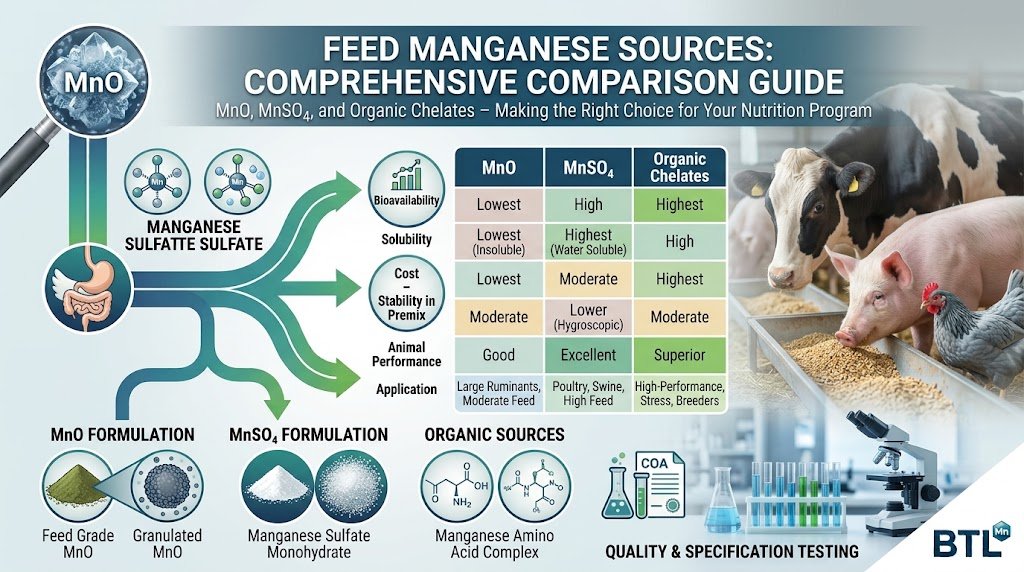
Side-by-Side Comparison: Mn Content, Solubility, Bioavailability, Handling, and Cost
| Source | Mn % | Water solubility | Relative bioavailability | Hygroscopicity | Relative cost per kg Mn |
|---|---|---|---|---|---|
| MnO 60% | 46–47% | Insoluble (citric-acid soluble) | 70–100% | No | ★ Lowest |
| MnSO₄·H₂O | 31.8% | High | 100% (reference) | Yes | ★★ |
| MnCO₃ | 43–44.5% | Low | Low–moderate | No | ★★ |
| Mn proteinate | 8–12% | Moderate | 100–130% | Varies | ★★★★ |
| Mn-methionine | 14–17% | Moderate | 100–130% | Varies | ★★★★★ |
| MnO₂ | ~58% | Insoluble | Not for feed | No | Industrial only |
How Species and Formulation Stage Affect Your Choice
| Species / system | Recommended default | Reason |
|---|---|---|
| Poultry premix | MnO 60% | Cost per kg Mn; citric solubility adequate |
| Swine complete feed | MnO 60% | Standard practice, stable in storage |
| Ruminants | MnO or MnCO₃ | Rumen environment; reactivity concerns |
| Aquaculture | MnSO₄ or MnO (fine) | Water exposure leaching water-soluble Mn |
| Liquid feed lines | MnSO₄ only | Only water-soluble option |
| Breeder / early life | MnO base + organic Mn top-up | Absorption priority over cost |
Stage matters as much as species. Cost pressure is highest in grow-finish. Absorption priority is highest in the first weeks and in breeding animals.
How to Compare Supplier Quotes Across Different Mn Sources
Convert every quote to price per kilogram of usable elemental Mn.
Price per kg Mn = Price per kg product ÷ Mn %
| Source | Price per kg | Mn % | Price per kg Mn |
|---|---|---|---|
| MnO 60% | $0.90 | 46.5% | $1.94 |
| MnSO₄·H₂O | $0.55 | 31.8% | $1.73 |
| MnCO₃ | $0.80 | 43.9% | $1.82 |
The numbers above are illustrative. Run them with live quotes.
COA checks before ordering:
- Mn or MnO assay matches the grade claim.
- Heavy metals within feed limits (As, Pb, Cd, Hg).
- Moisture and particle size match the formula’s handling needs.
- Test method stated (ICP-OES, AAS, or titration).
Frequently Asked Questions About Feed Manganese Sources
Is manganese sulfate always better than manganese oxide?
No. MnSO₄ has higher bioavailability but much lower Mn density and higher handling cost. For most premixes, MnO delivers usable Mn at lower total cost.
Can I switch sources without changing dosage?
Only if you recalculate. Replacing MnO 60% with MnSO₄·H₂O requires 46% more product by weight to supply the same elemental Mn.
Which source is cheapest per kg of elemental Mn?
Manganous oxide, in most markets. This is why it dominates premix formulations worldwide.
Are organic manganese sources worth the price?
In breeding stock, hatcheries, and antagonist-heavy diets, they can be. In standard grower and finisher feeds, the premium rarely pays.
Conclusion: Match the Source to the Formula, Not the Label
Decide by Mn %, bioavailability, and cost per kg Mn — not by the product name. MnO 60% is the default for premixes and complete feed. MnSO₄ for solubility and liquid systems. MnCO₃ where low reactivity is required. Organic Mn only where absorption justifies the premium.
We supply all major feed-grade manganese sources with batch COAs. TDS, samples, and custom specifications are available on request. Contact us for a quote.

I am Edward lee, founder of manganesesupply( btlnewmaterial) , with more than 15 years experience in manganese products R&D and international sales, I helped more than 50+ corporates and am devoted to providing solutions to clients business.