Executive Summary
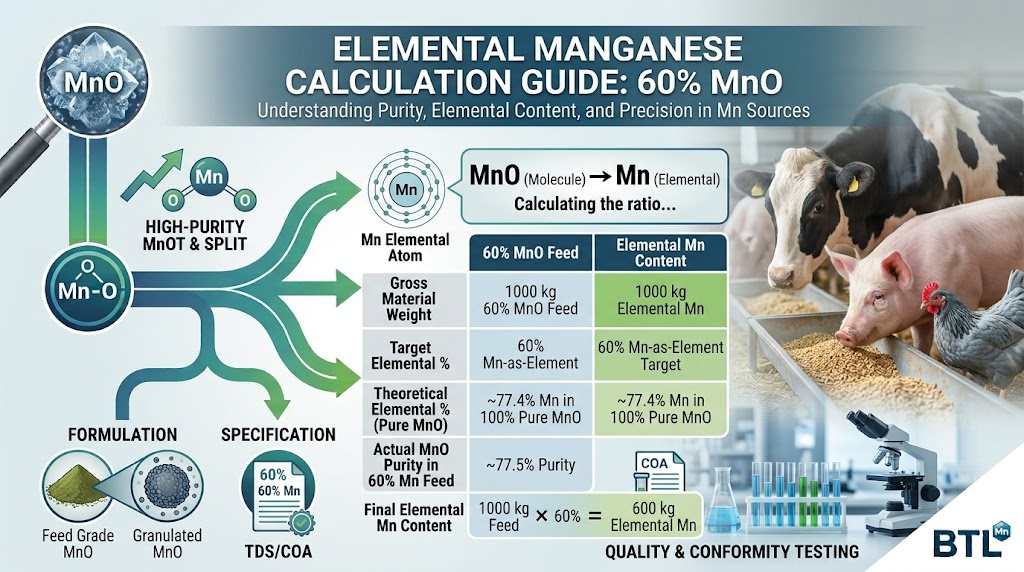
60% MnO is not 60% elemental manganese.
- 60% MnO ≈ 46.5% elemental Mn.
- Conversion factor: Mn% = MnO% × 0.774.
- One tonne of 60% MnO powder delivers about 465 kg of elemental Mn.
- A 25 kg bag delivers about 11.6 kg of elemental Mn.
Supplier spec sheets list both numbers: MnO ≥ 60% and Mn ≥ 46–47%. MnO is the product assay. Mn is the nutrient buyers actually compare.
Quick Answer: 60% MnO = 46–47% Elemental Manganese
Manganese makes up 77.4% of MnO by molecular weight.
60% × 0.774 = 46.5% elemental Mn.
In practical terms:
| Quantity of 60% MnO | Elemental Mn delivered |
|---|---|
| 1 metric tonne | ~465 kg |
| 25 kg bag | ~11.6 kg |
| 1,000 kg | ~465 kg |
Use 46.5% as the planning number. Typical COA ranges show 46–47% because of normal batch variation.
How to Convert MnO % to Elemental Mn %: The 0.774 Factor Explained
The conversion comes from atomic and molecular weights.
| Value | Number |
|---|---|
| Atomic weight of Mn | 54.94 g/mol |
| Molecular weight of MnO | 70.94 g/mol |
| Mn / MnO ratio | 54.94 / 70.94 = 0.774 |
Formula:
Elemental Mn % = MnO % × 0.774
For 60% MnO:
60 × 0.774 = 46.4% (commonly rounded to 46–47%)
The factor stays the same regardless of grade. Only the MnO% changes.
MnO-to-Mn Conversion Table for Common Grades (55%, 58%, 60%, 62%, 70%)
| MnO grade | Elemental Mn % | Mn per tonne |
|---|---|---|
| 55% | ~42.6% | ~426 kg |
| 58% | ~44.9% | ~449 kg |
| 60% | ~46.5% | ~465 kg |
| 62% | ~48.0% | ~480 kg |
| 70% | ~54.2% | ~542 kg |
Higher MnO grade means more manganese per kilogram. It also usually means higher price per tonne. The right grade depends on nutrient targets, not just the headline percentage.
Why a TDS Lists Both “MnO ≥ 60%” and “Mn ≥ 46–47%”
A technical data sheet uses two related but separate numbers.
| Value | What it measures | Why it matters |
|---|---|---|
| MnO ≥ 60% | Manganous oxide purity | Product grade and quality |
| Mn ≥ 46–47% | Elemental manganese content | Nutrient value for formulations |
MnO% tells you how clean the product is. Mn% tells you how much actual manganese you are buying. Formulators, nutritionists, and procurement teams use Mn% to calculate dosage and cost per nutrient unit.
What 60% MnO Means in Real Purchases: Mn per Tonne and per Bag
Buyers move from percentages to real weights when planning shipments and formulations.
| Package size | Gross weight | Elemental Mn content |
|---|---|---|
| 1 MT | 1,000 kg | ~465 kg |
| 25 kg bag | 25 kg | ~11.6 kg |
| 1,000 kg (20 × 25 kg bags) | 1,000 kg | ~465 kg |
If your formulation needs 100 kg of elemental Mn, you need about 215 kg of 60% MnO.
100 ÷ 0.465 = 215 kg.
This calculation is essential when comparing products with different MnO grades.
Don’t Confuse “60% MnO” with “60% Mn”: A Costly Label Trap
This is a common sourcing mistake.
| Label | Elemental Mn | Equivalent MnO |
|---|---|---|
| 60% MnO | ~46.5% Mn | 60% MnO |
| 60% Mn | 60% Mn | ~77.5% MnO |
A product labeled “60% Mn” contains significantly more manganese than one labeled “60% MnO.” If you compare prices using only the percentage, the 60% Mn product looks more expensive per tonne but may be cheaper per kilogram of manganese.
Always confirm the basis before comparing quotes.
How to Compare Supplier Quotes by Price per kg of Elemental Mn
The fair comparison is price per unit of elemental manganese.
Formula:
Price per kg Mn = Price per kg product ÷ Elemental Mn %
Example:
| Product | Price per kg | Mn content | Price per kg Mn |
|---|---|---|---|
| Supplier A: 60% MnO | $1.20 | 46.5% |
2.58 |
| Supplier B: 58% MnO | $1.15 | 44.9% |
2.56 |
Supplier B is slightly cheaper per kilogram of manganese despite the lower MnO grade. This is the number that drives purchasing decisions.
How to Verify Elemental Mn Content on the COA Before Ordering
The certificate of analysis confirms what the TDS promises.
Key COA lines to check:
| Line | What to look for |
|---|---|
| MnO % | Should match or exceed grade claim |
| Mn % | Should match 46–47% for 60% MnO |
| Moisture | Usually ≤ 1.5% |
| Particle size | Often 80–200 mesh for feed-grade powder |
| Heavy metals | As, Pb, Cd within stated limits |
| Test method | ICP-OES, AAS, or titration |
If the COA omits Mn%, ask the supplier to add it. If the numbers look inconsistent with the 0.774 factor, request third-party testing.
60% MnO vs. Other Manganese Sources: Mn Content Compared
MnO is not the only manganese source buyers evaluate.
| Product | Typical Mn content | Form | Common use |
|---|---|---|---|
| Manganese oxide (MnO) 60% | ~46.5% Mn | Powder | Feed, fertilizers, ceramics |
| Manganese sulfate monohydrate | ~32% Mn | Crystalline powder | Feed, agriculture |
| Manganese carbonate | ~44–47% Mn | Powder | Feed, ceramics, pigments |
| Manganese dioxide (MnO₂) 92% | ~58% Mn | Powder | Glass decolorizing, batteries |
Each source differs in solubility, handling, compatibility, and cost per kilogram of Mn. Choose based on application, not Mn content alone.
Frequently Asked Questions About MnO and Elemental Manganese
Does 60% MnO mean 60% Mn?
No. 60% MnO means about 46.5% elemental Mn.
How much MnO do I need to reach a target Mn level?
Divide the target Mn weight by 0.465. For example, 100 kg Mn requires about 215 kg of 60% MnO.
Is higher MnO% always better?
Not necessarily. Higher MnO% means more Mn per kilogram, but price, solubility, particle size, and impurity limits also matter.
Why do some suppliers quote MnO and others quote Mn?
Regional and industry habits differ. Feed and fertilizer sectors often focus on elemental Mn. Chemical and industrial sectors may focus on MnO. Always convert to the same basis.
Can Mn content vary between batches?
Yes. Typical COA ranges like 46–47% reflect normal manufacturing variation. Ask for batch-specific COAs.
Should I calculate Mn on a dry basis or as-received basis?
Use the same basis the supplier uses. Moisture reduces effective Mn content. A 60% MnO product with 1.5% moisture has slightly less Mn in the bag than a dry-basis assay suggests.
What test method should I request for Mn verification?
ICP-OES, AAS, and titration are all valid. Specify the method in your purchase agreement if consistency matters for your process.
Conclusion: Convert First, Then Compare, Then Buy
60% MnO equals about 46.5% elemental manganese. The conversion is simple: multiply MnO% by 0.774. Use this to compare grades, calculate dosage, and evaluate supplier quotes on a fair basis.
Before you order, confirm three things:
- Whether the percentage is MnO or elemental Mn.
- Whether the assay is reported dry basis or as-received.
- That the COA matches the TDS and shows the test method.
A few minutes of conversion prevents a costly specification error.
Need feed-grade MnO 60% powder? Contact us for TDS, COA, pricing, and a sample.

I am Edward lee, founder of manganesesupply( btlnewmaterial) , with more than 15 years experience in manganese products R&D and international sales, I helped more than 50+ corporates and am devoted to providing solutions to clients business.