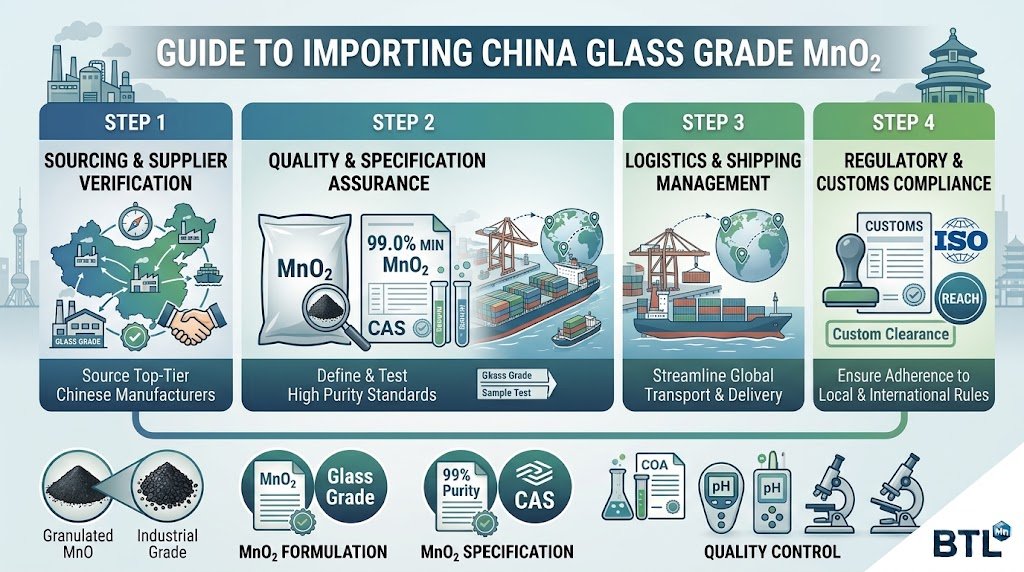
Summary: Importing MnO₂ from China follows 8 steps: select the manufacturer, verify the sample, compare quotes, lock the specification, agree COA and QC terms, confirm packaging, prepare HS code and customs documents, and ship with clear terms. Each step prevents a different failure. Import once, import right.
The Short Answer: An 8-Step Import Process, From Factory to Furnace
Why China Is the Main Supply Source for Glass-Grade MnO₂
China hosts large-scale MnO₂ processing: ore beneficiation, milling, classification, and export logistics in one chain. Container-scale supply is competitive, and QC documents are standard practice. Most global glass plants already source from China.
The 8 Steps at a Glance: Select → Sample → Quote → Spec → COA → Pack → Ship → Clear
| Step | Action | Risk it prevents |
|---|---|---|
| 1. Select | Verify factory vs. trader | Wrong source |
| 2. Sample | Test with COA | Wrong product |
| 3. Quote | Compare the same basis | Overpaying |
| 4. Spec | Lock ranges in contract | Drifting quality |
| 5. COA/QC | Every batch plus inspection | Silent variation |
| 6. Packaging | Ocean-ready packing | Arrival damage |
| 7. Documents | Correct HS code and paperwork | Customs delay |
| 8. Ship and clear | Clear terms, test before final payment | Payment risk |
Who Should Handle Each Step: You, the Supplier, or the Forwarder
You: specification, sample testing, approval. Supplier: production, COA, export documents. Forwarder: booking, freight, clearance. Assign an owner to each step. No step runs without an owner.
Step 1: Select the Manufacturer
Factory vs. Trader: Verify the Source
A factory controls ore, milling, and QC. A trader resells. Ask: who produces? Where is the plant? Ask for the business license, plant photos, and export records. One video call to the plant verifies more than ten brochures.
Related reading: How Do You Evaluate a Manganese Dioxide Supplier for Glass Manufacturing?
What to Check: License, Capacity, QC, Export Record
| Check | What to ask |
|---|---|
| Business license | Manufacturing scope |
| Capacity | Monthly MnO₂ output |
| QC | In-house lab? Test methods? |
| Export record | Past shipments to your region |
Shortlist two to three factories, not one.
Step 2: Request a Sample and Verify It
What to Ask For: Sample + COA + TDS
Request 5–25 kg with three documents: COA with batch number and date, TDS with grade and D50 range, and the batch ID. No documents: no trial.
Lab Test the Sample Before Quotation Discussions
Test MnO₂, Fe, moisture, and D50/D90 independently. Compare with the COA. Set the deviation rule: MnO₂ ±1%, Fe ±0.02%, D50 ±10%. The sample test happens before the price talk. Testing a sample is cheaper than rejecting a container.
Step 3: Get a Comparable Quotation
What a Complete Quote Must Show: Spec, Packaging, Incoterm
A complete quote shows: grade and Fe limit, D50 range, packaging, quantity, Incoterm, currency, payment terms, and lead time. Missing lines: ask. Compare only quotes on the same basis.
FOB vs. CIF vs. DDP: Which Basis to Ask For
| Basis | Supplier covers | You arrange |
|---|---|---|
| FOB | Goods to the vessel | Freight, insurance, clearance |
| CIF | Freight and insurance to destination port | Duties, port fees, inland |
| DDP | Delivered to your door, duties paid | Almost nothing |
Ask for FOB or CIF first. DDP is convenient but harder to verify costs. Compare landed cost, not the headline.
Step 4: Lock the Specification
Glass-Grade Reference Spec: MnO₂ 88–92%, Fe ≤ 0.20%, Moisture ≤ 2.0%
| Parameter | Glass-grade reference |
|---|---|
| MnO₂ | 88–92% |
| Fe₂O₃ | ≤ 0.20% |
| Moisture | ≤ 2.0% |
| SiO₂ | ≤ 2.0% |
| LOI | ≤ 5.0% |
| Heavy metals | Per your market’s rules |
Put these numbers in the contract, not in the email.
D50/D90, Bulk Density, and Packing Details in the Contract
Add the physical lines: D50 range and D90 cap, bulk density 0.8–1.2 g/cm³, packing type, and weight per bag. Each line in the contract becomes a claim you can enforce.
Related reading: What Should You Check on a Manganese Dioxide COA Before Buying for Glass Production?
Step 5: Agree on COA and QC Terms
COA with Every Batch: Lines, Methods, Signatures
The COA must name the batch, show every spec line, state the test methods, and carry a QC signature. Request COAs from the last five lots to see the trend before you commit.
Third-Party Inspection: SGS/BV at Loading
For first orders, add loading inspection: SGS or Bureau Veritas samples the lot at the factory or port. The inspection report becomes your shipping evidence. The cost is small. The protection is a whole container.
Step 6: Confirm Packaging for Ocean Freight
Bags, Jumbo Bags, and Pallets: What Survives the Voyage
| Packing | Use |
|---|---|
| 25 kg bags with PE liner | Small batches, easy dosing |
| 1,000 kg jumbo bags | Container volumes |
| Palletized, shrink-wrapped | Ocean freight protection |
The moisture barrier matters. Ocean humidity attacks powder.
Container Loading: 20 ft vs. 40 ft, Palletized or Bulk Loading
A 20 ft container holds about 20–25 tons of MnO₂. A 40 ft holds roughly double. Palletized loading protects bags but uses space. Loose loading maximizes tonnage. Ask the supplier which fits your volume and port.
Step 7: Understand HS Code and Customs Documentation
HS Code 2820.10: Classification and Duty
Manganese dioxide classifies under HS 2820.10. The duty rate depends on your country’s tariff schedule. Verify the rate with your customs broker before ordering. A wrong classification delays the shipment.
The Document Set: Invoice, Packing List, B/L, COA, MSDS, Certificate of Origin
| Document | Purpose |
|---|---|
| Commercial invoice | Value and description |
| Packing list | Bags, weight, container |
| Bill of lading | Ownership and receipt |
| COA | Quality evidence |
| MSDS | Handling and transport |
| Certificate of origin | Duty treatment |
Check the documents against the contract before payment.
Step 8: Ship and Clear the Goods
Shipping Terms: FOB, CIF, and Who Books the Vessel
Whoever books the vessel controls the schedule. Under FOB, you or your forwarder books. Under CIF, the supplier books. Confirm the vessel, ETD, and ETA in writing. Get the bill of lading copy before releasing final payment.
Customs Clearance at Destination: Duties, Port Fees, Inland Transport
Clearance covers duty, VAT or GST, port fees, and inland transport. Ask your broker for a landed-cost estimate before the shipment. The estimate prevents surprise costs at arrival.
Incoming QC and Claims: Test Before You Pay the Final Balance
On arrival: check seals, count bags, take retained samples, and test the core parameters. Structure payment so the final balance releases after loading evidence or arrival inspection. Notify the supplier of any deviation within the claim window.
Common Import Mistakes and How to Avoid Them
The 5 Most Common Mistakes: Sample Traps, Spec Gaps, Document Errors
| Mistake | Prevention |
|---|---|
| Buying on the sample without a trial | Run a production trial |
| Vague spec in the contract | Lock every line |
| Wrong documents | Check before shipment |
| Comparing FOB with CIF quotes | Normalize the basis |
| Paying in full before arrival | Tie payment to documents |
How Long the Full Import Takes: A Realistic Timeline
| Stage | Typical time |
|---|---|
| Sample and approval | 1–2 weeks |
| Production | 1–2 weeks |
| Ocean freight (Asia to Europe/US) | 3–5 weeks |
| Clearance and delivery | 1–2 weeks |
Plan 6–10 weeks from first contact to arrival.
Frequently Asked Questions
Do I Need an Import License to Buy MnO₂ From China?
Glass-grade MnO₂ is a general chemical product. Most countries do not require an import license. Check with your customs broker. Also confirm the dangerous-goods classification in your market; standard bagged powder usually ships as general cargo.
Who Pays the Customs Duty — Buyer or Seller?
The buyer pays duty, unless the contract says DDP. Under FOB and CIF, duty is the buyer’s cost. Confirm the Incoterm in the contract and the tariff rate with your broker.
Can I Import a Small Trial Quantity First?
Yes. Most factories accept trial orders of 1–5 tons or a partial container. A trial verifies product, documents, and logistics at low risk. Then scale to full containers.
Conclusion: Import Once, Import Right
Key Takeaways: 8 Steps, Zero Surprises
- Select and verify the manufacturer first.
- Test the sample before the price talk.
- Lock spec, COA, and QC terms in the contract.
- Use HS 2820.10 and a complete document set.
- Tie payment to documents and arrival inspection.
Send Us Your Spec and Destination Port — We Handle the China Side
BTLnewmaterial is a Chinese manganese dioxide manufacturer. We provide glass-grade specs with COA per batch, trial samples, complete export documents (invoice, packing list, COA, MSDS, certificate of origin), and FOB or CIF quotes to your port. Send us your spec and destination port. We will handle the China side.

I am Edward lee, founder of manganesesupply( btlnewmaterial) , with more than 15 years experience in manganese products R&D and international sales, I helped more than 50+ corporates and am devoted to providing solutions to clients business.