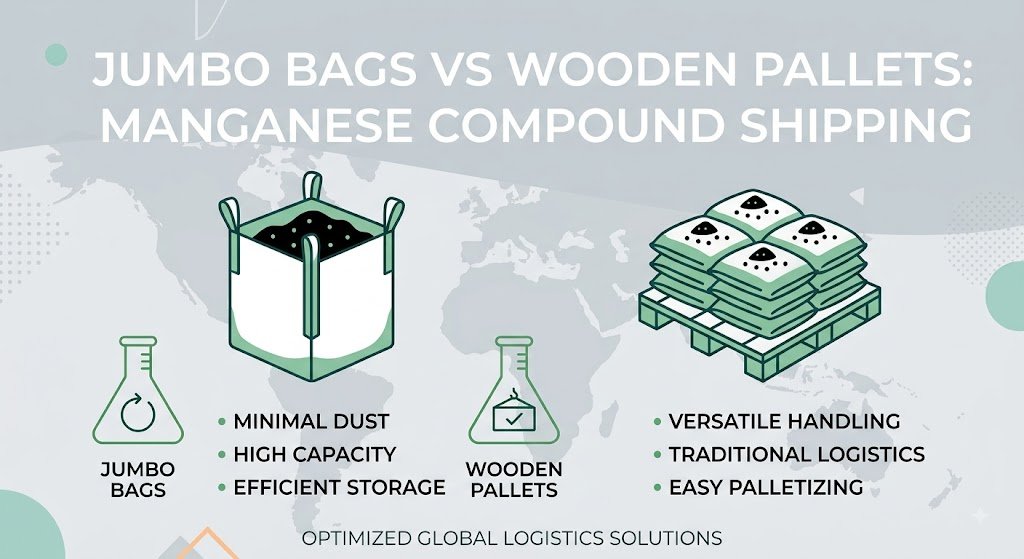
When importing bulk inorganic minerals such as Manganese Carbonate (MnCO₃, CAS No. 598-62-9), Manganese Dioxide (MnO₂), and Manganese Oxide (MnO), packaging selection plays an important role in transportation efficiency, customs compliance, and product protection.
For standard 20-foot full container load (FCL) shipments, typically carrying 20–25 metric tons, exporters usually choose between two common packaging methods:
- Direct-stowed jumbo bags (FIBC bags without pallets)
- Jumbo bags placed on wooden pallets
While wooden pallets are widely used for warehouse handling, many chemical importers now prefer non-pallet jumbo bag packaging because it reduces timber-related compliance requirements, maximizes container utilization, and simplifies ocean freight operations.
This article explains the differences between these two packaging solutions and why direct-stowed jumbo bags are increasingly adopted for bulk manganese compound shipments.
Jumbo Bags vs. Wooden Pallets: Packaging Comparison
| Packaging Feature | Direct-Stowed Jumbo Bags | Jumbo Bags on Wooden Pallets |
|---|---|---|
| Timber Packaging Requirement | No wooden materials used | Requires compliant wooden pallets |
| ISPM 15 Consideration | Avoids timber treatment requirements | Requires heat treatment and marking |
| Container Space Utilization | Maximizes loading capacity | Uses additional space for pallets |
| Loading Capacity (20ft Container) | Up to approximately 25 MT | Usually lower due to pallet volume |
| Biosecurity Inspection Risk | Lower risk related to wood packaging | Additional inspection considerations |
| Handling Method | Requires lifting loops or bag lifting equipment | Easier pallet forklift handling |
Why Packaging Choice Matters for International Chemical Shipments
Biosecurity Requirements for Wooden Packaging
Countries such as New Zealand and Australia maintain strict biosecurity controls on imported timber packaging materials.
Organizations including:
- New Zealand Ministry for Primary Industries (MPI)
- Australian Department of Agriculture, Fisheries and Forestry (DAFF)
require imported wooden packaging to comply with international timber treatment standards.
Risks Associated with Wooden Pallets
Using wooden pallets may create additional requirements during customs clearance:
ISPM 15 Compliance
Wood packaging materials normally require:
- Approved heat treatment (HT)
- Official ISPM 15 marking
- Proper documentation
Missing, unclear, or incorrect marks may result in additional inspection.
Additional Handling Costs
If timber packaging does not meet destination requirements, importers may face:
- Additional inspection procedures
- Treatment costs
- Port storage charges
- Clearance delays
For chemical raw materials, avoiding unnecessary customs procedures can improve supply chain efficiency.
Advantages of Direct-Stowed Jumbo Bag Packaging
To minimize timber-related compliance issues, many chemical exporters use new polypropylene FIBC jumbo bags loaded directly into containers without pallets.
Typical configuration:
- Bag capacity: 1,000–1,250 kg
- Material: Heavy-duty woven polypropylene
- Optional inner PE liner for moisture protection
- Four lifting loops for unloading
Reduced Timber Compliance Requirements
Because no wooden pallets are used:
- No ISPM 15 pallet treatment is required
- No timber packaging declaration is needed
- Lower risk of wood-related inspection delays
Better Container Space Utilization
Removing pallets creates additional vertical loading space and reduces packaging weight.
Advantages include:
- Higher payload efficiency
- Lower packaging cost per ton
- Better utilization of 20ft container capacity
For example:
A 20ft container can typically load approximately:
- 20–25 MT manganese carbonate
- 20–25 jumbo bags depending on bag size and loading arrangement
Better Product Protection During Ocean Transit
Export-grade FIBC bags are designed for bulk chemical transportation.
Features include:
- High-strength polypropylene woven fabric
- Optional moisture barrier liner
- Protection against humidity exposure
- Reduced risk of contamination from wooden materials
How to Unload Jumbo Bags Without Pallets
A common concern from importers is:
“How can we unload jumbo bags without pallets?”
Modern FIBC bags are designed with reinforced lifting loops, allowing safe unloading using:
Forklift Bag Lifting Attachments
A forklift equipped with a suitable lifting hook or jib attachment can lift bags directly from the container.
Jumbo Bag Lifting Bars
Special lifting bars can connect multiple loops and allow controlled warehouse handling.
Most industrial warehouses handling minerals, fertilizers, and chemicals already use similar unloading methods.
FAQ About Non-Pallet Jumbo Bag Packaging
Will jumbo bags be damaged during ocean transportation without pallets?
No, when using export-grade FIBC bags designed for bulk materials.
High-quality jumbo bags normally feature:
- Strong polypropylene woven construction
- Reinforced lifting loops
- Suitable safety factor design
Proper container loading also helps prevent excessive movement during ocean transportation.
What documents should mention non-pallet packaging?
For smooth import procedures, packaging details should be consistent across shipping documents, including:
- Commercial Invoice
- Packing List
- Certificate of Analysis (COA)
- Shipping declarations when required
The packaging description may state:
“Packed in 1,000kg polypropylene jumbo bags without wooden pallets.”
Are plastic pallets a better alternative to wooden pallets?
Plastic pallets can avoid timber regulations, but they also have disadvantages:
- Higher packaging cost
- Additional pallet weight
- Reduced container space utilization
For bulk mineral shipments, direct-stowed jumbo bags are often a more economical solution.
Bulk Manganese Compound Packaging Solutions from BTL New Material
At Leiyang BTL New Material Co., Ltd., we supply bulk manganese compounds including:
- Manganese Carbonate (MnCO₃)
- Manganese Oxide (MnO)
- Manganese Dioxide (MnO₂)
Our export packaging solutions are designed for international chemical transportation, including:
✓ New polypropylene jumbo bags
✓ 1,000kg–1,250kg bulk packaging options
✓ PE inner liner protection when required
✓ Batch-specific COA documentation
✓ Export shipping support for global customers
For manganese carbonate specifications, packaging details, or bulk shipment quotations, contact our export team.

I am Edward lee, founder of manganesesupply( btlnewmaterial) , with more than 15 years experience in manganese products R&D and international sales, I helped more than 50+ corporates and am devoted to providing solutions to clients business.