Manganese Sulfate Powder for Swine and Ruminant Diets
Short Product Description
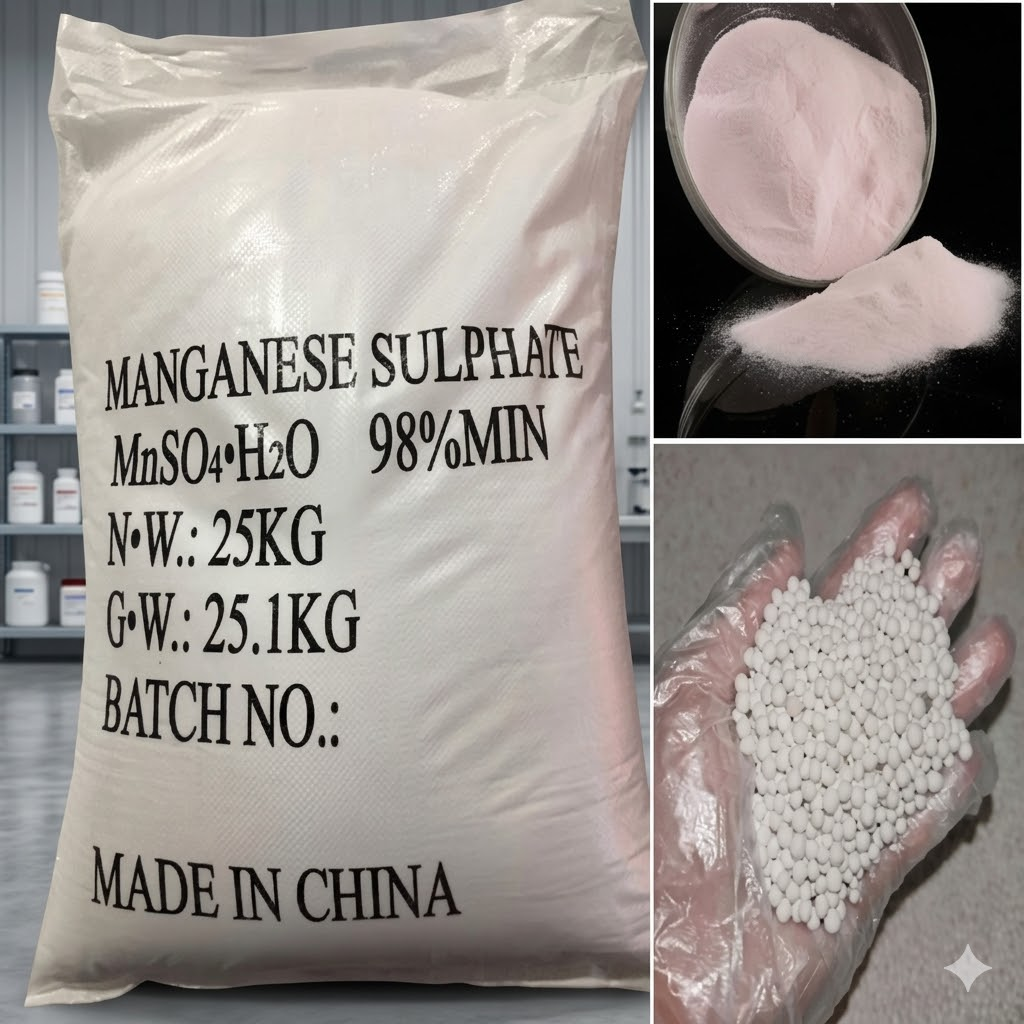
Manganese Sulfate Powder for Swine and Ruminant Diets is a feed-grade MnSO₄·H₂O with manganese content ≥31.8%, designed for livestock mineral supplementation. It provides a highly bioavailable manganese source for premix and complete feed formulations. Suitable for swine and ruminant diets requiring stable Mn input and controlled impurities.
Technical Specifications
| Parameter | Typical Value |
|---|---|
| MnSO₄·H₂O Purity | ≥ 98% |
| Manganese (Mn) Content | ≥ 31.8% |
| Moisture | ≤ 0.5% |
| Particle Size | 100–200 mesh |
| Bulk Density | 0.9–1.3 g/cm³ |
| Iron (Fe) | ≤ 0.05% |
| Calcium (Ca) | ≤ 0.3% |
| Magnesium (Mg) | ≤ 0.3% |
| Lead (Pb) | ≤ 10 ppm |
| Copper (Cu) | ≤ 5 ppm |
| Zinc (Zn) | ≤ 5 ppm |
Key Features
- High Mn bioavailability compared to oxide sources, improving absorption efficiency in livestock
- Stable manganese source for enzyme activation, bone formation, and metabolic functions
- Controlled Fe, Ca, Mg levels to avoid mineral antagonism in premix formulations
- Low heavy metals (Pb, Cd, As) for feed safety compliance
- Consistent particle size ensures uniform blending in premix production
- Specifically optimized Manganese Sulfate Powder for Swine and Ruminant Diets for livestock applications
Applications
- Swine feed premix – supports growth, bone development, and enzyme systems; typical supplementation ranges vary depending on diet composition
- Ruminant nutrition (cattle, sheep) – contributes to reproductive performance and metabolic enzyme activity
- Mineral premix manufacturing – reliable Mn source for compound feed blending
- Complete feed production – ensures consistent manganese levels across formulations
- Trace mineral supplementation – Manganese Sulfate Powder for Swine and Ruminant Diets widely used in livestock nutrition systems
Problems This Product Solves
- Low Mn absorption from MnO → MnSO₄ provides higher bioavailability and utilization
- Inconsistent Mn levels in raw feed → standardized Mn ≥31.8% ensures formulation accuracy
- Excess Fe interference → controlled Fe improves trace mineral uptake efficiency
- Heavy metal contamination risks → low Pb and regulated impurities enhance feed safety
- Poor dispersion in premix → uniform particle size improves blending consistency
Packaging & Supply
- 25 kg kraft paper bags with PE liner
- Palletized export packaging
- 20GP / 40HQ container shipment
- Samples available for formulation testing
Customization & Technical Support
- Adjustable manganese (Mn) content
- Low-iron (Fe) grade options available
- Custom particle size for premix compatibility
- Technical support for swine and ruminant diet formulation
FAQ
1. Why is Manganese Sulfate Powder for Swine and Ruminant Diets preferred over MnO?
Manganese sulfate has higher relative bioavailability, often used as a reference standard (100%) in animal nutrition. This improves Mn absorption and reduces required inclusion rates.
2. How do Fe, Ca, and Mg impurities affect feed performance?
Excess Fe, Ca, and Mg can interfere with manganese absorption and disrupt mineral balance. Controlled impurity levels ensure better nutrient utilization and consistent animal performance.
3. What are the heavy metal limits for feed-grade MnSO₄?
Typical feed-grade standards require Pb ≤10 ppm and strict control of As and Cd. These limits ensure compliance with feed safety regulations and reduce contamination risks.
4. Is manganese sulfate suitable for both swine and ruminants?
Yes, it is widely used across livestock species due to its solubility and bioavailability. It supports enzyme systems, bone formation, and reproductive health.
5. How should manganese sulfate be stored?
Store in a dry, ventilated environment to prevent moisture absorption. Proper storage maintains flowability and prevents caking during long-term use.