Feed Grade Manganese Sulfate for Animal Nutrition Applications
Short Product Description
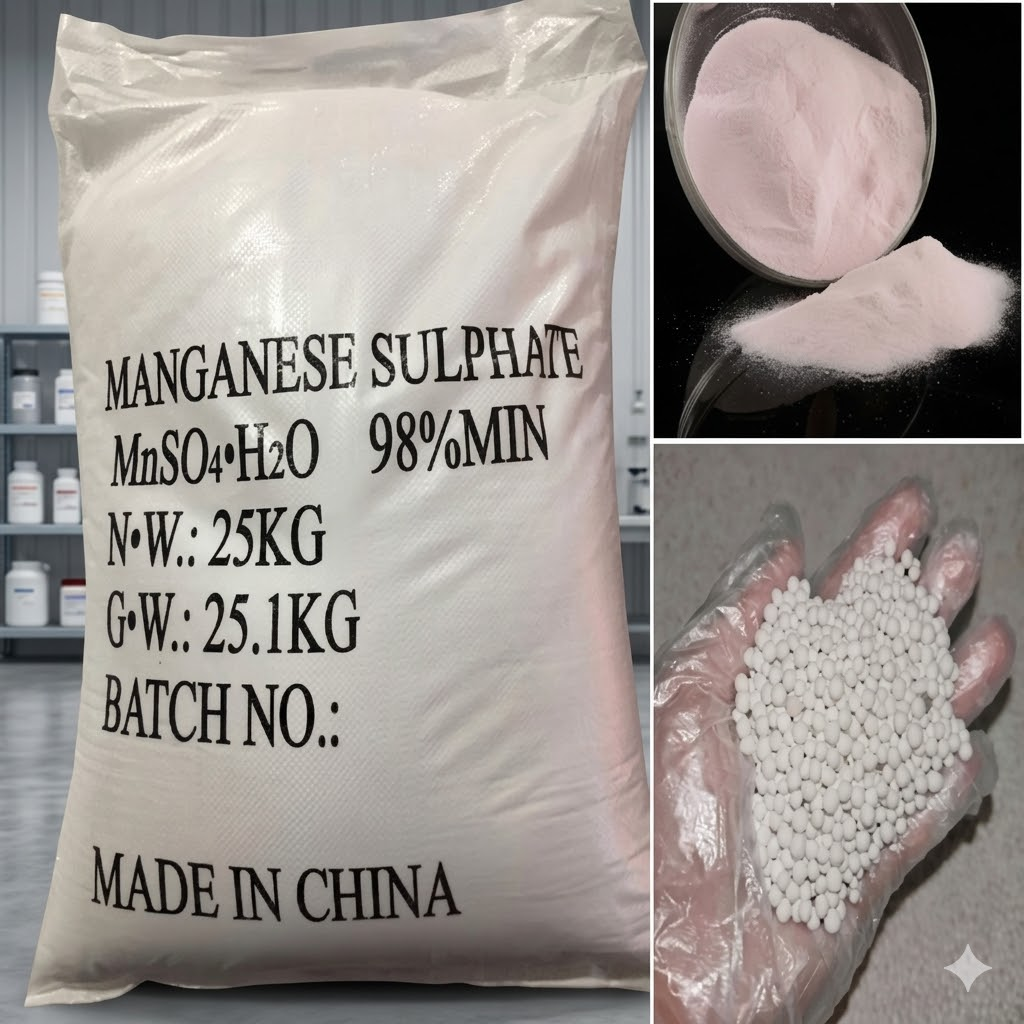
Feed Grade Manganese Sulfate Monohydrate (Mn 31.8%) is a highly bioavailable trace mineral source used in animal nutrition. It is designed for premix production, poultry, swine, and ruminant diets. Controlled impurity levels ensure safety, stability, and compatibility in feed formulations.
Technical Specifications
| Parameter | Typical Value |
|---|---|
| MnSO₄·H₂O Purity | ≥ 98% |
| Manganese (Mn) Content | 31.5–32% |
| Moisture | ≤ 0.5% |
| Particle Size | 80–200 mesh |
| Bulk Density | 0.9–1.3 g/cm³ |
| Iron (Fe) | ≤ 0.05% |
| Calcium (Ca) | ≤ 0.3% |
| Magnesium (Mg) | ≤ 0.3% |
| Lead (Pb) | ≤ 10 ppm |
| Copper (Cu) | ≤ 5 ppm |
| Zinc (Zn) | ≤ 5 ppm |
Key Features
- High bioavailability manganese source compared to manganese oxide
- Stable Mn content suitable for precise feed formulation
- Controlled Fe, Ca, Mg to avoid mineral antagonism in animals
- Low heavy metals (Pb, Cu, Zn) ensuring feed safety compliance
- Consistent particle size for uniform premix blending
- Feed Grade Manganese Sulfate Monohydrate (Mn 31.8%) optimized for large-scale feed production
Problems This Product Solves
- Low Mn absorption from oxide sources → improved bioavailability with MnSO₄
- Excess Fe interfering with trace mineral uptake → low Fe grade ensures efficiency
- Mineral imbalance in premix formulations → controlled Ca and Mg levels
- Heavy metal contamination risks → strict Pb and trace element control
- Uneven distribution in feed → optimized particle size improves mixing uniformity
Packaging & Supply
- 25 kg kraft paper bags with PE liner
- 1 MT jumbo bags for bulk users
- Palletized export packaging
- 20GP / 40HQ container loading
- Sample available for premix and feed testing
Customization & Technical Support
- Adjustable Mn levels for specific feed formulations
- Low heavy metal grade for sensitive livestock applications
- Custom particle size for premix compatibility
- Technical support for feed formulation and mineral balancing
FAQ
1. Why is manganese sulfate preferred over manganese oxide in feed?
Manganese sulfate has higher solubility and bioavailability, allowing better absorption in the animal digestive system. This leads to improved performance and nutrient utilization.
2. How do Fe, Ca, and Mg impurities affect animal nutrition?
High iron levels can reduce manganese absorption, while calcium and magnesium may interfere with mineral balance. Controlled impurity levels improve feed efficiency and animal health.
3. Is Feed Grade Manganese Sulfate Monohydrate (Mn 31.8%) suitable for poultry premixes?
Yes, it is widely used in poultry premixes due to its consistent Mn content and low heavy metal levels. It supports eggshell formation and skeletal health.
4. What are the heavy metal limits in feed grade manganese sulfate?
Lead is typically controlled at ≤10 ppm, with strict limits on other trace metals to meet feed safety regulations. This ensures compliance with international standards.
5. How should manganese sulfate be stored in feed mills?
Store in a dry and ventilated area to prevent moisture absorption and caking. Proper storage maintains flowability and product stability.