High-Precision Manganese Carbonate Customization Case
Background
A procurement manager from an Australia-based liquid fertilizer manufacturer approached us seeking a stable supply of high-grade manganese carbonate for agricultural applications. The company operates across Australia, the United States, and Kenya, and required a reliable long-term partner capable of meeting strict technical standards.
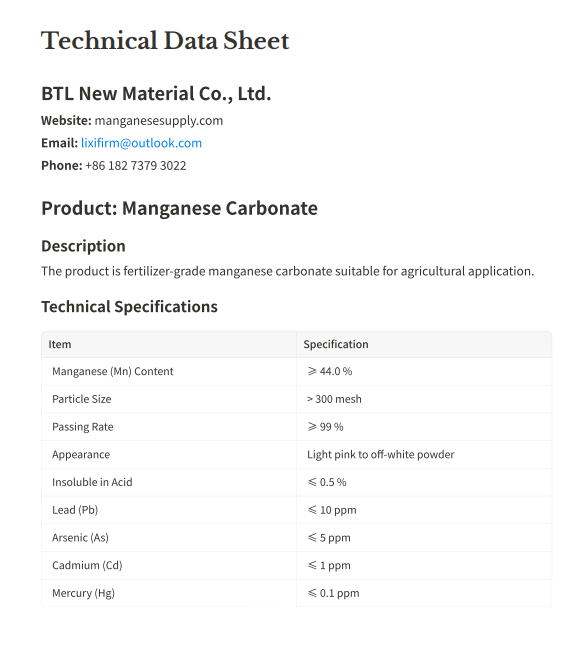
Their required specification was:
Mn content ≥ 44.0%
Particle size ≥ 300 mesh
Passing rate ≥ 99%
They emphasized that several suppliers had failed to consistently meet this requirement.
Initial Stage: Specification Approval and Sample Testing
We provided our latest technical specification for manganese carbonate, including:
Mn ≥ 44%
Controlled impurity levels
Industrial-grade agricultural suitability
The specification was reviewed and approved by their technical team.
A 2 kg sample was arranged for lab-scale validation.
However, during internal testing, the client reported:
“The samples are too coarse.”
This feedback marked a critical turning point in the project.
The Core Technical Challenge: Why 300 Mesh at 44% Mn Is Difficult
Producing manganese carbonate with Mn ≥ 44.0% already requires high-purity raw materials and controlled precipitation conditions.
However, combining:
Mn ≥ 44.0%
Particle size ≥ 300 mesh
Passing rate ≥ 99%
creates a significant technical contradiction.
Structural Limitation
High-Mn manganese carbonate forms a denser and harder crystal structure. This directly impacts grinding performance:
The harder the structure → the more difficult ultra-fine grinding becomes.
If excessive grinding force is applied, it can result in:
Reduced Mn content
Lower overall passing rate
Significant yield loss
Unstable batch-to-batch consistency
Many suppliers fail because they attempt to push fineness beyond structural limits without controlling chemistry.
Our Internal Review and Technical Strategy
Instead of rejecting the requirement, we conducted a full internal feasibility study.
We confirmed that achieving the required specification was possible — but only under high-precision customized production conditions.
To meet the 300 mesh and 99% passing rate while maintaining Mn ≥ 44%, we implemented:
Secondary ultra-fine grinding at a specialized facility
Controlled batch processing instead of mass production
Strict particle size monitoring
Re-screening and classification
Acceptance of over 10% yield loss during fine separation
For a 10-ton production batch, at least 1 ton would be lost during secondary screening to ensure compliance.
This is the hidden cost most suppliers are unwilling to absorb.
Cost Reality and Transparent Communication
Due to:
Additional processing
Transport between facilities
High yield loss
Manual monitoring
Small trial volume (10 tons)
The updated quotation was:
double the previous cost
We clearly explained the cost structure and technical reasoning behind the price adjustment.
Rather than simply increasing price without explanation, we demonstrated:
Where the cost came from
Why the requirement was technically demanding
What quality guarantee we would provide
This transparency helped build trust.
Final Outcome: 10-Ton Order Confirmed
After internal review, the client recognized:
Multiple suppliers had failed previously
We were the only supplier who clearly understood the technical barrier
We provided a workable and scientifically explained solution
The client proceeded with a 10-ton customized order.
The production batch successfully achieved:
Mn ≥ 44.0%
Particle size ≥ 300 mesh
Passing rate ≥ 99%
The “too coarse” issue was fully resolved.
Key Success Factors
1. Technical Honesty
We did not overpromise at the beginning. We explained the structural limits of high-Mn manganese carbonate.
2. Process Engineering Approach
Instead of standard grinding, we treated the order as a precision engineering project.
3. Acceptance of Yield Loss
We accepted over 10% material loss to guarantee 99% passing rate.
4. Clear Cost Transparency
Every price adjustment was supported by technical reasoning.
Why Many Suppliers Fail at 300 Mesh 99% Pass
In the global manganese carbonate supply chain, many manufacturers:
Focus only on Mn content
Ignore crystal density impact
Lack ultra-fine secondary grinding capability
Do not want to sacrifice yield
As a result, they can provide either:
High Mn content
or
Ultra-fine powder
but rarely both at stable industrial scale.
Conclusion
This case demonstrates that high-precision manganese carbonate production is not simply about grinding finer.
It requires:
Understanding crystal chemistry
Process control
Yield management
Engineering mindset
Transparent communication
For customers requiring high Mn content with strict particle size control, customized production is often the only reliable path.
If your application demands manganese carbonate with ≥44% Mn and ultra-fine particle size control, our team can evaluate feasibility and provide a structured technical solution.
Learn more cases.