Manganese dioxide (MnO₂) plays a specialized but critical role in fragrance and flavor chemistry, primarily as a selective oxidation catalyst and reagent in fine chemical synthesis. In aroma and flavor intermediate production, MnO₂ enables controlled oxidation of allylic and benzylic alcohols to aldehydes or ketones—key functional groups responsible for many sensory-active compounds. Compared with broader oxidants, high-purity MnO₂ offers reaction selectivity (>90%), low byproduct formation, and minimal metal contamination (typically <50 ppm total heavy metals) when properly specified. For fragrance and flavor manufacturers operating under IFRA, FEMA, and FDA frameworks, MnO₂ quality—particularly purity, surface activity, particle size, and impurity profile—directly influences yield, odor cleanliness, and regulatory compliance.
Technical Background: What MnO₂ Does in Fragrance and Flavor Synthesis
Chemical Nature and Functional Role
Manganese dioxide is a transition metal oxide (Mn⁴⁺) with strong oxidizing capability. In fragrance and flavor chemistry, it is typically used as:
A stoichiometric oxidant
A heterogeneous oxidation catalyst
A reaction aid for selective alcohol oxidation
Unlike bulk oxidants (e.g., chromates or permanganates), MnO₂ allows mild reaction conditions and functional group tolerance, which is essential when working with odor-sensitive molecules.
Where MnO₂ Fits in the Process
In aroma chemical synthesis, MnO₂ is commonly used in:
Conversion of allylic alcohols → aldehydes
Oxidation of benzylic alcohols → aromatic aldehydes/ketones
Late-stage oxidation where over-oxidation must be avoided
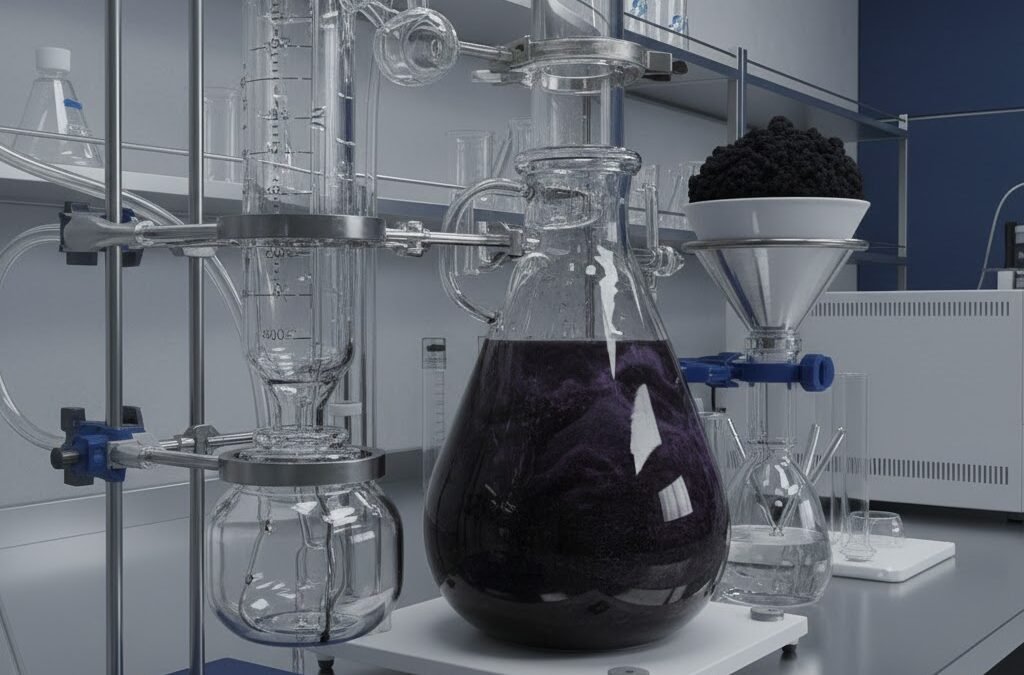
Typical reaction temperatures range from 20–60 °C, and MnO₂ is removed by filtration after reaction completion, making particle size and filtration behavior operationally important.
Why MnO₂ Quality Matters
Fragrance and flavor compounds are extremely sensitive to:
Trace metal impurities (can cause off-odors)
Over-oxidation (changes odor profile)
Residual solids (affect clarity and stability)
As a result, technical-grade MnO₂ is often unsuitable, while low-impurity, controlled-activity MnO₂ is preferred.
Key Benefits of MnO₂ in Fragrance and Flavor Chemistry
Purity (%) → Odor Cleanliness and Reaction Selectivity
High-purity MnO₂ (≥90–95%) reduces side reactions caused by foreign oxides or residual salts.
Typical fragrance-grade MnO₂ purity: 90–96%
Impact:
Cleaner oxidation pathways
Reduced formation of acidic or resinous byproducts
Higher sensory fidelity of target molecules
Low-purity MnO₂ often introduces trace iron or copper that can catalyze unwanted polymerization or discoloration.
Particle Size (D50, µm) → Reaction Kinetics and Filtration Efficiency
Particle size influences both reaction rate and downstream processing.
Typical D50 range: 5–20 µm
Smaller particles:
Higher surface area → faster oxidation
But harder filtration
Larger particles:
Easier filtration
Lower reactivity
Fine chemical producers often balance activity and operability by specifying a narrow PSD with D50 around 10–15 µm.
Moisture Content (%) → Storage Stability and Reaction Control
Excess moisture can:
Reduce oxidation efficiency
Promote agglomeration
Introduce variability in batch performance
Typical requirements:
Moisture: ≤1.0–2.0%
Loss on ignition (LOI): ≤3–5%
Controlled moisture ensures reproducible results, especially in solvent-based systems.
Impurity Control (ppm) → Regulatory and Sensory Safety
Heavy metals are tightly controlled in fragrance and flavor supply chains.
Common internal limits for MnO₂ used in aroma synthesis:
Fe: ≤100 ppm
Cu: ≤30 ppm
Pb, As, Cd: ≤5–10 ppm each
Even trace levels can alter oxidation pathways or introduce long-term stability issues in finished formulations.
Typical MnO₂ Specification for Fragrance & Flavor Applications
| Parameter | Typical Range | Why It Matters |
|---|---|---|
| MnO₂ purity (%) | 90–96 | Controls selectivity and byproduct formation |
| Particle size D50 (µm) | 5–20 | Balances reaction rate and filtration |
| Moisture (%) | ≤2.0 | Ensures stable reactivity |
| LOI (%) | ≤5.0 | Indicates thermal and chemical stability |
| Fe (ppm) | ≤100 | Prevents discoloration and odor shift |
| Cu (ppm) | ≤30 | Avoids catalytic side reactions |
| Pb / As (ppm) | ≤5–10 | Regulatory and toxicological compliance |
Impact on Performance KPIs in Aroma Chemical Production
Reaction Yield
High-activity MnO₂ typically achieves:
85–95% isolated yield for allylic alcohol oxidation
Reduced over-oxidation compared with stronger oxidants
Odor Profile Integrity
Cleaner oxidation leads to:
Lower formation of acidic notes
Reduced “metallic” or “burnt” off-odors
Improved alignment with reference odor standards
Batch-to-Batch Consistency
Consistent MnO₂ specifications result in:
Stable reaction times (±5–10%)
Predictable filtration behavior
Reduced need for rework or deodorization steps
Quality Control and Testing Methods
Certificate of Analysis (COA) Key Items
A proper COA for fragrance/flavor use should include:
MnO₂ assay (%)
Moisture and LOI
Particle size distribution
Heavy metal profile (ppm)
Analytical Techniques
ICP-OES / ICP-MS
For Fe, Cu, Pb, As, Cd analysis at ppm or sub-ppm levelsLaser Diffraction (ISO 13320)
For PSD and D50 controlThermogravimetric Analysis (TGA)
For LOI and moisture evaluation
Sampling Considerations
Because MnO₂ is a heterogeneous solid:
Composite sampling is recommended
Avoid surface-only sampling from bags or drums
Consistent sampling protocols improve data reliability
Purchasing and Supplier Evaluation Considerations
Grade Differentiation
MnO₂ used in fragrance and flavor chemistry typically differs from:
Battery-grade MnO₂ (focus on electrochemical activity)
Water treatment MnO₂ (focus on adsorption)
Pigment-grade MnO₂ (color performance)
Key focus areas should be chemical cleanliness, not electrochemical metrics.
Packaging and Storage
Recommended practices:
Double-layer PE bags or fiber drums
Dry, ventilated storage
Avoid prolonged exposure to humidity
MnO₂ is chemically stable but can adsorb moisture and odors if improperly stored.
Common Sourcing Risks
Inconsistent PSD between batches
Hidden impurities from recycled raw materials
Lack of traceability for heavy metal control
Supplier audits and historical COA comparison are common risk-mitigation strategies.
Frequently Asked Questions
What purity of MnO₂ is suitable for fragrance synthesis?
Typically 90–96%, depending on reaction sensitivity.
Is food-grade MnO₂ required for flavor applications?
MnO₂ is generally used as a processing aid; impurity control matters more than formal “food-grade” labeling.
Why is iron content critical?
Iron can catalyze side reactions and cause discoloration or odor deviation.
Does particle size affect odor quality?
Indirectly—through reaction control and filtration efficiency.
Can MnO₂ be reused?
In some systems, partial reuse is possible, but activity loss and contamination risk must be evaluated.
How is MnO₂ removed after reaction?
Typically by filtration; PSD strongly influences filterability.
Final Practical Checklist for Procurement and QA Teams
Define MnO₂ purity and impurity limits in writing
Specify PSD (not just “fine powder”)
Require ICP-based heavy metal data
Compare COAs across multiple batches
Validate MnO₂ performance in pilot reactions
Control storage humidity and odor exposure

I am Edward lee, founder of manganesesupply( btlnewmaterial) , with more than 15 years experience in manganese products R&D and international sales, I helped more than 50+ corporates and am devoted to providing solutions to clients business.