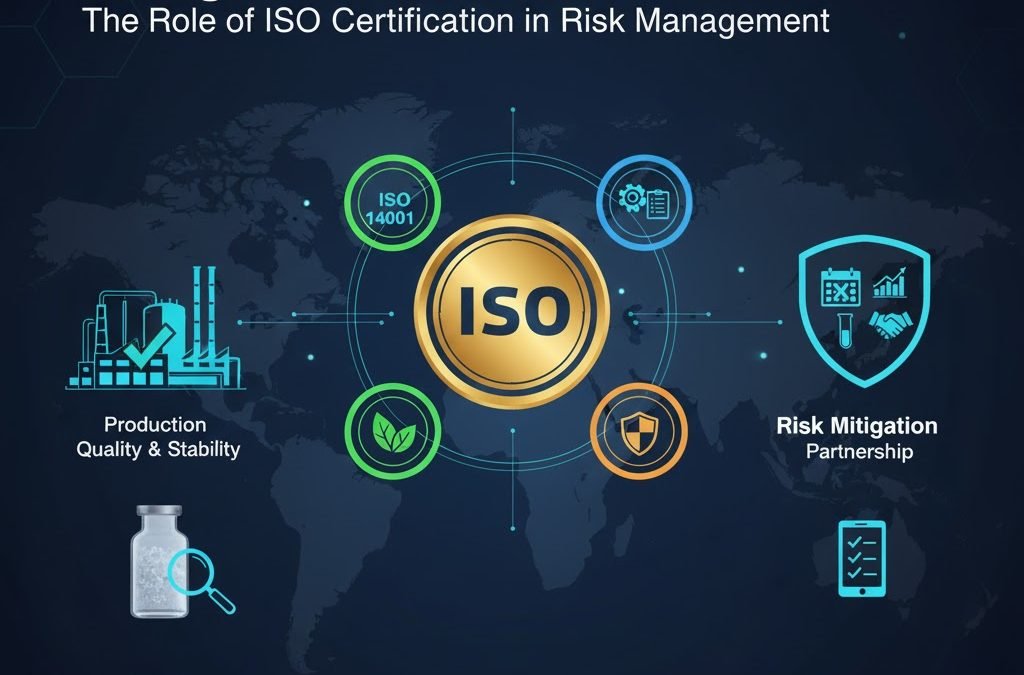
Objective: To analyze the impact of ISO management systems on the reliability of Manganese Carbonate (MnCO3) supply chains.
Key Finding 1 (Quality): ISO 9001 certification is the primary indicator of batch-to-batch consistency and traceability (Lot Management).
Key Finding 2 (Stability): ISO 14001 compliance significantly reduces the risk of supply interruptions caused by environmental regulatory shutdowns in China.
Key Finding 3 (Verification): Buyers must verify the “Scope of Registration” to distinguish between manufacturers and trading companies.
For global procurement managers, sourcing Manganese Carbonate from China presents a specific challenge: ensuring consistent quality across multiple shipments. In the chemical industry, a deviation in purity specifications (e.g., heavy metal content) or physical properties (e.g., bulk density) can disrupt downstream production in ferrite, battery, or agriculture sectors.
Supply chain uncertainty usually stems from two sources: operational inconsistency and regulatory non-compliance. ISO certifications (International Organization for Standardization) serve as the objective framework to measure these risks. This article provides a technical analysis of how ISO 9001, ISO 14001, and ISO 45001 standards directly correlate with supplier reliability.
2. ISO 9001: Quality Management and Batch Consistency
ISO 9001:2015 is not a guarantee of product superiority, but a guarantee of process consistency. For Manganese Carbonate buyers, this distinction is critical.
2.1 Batch-to-Batch Stability (Process Control)
Manganese Carbonate production involves sensitive chemical reactions where variables such as temperature (50°C – 60°C), pH levels, and reaction time must be strictly controlled.
Non-Certified Risk: Without standardized controls, product quality relies on the experience of individual operators. This leads to high variance in Manganese (Mn) content between batches.
ISO Standard: ISO 9001 Clause 8.5 requires Standard Operating Procedures (SOPs) for every production stage.
Control Point 1: Leaching time is fixed to ensure complete dissolution of Manganese Ore.
Control Point 2: Drying temperatures are monitored via calibrated sensors to prevent oxidation (which turns MnCO3 brown).
Result: This ensures that the Mn content remains stable (e.g., >= 44%) and moisture content stays below 2.0% consistently.
2.2 Traceability Systems (Lot Management)
Traceability is the backbone of supply chain security.
Requirement: ISO 9001 Clause 8.5.2 mandates “Identification and Traceability.”
Implementation: A certified factory assigns a unique Batch/Lot Number to every production run.
Audit Trail: If a customer reports a quality issue, the supplier must be able to retrieve:
The specific date and shift of production.
The exact source of raw materials (Ore/Acid) used for that batch.
The calibration records of the lab equipment (e.g., ICP-OES) used for testing.
2.3 Instrument Calibration
Quality control is only as good as the testing equipment.
ISO Requirement: All measuring instruments must be calibrated against traceable international standards at defined intervals.
Application: For Manganese Carbonate, precise detection of heavy metals (Pb, Cd, As) requires Inductively Coupled Plasma (ICP) machines. An ISO audit verifies that these machines are calibrated regularly, ensuring the Certificate of Analysis (COA) is accurate.
3. ISO 14001: Environmental Compliance and Supply Security
ISO 14001 (Environmental Management System) is often viewed as a “corporate responsibility” badge, but for buyers sourcing from China, it is a supply security indicator.
3.1 Regulatory Risks in China
China’s Ministry of Ecology and Environment enforces strict regulations on the chemical sector.
The Reality: Factories failing to meet wastewater or emission standards face immediate, indefinite shutdowns during environmental inspections.
Supply Impact: Sourcing from a non-compliant supplier carries the risk of sudden force majeure declarations due to government closures.
3.2 Wastewater Management Protocols
Manganese Carbonate production generates wastewater containing sulfates and manganese ions.
ISO 14001 Standard: Requires a systematic approach to waste management.
Verification: Certified factories possess on-site wastewater treatment facilities to neutralize pH and precipitate heavy metals before discharge.
Buyer Benefit: A supplier with ISO 14001 and a valid Pollutant Discharge Permit is statistically less likely to face production stoppages, ensuring on-time delivery.
4. ISO 45001: Operational Health and Safety
ISO 45001:2018 focuses on Occupational Health and Safety (OH&S). While internal to the factory, it impacts external supply reliability.
4.1 Operational Stability
Chemical manufacturing presents hazards, including exposure to manganese dust and acidic solutions.
Risk: Accidents or occupational health issues lead to high staff turnover and production halts.
ISO Standard: Mandates risk assessments, adequate Personal Protective Equipment (PPE), and dust control systems.
Conclusion: A safe factory is a stable factory. High retention of skilled operators directly correlates with consistent product quality.
5. Verification Guide: How to Audit a Supplier
Possessing a PDF certificate is not sufficient proof of capability. Procurement teams must perform due diligence to verify the authenticity and scope of the certification.
5.1 Differentiating Traders from Manufacturers
A common pitfall in B2B sourcing is engaging with a trading company masquerading as a factory.
The Check: Examine the “Scope of Certification” (Scope of Registration) on the ISO certificate.
Manufacturer Scope: Will explicitly state: “Production / Manufacturing of Manganese Carbonate.”
Trader Scope: Will state: “Sales / Trading / Export of Chemical Products.”
Implication: A company certified only for “Sales” has no control over the production quality management system (QMS) of the actual product.
5.2 Verifying Authenticity (CNCA Database)
For Chinese suppliers, the Certification and Accreditation Administration (CNCA) maintains a public database of all valid certificates.
Action: Visit the CNCA Public Service Platform.
Input: Enter the Certificate Number or Company Name.
Status: Confirm the certificate status is “Valid” (Effective). If a certificate has been revoked due to failed annual audits, it will be flagged here.
5.3 Third-Party Accreditation (IAF)
Ensure the certificate is issued by a registrar accredited by the IAF (International Accreditation Forum). Common reputable registrars include SGS, Bureau Veritas (BV), TÜV SÜD, BSI, and CQC. Certificates issued by non-accredited bodies lack international recognition.
6. Procurement Checklist for Supplier Qualification
To streamline the Request for Information (RFI) process, use the following checklist to evaluate potential Manganese Carbonate suppliers.
1. Documentation Review
[ ] Request a high-resolution copy of ISO 9001, 14001, and 45001 certificates.
[ ] Verify the company name matches the bank account name exactly.
[ ] Check the expiration dates on all certificates.
2. Scope Verification
[ ] Does the ISO 9001 scope specifically mention “Manufacturing” or “Production”?
[ ] Does the scope cover the specific location (address) where production takes place?
3. Quality Control Data
[ ] Request the “Quality Manual” table of contents (confidentiality usually prevents sharing the full manual).
[ ] Request the “Process Capability Index” (Cpk) for Manganese content.
[ ] Ask for a sample “Batch Production Record” (redacted if necessary) to test traceability.
4. Environmental Compliance
[ ] Request a copy of the government-issued “Pollutant Discharge Permit.”
7. Conclusion
Selecting a Manganese Carbonate supplier is a risk management decision. While price is a significant factor, the hidden costs of quality failure—reprocessing, production downtime, and reputation damage—far outweigh the marginal savings offered by non-compliant suppliers.
ISO certifications provide a standardized, verifiable metric for assessing supplier competence.
ISO 9001 validates the consistency of chemical specifications.
ISO 14001 validates the sustainability and continuity of supply.
ISO 45001 validates operational stability.
Buyers are advised to prioritize suppliers who not only hold these certificates but can transparently demonstrate their application through traceability audits and rigorous process control data.
FAQ (Frequently Asked Questions)
Q1: Why is ISO 9001 specifically crucial for Manganese Carbonate quality?
A: ISO 9001 mandates a Quality Management System (QMS) that ensures batch-to-batch consistency. This is critical because MnCO3 synthesis relies on strict control over temperature, pH levels, and drying processes. ISO 9001 requires the use of Standard Operating Procedures (SOPs) and calibrated instruments, significantly reducing the risk of variations in Mn content, moisture, and impurity levels.
Q2: How does a supplier’s ISO 14001 certification affect my supply chain stability?
A: ISO 14001 (Environmental Management) indicates the factory has a verified system for monitoring and controlling environmental impact, particularly wastewater discharge. In China, strict environmental enforcement means non-compliant factories face potential, indefinite government-mandated shutdowns. An ISO 14001 certified supplier is statistically less likely to experience such operational interruptions, thus enhancing supply continuity.
Q3: What is the most common pitfall when verifying a Chinese supplier’s ISO certificate?
A: The most common pitfall is the “Scope of Registration.” Many trading companies hold an ISO 9001 certificate only for “Sales” or “Trading.” Buyers must ensure the scope explicitly states “Production” or “Manufacturing” of Manganese Carbonate to confirm the quality system covers the actual chemical process, not just office paperwork.
Q4: How can a buyer verify the authenticity of an ISO certificate?
A: Buyers should verify the certificate through official channels. For Chinese suppliers, the certificate number or company name can be checked on the CNCA (Certification and Accreditation Administration) public database to confirm the status is “Valid” and the accrediting body is legitimate (e.g., IAF member).
Q5: Does a supplier with ISO 9001 need other certifications for Manganese Carbonate?
A: Yes, depending on the end application. For use in animal feed, certifications like FAMI-QS or GMP+ are often required due to food safety regulations. For high-purity battery-grade material (used in EV battery precursors), standards like IATF 16949 (Automotive Quality) may be preferred due to their stringent statistical process control requirements.
Q6: What is the primary function of a Batch/Lot Number under ISO 9001? A: The Batch/Lot Number enables full traceability. If a quality deviation occurs, the supplier can instantly trace the product back to its specific production date, raw material source, processing parameters, and QA technician, allowing for swift root-cause analysis and corrective action.

I am Edward lee, founder of manganesesupply( btlnewmaterial) , with more than 15 years experience in manganese products R&D and international sales, I helped more than 50+ corporates and am devoted to providing solutions to clients business.